June 9, 2025
Marley Freeman was sitting in the back room of Karma’s Chelsea gallery, ready to talk. Her newest paintings, fresh and energetic abstractions ranging in scale from the hand-held to the totally epic, leaned on the pristine white walls of the gallery, about to be installed for “no when,” her anticipated new show with the gallery (now on view through July 18, 2025).
We weren’t there to talk about her paintings, though—at least not yet. Instead, Freeman began pulling antique textiles from a bag. They ranged from small swatches of fabric to several yards of silk. Freeman, who was born outside of Boston, is the daughter of a textile dealer, and her passion for the material world is palpable.
“My dad started collecting antique textiles in the ‘70s. He was working in a bank and for a shoe manufacturer, but he wanted to work for himself. Really the only thing he could afford to buy were textiles because nobody cared about them. Fabric was what you wrapped furniture in, to most Americans,” she recalled. It was an unlikely career turn for her father, who was raised working class in Boston. “His mom worked in a bowling alley. He had no sort of aesthetic experience on his own, but he very quickly started to get clients who were working for design houses and asking him to go to Europe to find whatever they were looking for,” she said.
Freeman and her brother, Jordan, often escorted her father to antique fairs and yard sales as kids; she remembers textiles aficionados perusing the fabrics they brought to the famed Brimfield Market, a massive biannual flea market in Massachusetts. Over the years, she developed a keen sensibility for color and form that would ultimately find an outlet in her paintings.
Over the past decade, Freeman has earned a reputation for her personal form of abstraction. Her paintings, made from a unique combination of gesso, acrylic, and oil, are created intuitively through gestural marks that build up often over months in an organic call-and-response rhythm. Her breakout debut with Karma came in 2019 and was followed by another buzzy solo exhibition with the gallery in 2022. Today, Freeman’s works are included in the collections of LACMA, the Hammer Museum, and the Whitney Museum. In 2023, poet and cult icon Eileen Myles even published a book of poems responding to Freeman’s paintings.
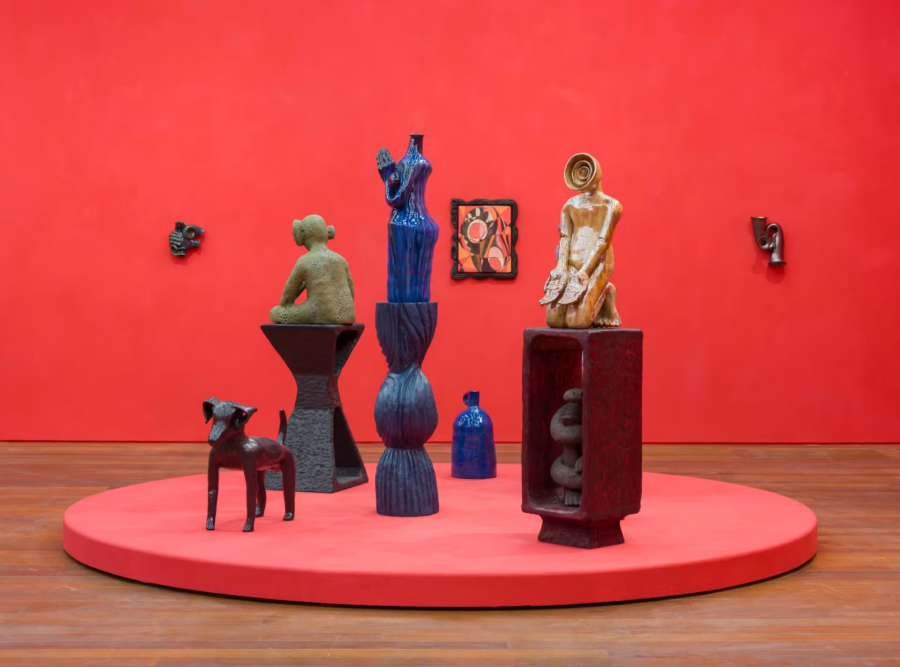
She can be unorthodox. Over the years, Freeman has collaborated with artists Lukas Geronimas and Jared Buckhiester (with whom she shared a studio). In 2023, Freeman and Geronimas showed works at Karma that they created by mailing them back and forth. “no when” includes a few works made by the three artists—small paintings by Freeman enveloped in ceramic frames by Buckhiester and a final surrounding metal armature by Geronimas—that speak to Freeman’s dialogue-driven approach to making.
Her process is distinctive, too. She applies hand-mixed gesso and layers in oil and acrylic, creating veils of color and form that hover and glide on top and beside one another. At times, her paintings can conjure up similarities to quilts or tapestries, though often the influence of textiles in her work is more nuanced.
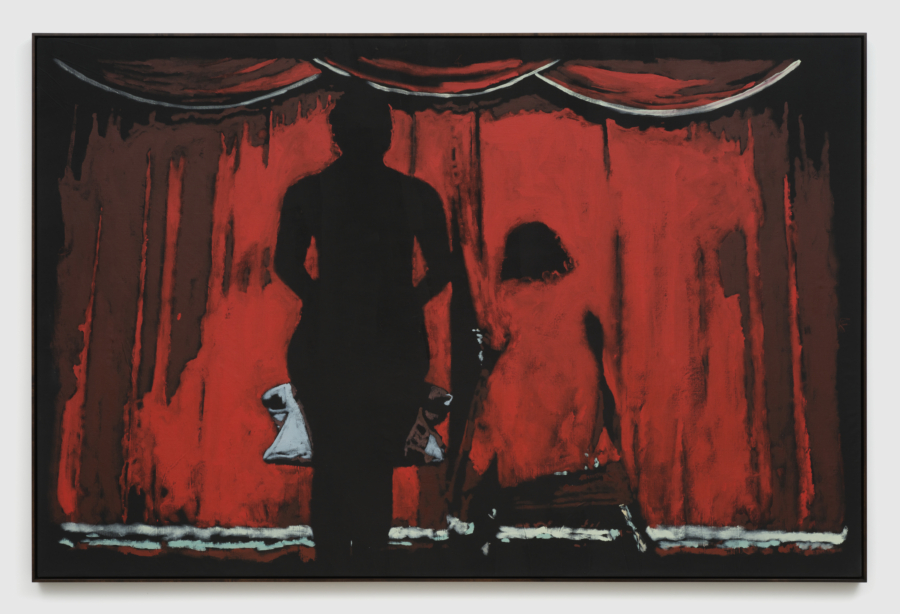
In a 2015 exhibition at the now-shuttered Brooklyn gallery Cleopatra’s, Freeman displayed her bright and energetic abstraction paintings and sculptures alongside vintage textiles, antique feed sacks, and popcorn quilts. She even included a former circus backdrop. “The artist’s earlier experience with textiles and the decorative arts was especially evident in the way she quilted together patches of color in the paintings,” a review in Art News aptly noted at the time. These pronged interests were on view again in 2017, in a Berlin exhibition at PSM Gallery, where the artist paired antique fabrics with her paintings quite literally.
Freeman spent her early adult life in textile mills. At age 19, Freeman took an internship in Manhattan working for a mill specializing in jacquard and dobby fabrics. Ultimately. She would spend nearly a decade working at two mills. At some point, one of her bosses encouraged her to consider her career beyond the world of textiles. “I didn’t understand at the time, but the industry was collapsing. They were under a tremendous amount of pressure,” she explained.
“When I was a kid going to antique shows, people would buy scraps of fabric and use them for putting on a lampshade or on their jacket or for sewing to a pillow, you know, doing creative projects,” she said “My brother and I did some antique shows in New York 10 years ago, and our experience felt sad. People really didn’t know how to look. They don’t know how to touch. They didn’t know how to be with the objects, never mind use them.”
Freeman took her boss’s advice to heart and began to find her way to painting, first taking classes at community college while still working at the mill, and ultimately earning acceptance to the School of the Art Institute of Chicago. She later earned a graduate degree from Bard College’s Milton Avery School of the Arts.
Now, over a decade into her painting career, Freeman splits her time between studios and homes in New York and the Berkshires. She exists as equal parts painter, textile collector, and archivist. As a textile collector, she describes her taste as “very Grandma” and says that she just loves “having things around the house.” She shows me a piece of 17th-century cut velvet she has pinned to the wall, then a piece of embroidery she recently acquired in Greece. “Greek people really prize their textiles. This was very expensive,” she said, handling the embroidery. “The lady didn’t want to sell it to me—they really care about their textiles in a way that I loved.”
But these interests expand well beyond her own home. Throughout his career, her father amassed a massive and significant textile collection, which is now located in the Los Angeles area, where her parents relocated. For the past five years, Freeman and her brother have been preserving the collection named Textile Artifacts, for their aging father and considering ways to maintain and support it.
Historically, her father collaborated with the movie industry, creating reproductions for period pieces. That’s become trickier in recent years. “It’s gotten fairly impossible to do that on the small scale. The minimums to create something woven are just enormous,” she said. Her brother had moved their focus toward printed reproductions. “We take a pattern, and then we fix it on the computer and print it onto fabric,” she said. They’ve also produced high-quality scarves with prints from rare antique fabrics. Recently, they’ve opened the Textile Artifacts storefront to curators. In March of this year, artist Christine Wertheim curated a show centered on lace in the collection.
The influence of textiles on her work is most strongly felt in conceptual approaches. Freeman’s compositions give equal importance to every inch. Her practice is generative, one form gives rise to another, adapting and reacting; in some ways, it’s not so unlike a seamstress seeing a bolt of fabric and imagining new possibilities for transforming what is essentially a length of color and form into another shape, adapting and tailoring in their process until it seems right.
In “no when” Freeman particularly sees the influence of 1960s textiles in the abundance of “oranges and yellows” in the new paintings. “This feels like a hot kind of moment, and maybe that’s why these works are expressing a lot of heat. There’s also a lot of blue, but blues have also gone hot, too,” she said. In another work, give this sea a name, brushy bursts of acrylic and oil layers in veils of varied transparency—in the hues of ochres, cerulean, magenta, and purple. Freeman compares this work to a 1960s eyelash silk.
In the end, Freeman sees artmaking as a last bastion of expression in a time when artisan craftsmanship has waned. “It doesn’t seem like small industries are coming back, so painting is a place where you can still have that expression,” she said. “It is just where we are at. Painting does support me and Textile Artifacts, as a business.”
What form the Textile Artifacts will ultimately take, however, is still unknown; much like the way she builds her paintings, Freeman and her brother approach these rare materials in a curious dialogue, acting, waiting, and responding until, at once, it all clicks into completion.