November 17, 2026
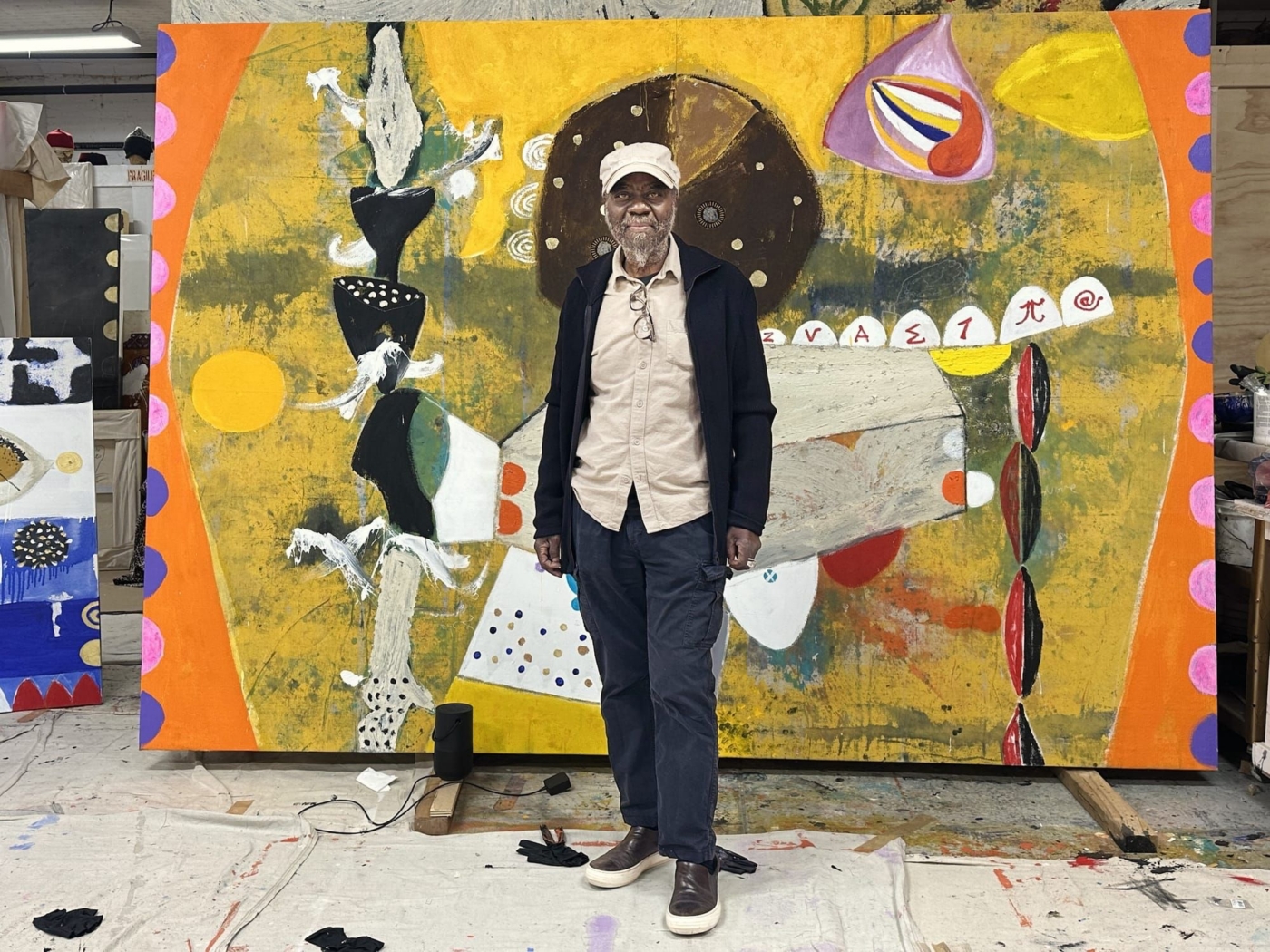
Last month, just a couple of weeks before Ouattara Watts’s solo show opened at Karma, I was directed to knock on the cracked glass door of his Bushwick studio. We met in the late afternoon, which is when his studio time begins. The Ivorian-American artist has coffee and a light evening meal, and works all night, before returning home to sleep during the day. To learn why Watts works only at night, one need only look at his paintings. He views art as a portal to the divine; night is when the veil with the spiritual realm is thinnest, and the outside voices of the physical world are quietest.
Although a gallery representative had told me Watts would be putting “finishing touches” on the paintings for his exhibition at the time of our meeting, I came to realize that he thinks about the work, and his process, without a beginning or end. The centrifugal energy of his rhythmic compositions does not obey edges. Totemic forms continue beyond the bounds of the canvases; arrows point in varying directions; seed pods are split open to reveal concentric circles. His compositions are stained and dripped fields populated by a lexicon of imagery and symbols, developed over the past four decades. They include coffee beans, sacred books, musical notes, serpents, bursting petals encased in atoms, diagrammatic cubes, and mathematical codes.
Watts has lived and worked in New York since 1988, when he moved to the city at the encouragement of Jean-Michel Basquiat, who died a few months after they first met. Early advocates of his work included Claude Picasso (the son of Pablo), Glenn O’Brien, Brice Marden, and Franklin Sirmans. He had two shows with Vrej Baghoomian and one with Larry Gagosian in 1995, before pulling back from the commercial art world.
His studio floor is covered by massive dropcloths, which, after collecting paint and footprints, are often incorporated into the paintings themselves. He also collages textiles from around the world, and mixes his own “alchemical” recipe of materials into his paint to create layers of texture. In his recent painting “Across the Road,” an impastoed, rough-hewn “spine” divides the canvas vertically, as if a sacred book has been laid flat to unveil its secrets. While jazz played, we spoke about his childhood and connection to shamans in Côte d’Ivoire, his friendship with Basquiat, and making art about the cosmos rather than oneself.
Watts was born in Abidjan, Côte d’Ivoire, in 1957 and studied at L’École Nationale Supérieure des Beaux-Arts, Paris, in 1984. A two-person exhibition with Basquiat was held at the Currier Museum of Art, New Hampshire, in 2024. Watts’s work was featured in the Shanghai Biennale in 2023, the Dakar Biennale of Contemporary African Art in 2018, the Venice Biennale in 2017, documenta 11 in 2002, and the Whitney Biennial in 2002. His solo exhibition at Karma is on view through December 19.
Hyperallergic: You were born in Côte d’Ivoire. At what age did you start making art?
Ouattara Watts: Painting came to me, and I felt this way by about age 15. That is when my connection with older people who were shamans began. They shone the light. Korhogo was a place where people made traditional Senufo sculpture. The sculptures were used to heal people.
I was very curious as a young person, and a friend told me to look at all of the art books in the library to learn. That is how I discovered European artists, like Picasso, Modigliani, and Brancusi. I recognized forms and figures from African art, and then everything started to come together. I saw these artists as my family.
I decided to go to Europe and wrote to the director of the Beaux-Arts de Paris. He told me to come and take the test. I was expecting it to be the Paris art world of the books, but I didn’t have all the information.
H: What was your experience like, and how did you feel as you learned more about the artists who were looking at African art?
OW: For me, it was fantastic. I thought, “Man, these people were smart. They came from a classical education, and found these forms and colors and combined them in a very smart way.”
I met a community of artists and I went to a lot of museums. I had read about Le Musée de l’Homme in a book, but I was able to go in person.
The teaching was too classical for me. I wanted to take from different sources and materials and put everything together. The teacher decided it was fine to let me do my thing, but the rest of the students were going to follow him.
After I finished school, I became part of the art world in Paris, learning more about what was going on with American artists, German artists, and the Transavantgarde movement.
One day, Jean-Michel Basquiat had a show in Paris. I went to the opening at Yvon Lambert Gallery and we connected, basically because he’s an artist, I’m an artist; he’s a Black guy, I’m a Black guy. At that time, not too many Black people visited the gallery. Jean-Michel was curious to see my work. We left the gallery and he came to my studio. After that we went to see a Cy Twombly show, and we ended up spending two months in Paris together.
H: What do you think drew Basquiat to your work?
OW: He was curious about African spirituality. He had been searching, and he had gone to Korhogo, Ivory Coast, in 1986, before we met. He said I should come to New York, and I did. Then we went together to New Orleans, which was a gift. We saw the Voodoo Museum, and had a very good time. After that, I went back to Paris, and Jean-Michel went to Hawaii. That was the same summer he died.
After he left, I thought, “Nobody’s here; he left me.” But, I had to fight. The next year I had my first exhibition in New York, at Vrej Baghoomian Gallery. Akira Ikeda bought several paintings and the work went to Japan, where he lived. I think Ikeda was also curious about the spirituality in my work.
H: Can you tell me about your friendships and connections to musicians, which were also developing at this time?
OW: I had met Fela Kuti in Paris, and one of the first musicians I met in New York was Ornette Coleman. I was staying in a friend’s loft that was for sale on Lafayette and Bleecker. I was working one day and the elevator opens, and there’s a Black guy standing there, who said, “You’re Ouattara, no?” He had seen my show, and he was interested in the loft. It was Ornette Coleman. We became friends. For me it’s easy to become friends with musicians, because it’s a passion. One of my new paintings is titled “My Favorite Things,” after the John Coltrane album.
H: How is music connected to your process in the studio?
OW: Music draws me to the energy, and the energy draws me to the painting. If I have a conversation like the one I am having with you, I can be inspired by that. I can think about wanting to make a painting, and go back to the studio. But it’s always different, because the way you think and the way you paint is different.
Sometimes you arrive in the studio and have no idea. You start to work because of the energy. You build something. You build and build. It can take five years to make a painting. Then one day you arrive, and boom! That’s it.
You also might have a thousand ideas, a thousand directions to move. It’s like fighting yourself. Which direction do you choose? Painting is a challenge, and you have to use your gut. That is very important.
H: I am curious about the symbolism of certain forms that are recurrent in your work. For example, you use a house form, numbers, an atom, eyes, and a coffee bean split in half. Can you tell me about these?
OW: The house is the secret house. The house is a symbol of family, or religion, or spirituality. The house is the place where you sleep and organize everything. And symbolically, the house is a place where you feel good and comfortable.
The coffee bean was used as currency in the Middle Ages in Africa. One of my new paintings includes the symbol of shoes; it is about the traveler. Traveling is about understanding and knowledge. The title “On the Road” is a reference to Jack Kerouac.
Many of my paintings include eyes; I give eyes to the objects. The eye is everywhere. Objects and plants metamorphose. We think they don’t see us, but they do. I always embrace trees and kiss them, and for me, it’s a reference to this. Water is also very important to me. The space of the painting can be like swimming, entering and going inside. I spend a lot of time on the west side of Manhattan, by the river. I like to sit there and think. I talk to the trees, and I talk to the water. They are messengers.
The numbers are a code. They may correspond to letters — like 1 equals A, 2 equals B, and so on. Also, the numbers symbolize the idea that, for many things on Earth, you might be able to find a solution in mathematics. I use symbols, like the @ symbol, or Greek letters.
The atom form is a reference to science. Science also offers solutions, but in painting, we can’t always find solutions. In the end, the painting is not one thing. I don’t work just to find solutions.
H: Many of your paintings incorporate textiles; where do they come from, and what is their significance? Also, how do you develop the textural quality in your surfaces?
OW: I work on tarps, cacao and coffee burlap sacks, and I have incorporated fabric into my paintings since the 1980s. Working with fabrics is a metaphorical form of travel. I can connect with other people by working with Indian and Japanese fabrics. It is an amazing unifier.
I want to talk to you about the texture, not too much, because this is my alchemy. I use pigment, papier-mâché, and leaves. I collect leaves from the ground in autumn, with all of their beautiful colors — from Connecticut, Upstate New York, Central Park, or anywhere I go. Then I bring them to my studio and cook them. For me, it is about connecting with nature.
After that, I try to paint with my hands. Sometimes I use a brush, but most of the time it’s my hands. I like to work physically, being a part of the painting.
H: It seems like interconnection and universality are most important to you. Do you also see the work as rooted in your childhood in Côte d’Ivoire?
OW: Interconnection is the key. Everybody needs everyone else, to build together for positivity. Côte d’Ivoire is just one place. People may take elements from Mali, or Dogon culture. But what about Pluto? We are nothing in the universe. That is why I paint. When you’re an artist, you’re not an artist for one place, you’re an artist for the cosmos.
You can see it in an artist like Jackson Pollock, who was from the Western United States. You can see the connection to the mountains and the desert. It is space. The more you go beyond the literal, you can become someone else, and your work becomes a mirror.
Robert Rauschenberg was also an incredible artist; he traveled everywhere, and found things which he worked with. Mark Rothko’s work is very deep and spiritual. I talk about artists like a family. We are connected energetically.
When I talk about a painting, I like to talk about it deeply. I don’t like for people to come to my show or the studio, and just pass through like nothing happened. Even if you stop for one second to reflect and question, I am happy.
Painting is not supposed to be decoration. It’s beyond decoration. Paintings that might seem ugly can be good paintings, because they make you think. If it is just about beautiful colors, it doesn’t make you think. You look at the color; you’re happy with the color, and that’s it. But what do you learn about it? After two days, you forget the painting.
Painting is supposed to make people think about what’s going on, and to understand and question oneself. Painting is a process to learn about life. For me, it is a triangle: l’art, la vie, et la mort. Art equals life equals death and then back to art. It is connected and circular.
I sleep thinking about painting; I eat thinking about painting. For me, painting is about a lifetime, not painting for five or 10 years and expecting to become famous or successful. You’re successful when you die. You paint until the last minute, like Matisse working in bed. That’s success.