Dike Blair
February 19–March 28, 2026
Opening reception Thursday, February 19, 6–8 pm
Karma
549 West 26th Street
New York
Dike Blair
February 19–March 28, 2026
Opening reception Thursday, February 19, 6–8 pm
Karma
549 West 26th Street
New York
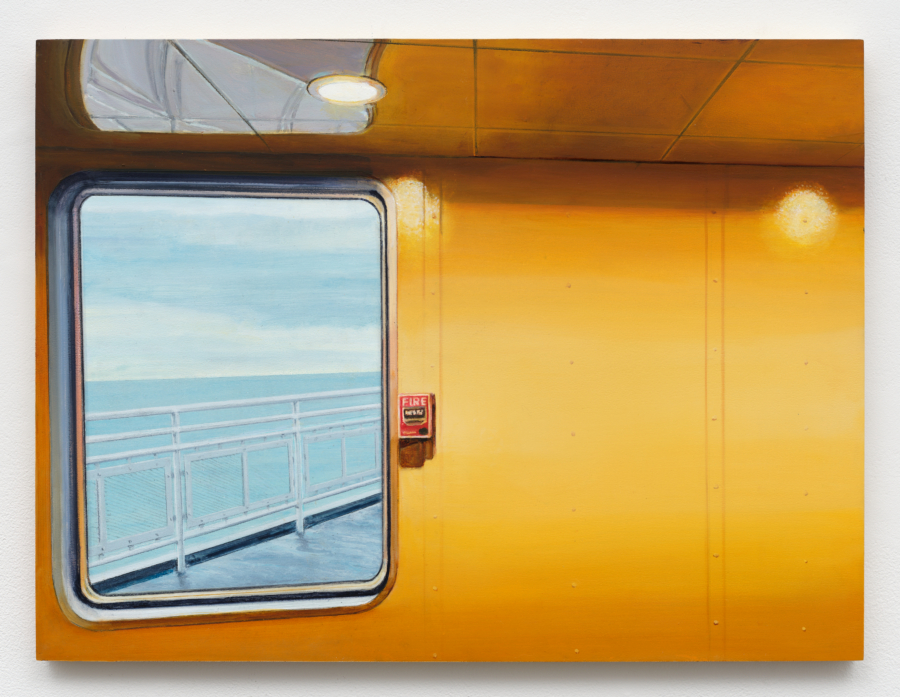
In Dike Blair’s observations of windowsills, elevators, airport lounges, construction scenes, and other precisely circumscribed settings, time is suspended. The oil paintings here were developed over the course of the past two years. Emphasizing framing devices, surfaces, and the complex interrelationships between and within compositions, these works self-reflexively nod toward the parameters of vision and painting alike.
No singular narrative asserts itself over this collection of images—instead, relationships both formal and conceptual proliferate. Unlike recent shows focused on outdoor scenes, these paintings primarily depict shallow spaces like corners, walls, and architectural thresholds. Motifs like drinks and flowers double or triple: Blair synthesized elements from three separate paintings to create the fluffy peonies in one work, covertly citing multiple sources at once, a gesture repeated throughout his work. Color echoes, as in the glossy leaves and fruit of a lime tree and the acid-green light reflected in a pool’s calm surface. Rectangles multiply within rectangles across windows, framed artworks, television screens, pools, doors, and light switches. Piet Mondrian’s geometries appear, his compositional harmony disrupted by Blair’s close crops. A slice of a lush Pierre Bonnard tablescape rhymes with paintings of flatware and cocktails, but Blair’s own table arrangements are spare and solitary instead of abundant and convivial. In a pair of paintings of televisions in airport bars, screens offer impenetrable portals to fictional worlds. In one such composition, Fellini’s La Dolce Vita is stilled at a shot of a window, yet another frame within frames.
Textures differ inside and between paintings, emphasizing points of disjunct and connection. Blair at times presses pieces of linen, plastic wrap, and other materials into his paint while it is still wet, subtly manipulating his surfaces. In his rendering of a rose in a vase on a sill, the linen’s coarse weave lends the window a hazy, impressionistic quality. As a result, the pane more closely resembles an abstract painting within an otherwise realist scene than a view onto a vista. The artist used a roller in his depictions of matte museum walls, a recurring subject in this body of work; their stippled skin echoes that of the gallery in which his works are hung. In these paintings, the frame—as lens, subject, boundary, and formal device—is endlessly generative. More than four decades into his practice, Blair continues to deepen his paintings’ commentary on ways of seeing.