William Turnbull
1946–1959
April 2–May 9, 2026
Opening reception Thursday, April 2, 6–8 pm
Karma
549 West 26th Street
New York
William Turnbull
1946–1959
April 2–May 9, 2026
Opening reception Thursday, April 2, 6–8 pm
Karma
549 West 26th Street
New York
Across painting and sculpture, Scottish artist William Turnbull (1922–2012) explored the transhistorical power of elemental forms. This exhibition surveys the transformative first period of the artist’s oeuvre: the years 1946 to 1959. Confronting a crisis of meaning in the wake of World War II, Turnbull foregrounded art’s role as part of the physical world, a connective tissue between the prehistoric past and the present. Bookended by his time in Surrealist Paris and Abstract Expressionist New York, these years were punctuated by his inclusion in some of the most important exhibitions in modern British art. All the while, Turnbull iterated on his key motifs—the horse, the standing figure, and the human head among them—in an eternal return that nonetheless propelled him forward. “Each new excavation,” he wrote in 1956, “is another step into the future.”
Born in Dundee, Scotland, in 1922, Turnbull left school at fifteen and soon after began working as an illustrator to help support his family. While a pilot in the Royal Air Force between 1941 and 1945, he studied the Impressionists in books he had brought with him. Turnbull enrolled in London’s Slade School of Fine Art in 1946 with the intention of joining the painting department, but switched to sculpture after only a few weeks; for the rest of his life, he would work in both two and three dimensions. In his first year at the Slade, Turnbull had already begun to engage motifs, philosophies, and materials that would persist throughout his career. Inspired by an encounter at the British Museum with a marble horsehead from the Parthenon, Horse (1946) is the earliest extant Turnbull sculpture, and the second he ever made. It was originally built from plaster over a metal armature and later cast in bronze, a process he would return to again and again. Although reduced to the brink of abstraction, the work nonetheless still functions symbolically, reflecting Turnbull’s pursuit of the minimum amount of context necessary for a composition of spare shapes to coalesce as a representation. In the horse, he found a key form (one he would iterate on for decades), iconic enough to withstand multiple degrees of simplification.
Breaking away from what he saw as the “prevailing postwar neo-romanticism” of British art to immerse himself in European modernism, Turnbull moved to Paris in 1948. He remained in the city for two years, spending time in the studios of older avant-gardists like Constantin Brâncuși, Paul Klee, and Alberto Giacometti. The latter’s influence is evident in many of Turnbull’s linear sculptures from the period. He shared Giacommetti’s interest in phenomenology—in his words, Turnbull “wanted to make sculpture that would express the implication of movement (not describe it).” Pulling from his time as an illustrator, he began drawing in space with wire, which he then hand-coated in layers of plaster and cast in bronze. Thin, rugged columns project upward from the horizontal base of the pinball-inspired Playground (Game) (1949), while lines incised into its surface seem to delineate spatial relations. The upright elements lend the scene an indeterminate scale: they could be pegs in a tabletop game board, children playing in a field, or prehistoric structures in a vast landscape. The 1949 Aquarium collages and drawings visualize movement through still symbols such as directional arrows, their nonhierarchical distribution influenced by a compositional strategy commonly used by Klee. Returning to London in 1950, Turnbull’s interest in kinesthetics began to manifest as Futurist-inflected drawings and paintings where bodies composed of radiating lines traverse the picture plane, or, in the case of Circus (1951), a tightrope.
With Horse (1950), Turnbull returned to the equine form, shaping it in plaster so pitted with texture that the sculpture’s final bronze surface appears to have eroded over time. The artist did not smooth over the marks left by his manipulation of the wet paste: “The surface comes out of the way you are working,” he later explained. “It’s not something you add on at the end.” Included in the United Kingdom’s pavilion at the 1952 Venice Biennale alongside works by Kenneth Armitage and Lynn Chadwick, among others, Horse heralded the arrival of a new era in art. In lieu of attempting to capture the natural sublime, like British artists of the preceding generation such as Henry Moore and Barbara Hepworth, Turnbull exposed artistic labor. Rather than illusion, he offered material fact, or the fact of materiality.
Around 1953, Turnbull shifted his focus from movement to stillness; as a result, his sculptures became progressively reflective of his interest in the ancient world. Instead of linear elements, he worked with solid masses of plaster and clay, manipulating their soft surfaces through carving or impressions. Devoid of facial features yet based on the human head, the large, round forms in works like Metamorphosis are textured. Turnbull created their lacerated ridges by pressing corrugated cardboard into wet plaster. In 1956, the artist participated in the landmark exhibition This is Tomorrow at London’s Whitechapel Gallery alongside other members of the Independent Group. This association of artists, which included Pop art pioneers like Richard Hamilton and Eduardo Paolozzi, aimed to upend distinctions between high art and mass media. But rather than turning to the new popular culture, Turnbull looked to prehistory, when art objects were fully absorbed into the rituals of everyday life. In the exhibition catalogue, he wrote: “Sculpture used to look ‘modern’: now we make objects that might have been dug up at any time during the past forty thousand years.” In his nearly life-sized Idol sculptures of the period, Turnbull’s treatment of the human form echoes the contours of the early Cycladic figures that were among his ancient inspirations. The marks on the surface of Head Relief (1955), incised into a block of clay, suggest glyphs from a long-lost language or an indecipherable diagram. Cast in bronze, these inscriptions are captured in the negative and raised like scar tissue. Screwhead (1957) is based on Ancient Greek herms, sculptures of heads and sometimes torsos on squared bases; Turnbull’s adaptation signals the figure through pure geometry. Translated into a bisected circle—like the slotted head of the titular tool—the face aligns art with everyday objects in the same archeology of human history.
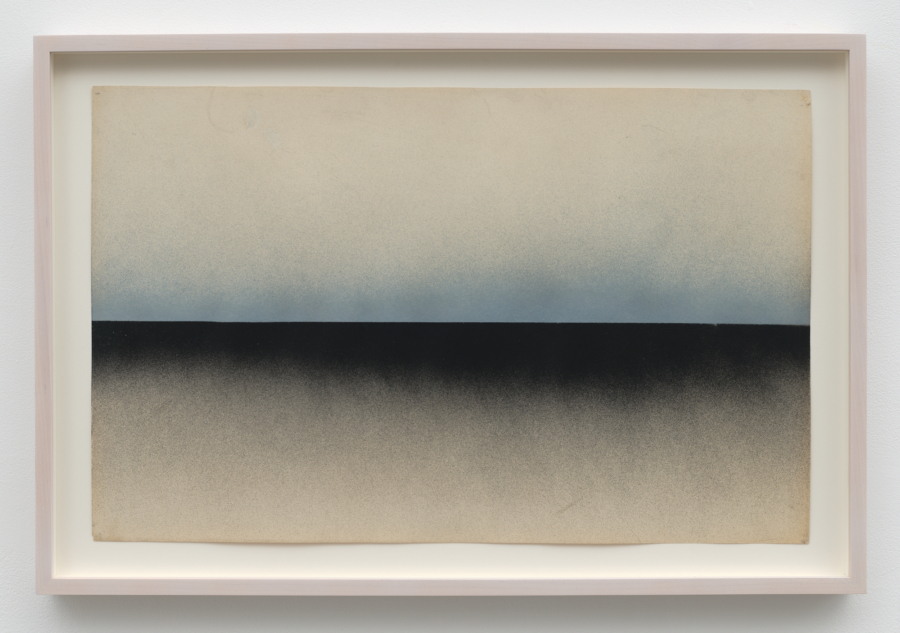
Like his sculptures, the paintings Turnbull created after 1953 grew increasingly abstract. In gestural compositions like the 1956 Untitled (Calligraphic Head 2), references to the body have nearly disappeared, but for the whorl of inky strokes that, in Turnbull’s visual language, signify the head. An encounter that year with American Abstract Expressionist paintings at the Tate reinforced his own turn toward nonrepresentational painting. Turnbull began to make near-monochrome works like Untitled (1957), where petal-like, impasto strokes, delicately flushed with color, draw the eye around the otherwise white ground. Later that year, he made a trip to New York to meet with Mark Rothko, Barnett Newman, and Helen Frankenthaler, with whom he discussed his formal shift toward an allover abstract surface. “What matters,” he later explained, “is the painting as object, not the painting as illusion.” In works like 03-1959 (1959), Turnbull thinned his paint and flattened his brushstrokes, shifting his focus from the tactility of gesture to pure color. On the eve of the 1960s, Turnbull sat at the precipice of a newly Minimalist vocabulary that would yield a new suite of painted, geometric sculptures. In the decades that followed, his early notion that art’s objecthood connects us to the whole of human history would continue to inform new iterations of his practice.