July 1, 2025
“I stepped into something with dark energy,” said artist Maja Ruznic. “This project was very treacherous and psychologically heavy for me.”
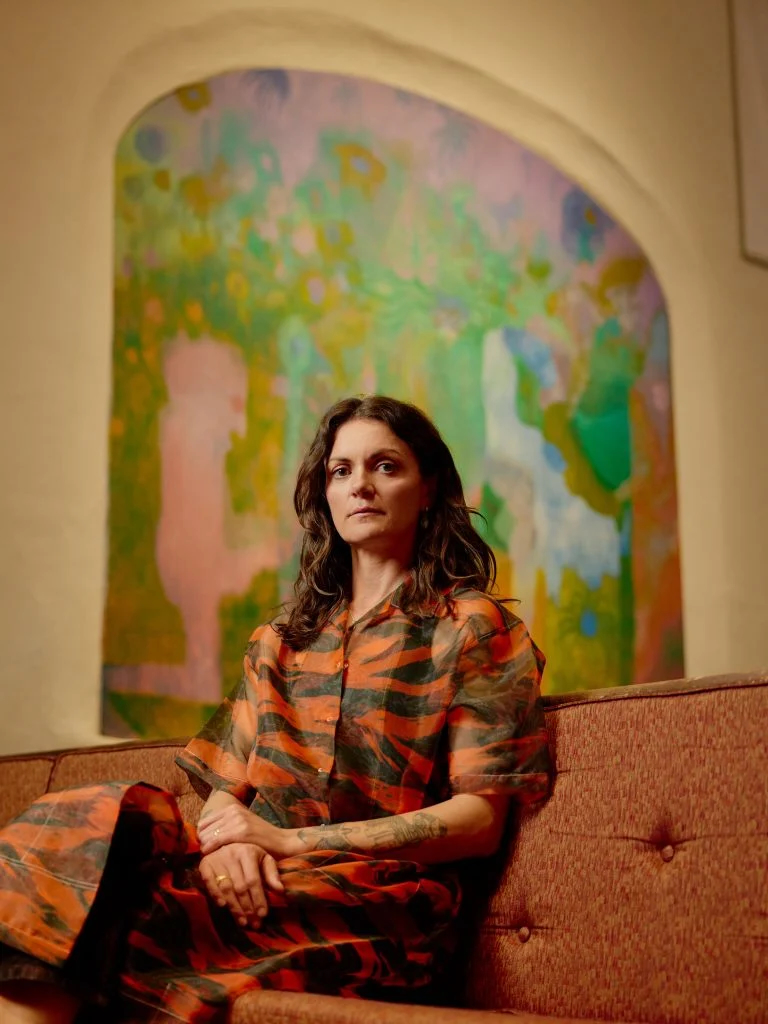
When we spoke, Ruznic, who lives in Placitas, New Mexico, had recently completed a significant undertaking for the 12th Site Santa Fe International, which opened last week—an artistic response to some of the city’s most problematic history paintings. At the St. Francis Auditorium at the New Mexico Museum of Art, now a performance space, hang six large-scale scenes of Spanish colonization of New Mexico painted by Utah-born artist Donald Beauregard (1884–1914) in the early 20th century.
Cecelia Alemani, the curator of this year’s edition, entitled “Once Within a Time,” invited Ruznic to contemplate these historically heavy works and respond to them artistically. Ruznic has created a suite of large, luminous canvases that confront—and complicate—the auditorium’s early 20th‑century paintings glorifying Spanish colonization. By filtering that fraught regional history through her own experience as a Bosnian war refugee and her fascination with spiritual archetypes, she turns the space into a conversation about conquest, loss, and the possibility of renewal.
“I was intimidated to respond to these paintings because they are very problematic,” said Ruznic, who is known for her richly chromatic paintings populated by mysterious figures and ritual-like scenes. “The paintings depict St. Francis receiving a message from God about what he should do, as well as scenes of Franciscan missionaries coming to America and colonizing the natives.” These scenes, which range from Preaching to the Mayas and the Aztecs to Building of the Missions in New Mexico, glorify, through a Christian lens, what was an era of brutal violence and cultural subjugation for the Pueblo Indian tribes native to the region.
Ruznic was well aware of her role as an outsider in New Mexico’s history. However, her works often obliquely allude to the loss of homeland and the lasting wounds of genocide, experiences that heightened her acuity to the lurking devastation obscured by these scenes of colonization. Ruznic, born in Bosnia and Herzegovina in 1983, came to the U.S. fleeing the Bosnian War with her family during the early 1990s.
“I’m an Eastern European woman, and although I have a whole history of being a refugee and an immigrant, I am still a white woman making paintings that respond to this history,” she said. “I really sensed the psychic darkness I was asked to step into.”
Peeling Back History
The early 20th-century paintings are haunted by another layer of tragedy, too—that of Beauregard, the artist behind them. The paintings were never meant for this space. He was originally commissioned to make the works for display at the 1915 Panama-California Exposition. “The paintings themselves were going to be part of this big biennial type of art show, which I think is interesting as a parallel,” said Ruznic. Unexpectedly, however, the artist died suddenly of cancer at the age of 29 in the middle of the commission.
“I read Beauregard’s letters between him and his patrons back and forth. He had to report how he was spending and using the money that they were sending him in Europe, where he was researching St. Francis. These letters are quite emotional, saying things like, ‘I could not paint for the last four days because I’ve been coughing all night,’” Ruznic recalled. The works were ultimately completed by two artists, Carlos Vierra and Kenneth Chapman, who have remained largely uncredited.
Here, Ruznic began her exploration of these layers of history and pain, creating a suite of monumental paintings designed to hang in conversation with the early 20th-century oil paintings (in addition to her installation at St. Francis Auditorium, she will display another work at Site Santa Fe).
She is a deeply spiritual person who embraces meditation, folklore, and Jungian dream analysis, and her paintings are, in some sense, another exploration of the subconscious mind and the collective unconscious, shaped by history. In her process, she pours paint onto her canvases and lets this guide her as she calls forth imagery. She often works in subtle shifts in jewel tones, color acting like a gauzy veil both revealing and obscuring; the eye needs to adjust, as though entering a dark room, before seeing the scenes unfolding.
Painting in Bosnian Greens
These nuanced images have earned Ruznic a share of acclaim over the past five years. Last year, her work was included in the Whitney Biennial. The 2024 Artnet Intelligence Report identified Ruznic as one of the artists with the most significant jumps at auction. According to auction data, most of her canvases range between $24,000 and $57,000. She is represented by CFA Berlin and Karma Gallery, where she will open a new exhibition in the gallery’s Los Angeles space later this summer.
Her palette is often centered on green, with each painting dominated by a bright and fecund shade, calling to mind lush fields, absinthe, or toxicity. “For me, everything is both an accident and meaningful. I didn’t set out to make a monochromatic palette,” said the artist, “I don’t really analyze the work until after the fact, but I was looking over my old notes, and I often write about green and yellow as the colors that tie me to my homeland of Bosnia. The house that I grew up in was mint green.”
One painting is titled Kiša Pada, Trava Raste, Gora Zeleni, after a folk song she remembered from childhood. “It means: the rain is falling, the grass is growing, everything is greening,” said the artist, “I was humming the song while I was making the painting, I just thought to look up the lyrics, which completely overwhelmed me with how poignant they felt.” Ruznic said she was drawn to the melancholy of Slavic folkloric music and also its anonymity (the songs are not authored, in a traditional sense). “The lyrics are about this lover who has lost his beloved, and he spends the entirety of the song going from place to place looking for her but never finds her,” she said. “It’s very tragic, but also very common.”
Myth, Memory, and the Mystic Desert
Often, these paintings hint at obscured pasts, untold histories, and pain-filled memories. Still, there is an openness that gives these moments beauty. There are deeply personal narratives unfolding, both to the artist and New Mexico. “I am obsessed with the archetypal trinity of the father, mother, and child. I never met my father. I paint this man with a mustache which resembles the only picture I’ve ever seen of him,” she said. The artist’s mother is represented here by a sunflower. Another figure, with a deformed foot, often alludes to the artist herself and the “family structure and the fragmentation of it.”
In this context, it also suggests the nuclear testing done at Los Alamos. “I think about the land as being both beautiful but also still radioactive. When we drive through Los Alamos, we see all these sections that are marked off ‘Do Not Enter.’”
The artist and her husband, the artist Æmen Ededéen, moved from Los Angeles to New Mexico eight years ago for the Roswell Artist Residency and never left. Ruznic senses a mystic intensity in the land itself.
“We felt very enveloped by this land,” she said. “The desert is not a friendly place per se. The summers here are intense. The plants are intense. Everything here has to be kind of hard to survive. We felt why all the artists moved here—Agnes Martin and Georgia O’Keeffe. They resonated with the vibration of this place; it is just different, there’s a numinous intensity.”
Ruznic also found herself trying to connect with Christianity in some way. Here, her compositions have arched tops, reminiscent of church arches. “My work includes masks and often a regal or royal shamanic wardrobe. My husband will often joke and say my work is so pagan,” she said. “The work has a quasi-religious quality. I’m drawn to that because it’s part of my ancestral lineage.”
The central work in the exhibition, The Littlest God, became a place to explore both the pagan folkloric imagery that has typified her work and more recent explorations of Christian mystic traditions. “I wanted to get into Christianity in a way that I found interesting, which I thought the mystical route might be best, as I have no real interest in Christianity itself, being raised by an atheist mother who lived during Communism,” she laughed. “With this painting, I was thinking of the Christian phrase ‘be in this world, but not of this world.’”
At the center of the canvas, a little girl floats in green, seeming to emerge from the land. “It’s how I might imagine God, as a five-year-old girl. It’s no coincidence that I have a five-year-old daughter,” she explained.
Ruznic also sees the painting as a tribute to Mary Magdalene. “She really is at the root of Christianity, but at around the 4th century, she was completely taken out by the church fathers of the day and deemed a prostitute. By putting this little girl in there too, it was my love letter to Mary Magdalene, putting her in this space where her spirit can bring some kind of love into this place of pain.”
At the center of the girl’s chest is a dark circle out of which radiant light emanates. For Ruznic, pain is a place where beauty can also emerge. “Out of that darkness is the light that comes through,” she said.