August 19, 2025
“I’m happy to be identified with a time and a place,” the artist answered when asked about her association with the hot cauldron of creativity that was 1980s New York.
One night in 1982, the painter Jane Dickson had a stirring encounter with time, place and genius. The era was one of seismic shifts set off by a hungry new generation of New York art masters. The location was The Odeon in Tribeca, then the downtown HQ of Manhattan’s art cognoscenti. And the genius was the newly minted king of neo-expressionist cool, Jean-Michel Basquiat, who took control of the night and ordered for the table.
That this particular evening would climax at The Odeon is significant; the location played a singular role in the evolution of Dickson’s career, and it continues to do so. More than 30 years after that night with the imperious Basquiat, Dickson, like The Odeon, remains part of New York City’s cultural DNA.
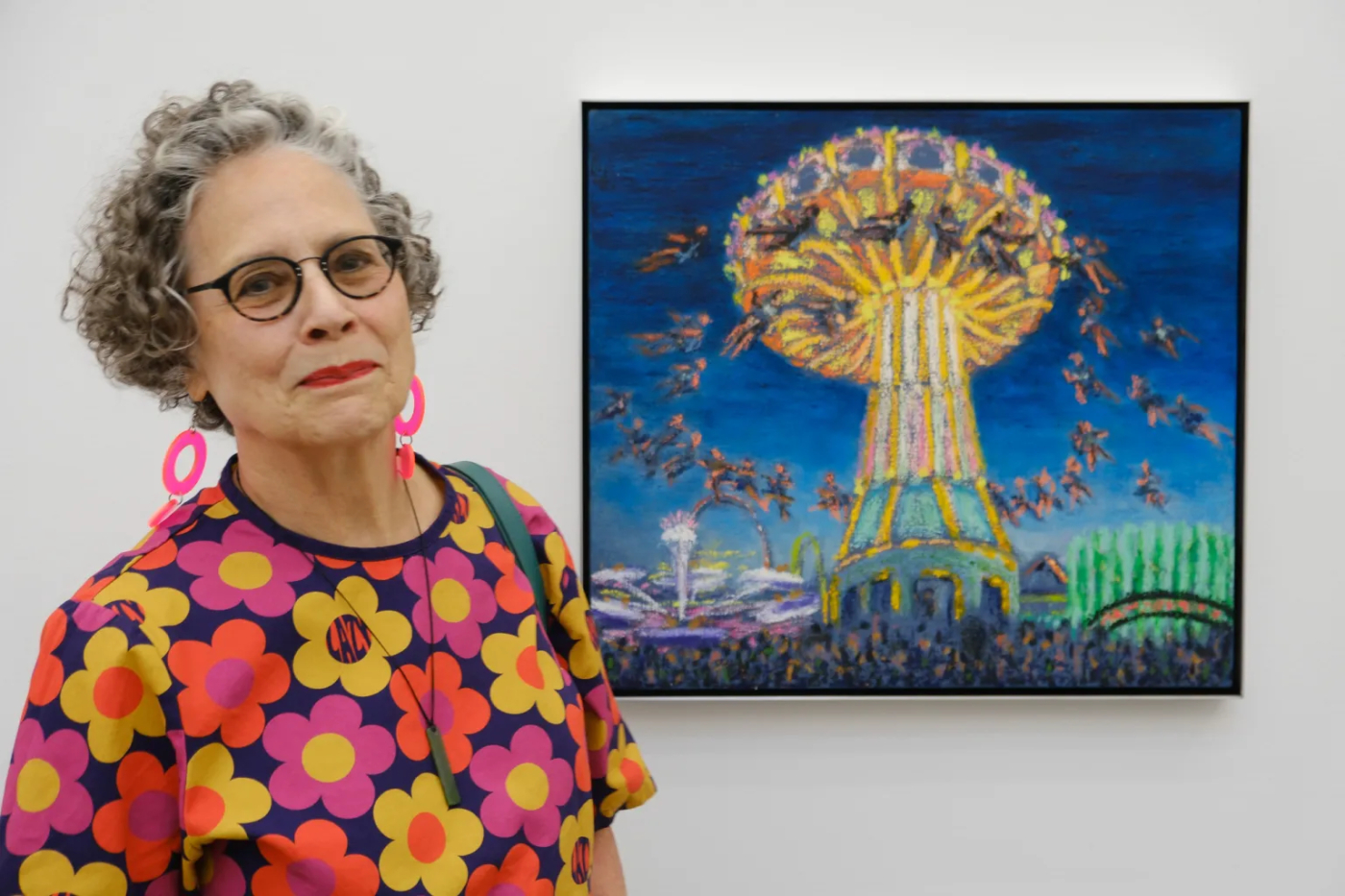
They’re still serving Cosmos and Moules Frites at The Odeon. And Dickson? She’s enjoying a renaissance moment as an enduring figure in Gotham’s next-generation art scene. “Wonder Wheel,” a solo show devoted to her latter-day paintings of fairground scenes, is at Karma in the East Village; her stunning Heading in – Lincoln Tunnel 3 is on display at the Whitney; and she is nearly finished with a monumental sculpture that will greet travelers arriving at JFK Airport’s new Terminal 6 when it opens next year. And then there’s her new silk-screen print, in a collaboration with master printer Gary Lichtenstein, of—wait for it—The Odeon.
Back in the heady days of 1982, Dickson was fresh off her first solo show at the long-gone Delahunty Gallery, at which the art world got its first look at her now-iconic Times Square paintings. It was in this rarefied moment that Dickson’s artistic philosophy and her career took shape amid spontaneous interactions with similar up-and-comers like Basquiat, Keith Haring, Julian Schnabel and Jenny Holzer.
By the early 1980s, Dickson was drawing attention for her many depictions of life in then-lawless Times Square, where she lived with her husband, the filmmaker Charlie Ahearn. She was, and remains, linked to the work she created at that time and place, dark portrayals of the crucible of sex work, drug dealing and violent crime that she witnessed from the window of her apartment at 43rd Street and 8th Avenue.
“There was a lot of action,” she said. She and Ahearn watched Times Square evolve in slow motion for more than a decade until, finally, the inevitable forces of redevelopment forced them out. “A definitive moment was that our building was condemned as part of the redevelopment, and we were evicted. We moved down to Tribeca at the end of ’93. I kept a studio in Times Square until 2008, so I was still spending time there, but Times Square itself was permanently changed as part of that redevelopment. The construction of high-rise luxury hotels wasn’t so exciting—the Disneyfication of Times Square.”
“I always had one foot out of Times Square. I thought it was exciting to document, but it was not the only thing in my life,” she added. This is true. A look back at her nearly five-decade career reveals flirtations with a raft of subjects ranging from carnivals to casinos, car races to quotidian suburban neighborhoods.
Her work at Karma focuses away from midtown Manhattan, depicting the intersection of thrills and desire at carnivals and street fairs in her signature dark, brooding style. A pair of studies of Ferris wheels at Little Italy’s San Gennaro festival is typical. The works, rendered in oil stick on linen, capture the carnival machinery from within, its geometric architecture rendered in hues of red, white and gold. In its description, Karma described the works as “present views of Ferris wheels as seen by the rider, situating the viewer in midair. Dickson’s emphasis on the symmetry of the iron spokes evokes Joseph Stella’s late-1930s paintings of the Brooklyn Bridge.”
“I think my work could be divided up into entertainment: Las Vegas, Coney Island, street fairs, Times Square. They’re all about our desires and what’s being pitched to us. And even though in almost all cases we know that the pitch is not going to be that fulfilling, we want to believe it, and we want to go for the ride. That’s better than sitting around being miserable. So you want to go and be wowed,” Dickson said.
At the same time, Dickson has demonstrated fluency in depicting automobiles, either crashing in a demolition derby or traveling America’s highways. One such work is her 2003 oil-on-AstroTurf piece Heading in – Lincoln Tunnel 3, now showing as part of the Whitney’s “Shifting Landscapes” exhibition. The piece presents the mundane ritual of tunnel travel as a meditation on the intersection of human desire, potential and a looming unknown.
“The highway also is about promise—you get in your car and you feel like you’re going to get out of here,” Dickson said. “It channels the American dream that wherever you are, you can just hit the road, go west, and everything will be more open and more free. Of course, it’s not true anymore, but we still have that dream.”
Next year, Dickson’s New York legacy will be cast even more deeply when a monumental 14-foot medallion will be unveiled as part of the $4.2 billion Terminal 6 project at John F. Kennedy International Airport. Her work will greet visitors alongside contributions from other art luminaries like Yoko Ono and Barbara Kruger and installations by the Museum of Modern Art, the Metropolitan Museum of Art, the American Museum of Natural History and Lincoln Center for the Performing Arts.
Though she’s not allowed to talk about the project, there is little doubt that it will channel her vintage New Yorkness. That Dickson was able to capture not just a time but also a place and bring them with her into her future could be her biggest artistic accomplishment. Her oeuvre issues from a crazy amalgam of experiences she gathered over decades, from that rampageous night on the town with Basquiat to Times Square window watching to rides in cars and Ferris wheels. But always, before she painted, she got to know her subjects. “You know how they tell young writers to write what you know? I feel like that’s good advice. I’m going to paint what I know. Actually, I feel like that was the key moment in my becoming an artist—the moment when I said, ‘I’m only going to paint things that I feel like I know something about.’”