September 3, 2025
“The moon, like a flower in heaven’s high bower, with silent delight sits and smiles on the night.”
–William Blake
How many thousands of years have you been there?
Why sometimes slender, sometimes full?
How old is the White Rabbit?
How many children belong to Moon-Girl?
Why do you circle the purple loneliness of night
and seldom blush before the sun?
Weary, past midnight, who are you searching for?
Are you in love with these rivers and hills?
–Ho Xuan Huong
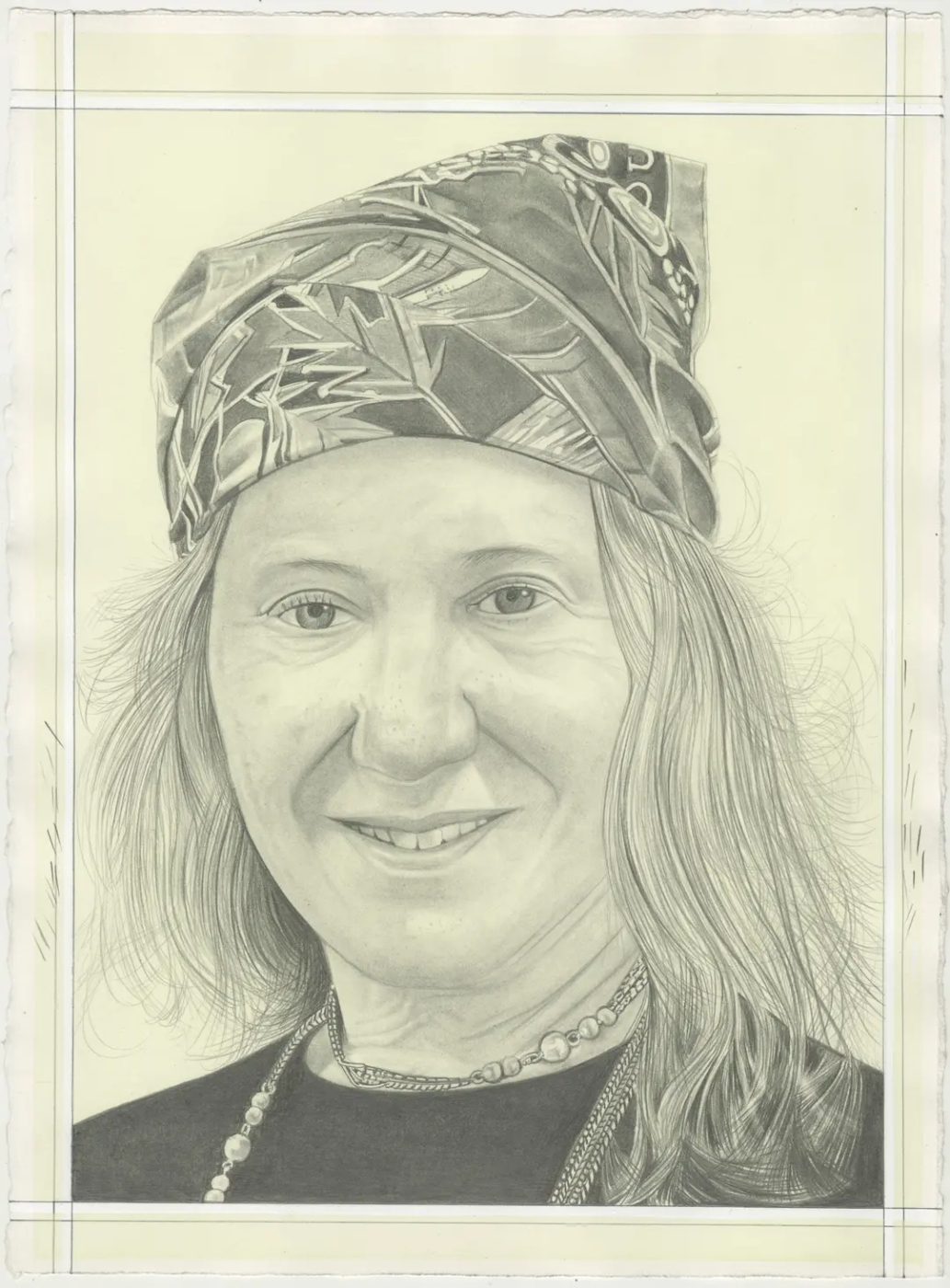
Those who have followed Ann Craven’s work would broadly acknowledge that in her lifelong commitment to painting, she has created an ongoing dialogue about the made factum that lies between guilty pleasures that have been constantly and firmly sheltered, and pictorial invention that thrives in-between the seen and the unseen, impression and memory. Ann, in her feverish longing to break through the narrow bonds of idealism and personal restraint, always seems to fearlessly adapt to the complete opposite of the human impulses that insist upon purity as an attainable system of value. At once susceptible to the fleeting vapors, deceptive excesses, and brevity of life, each of Ann’s painted images is highly charged with the personal aspiration for authorship over thoughtless overproduction, and her desire to recreate the made as remade while transforming annuity into perpetuity. This is essential for her absolute necessity to elevate and preserve the potential for a renewed interpretation, and a renewed relationship to things in our manmade world and the world of nature.
Although we’ve known each other for a long time, I began to pay greater attention to Ann’s work after seeing it in the group exhibit Joe Bradley, Ann Craven, Dana Frankfort, Keith Mayerson at Zach Feuer Gallery in 2007, which asserted her artistic sphere in context with her contemporaries, then I saw the second hang of her one-person exhibition Moon Birds at Knoedler & Co in 2008 which deepened my understanding of her lifelong obsession to catch the uncatchable glimpses of things. On the occasion of Ann receiving the 2025 Maine in America Award, in addition to her three exhibits in three institutions across Maine simultaneously, at the Bowdoin College Museum of Art, Portland Museum of Art, and Farnsworth Art Museum, we both flew from New York City to see Ann’s three exhibits on Saturday and Sunday, August 16 and 17, followed by a comprehensive and delightful interview in the Farnsworth’s conference room thereafter. Below is an edited version for your reading pleasure.
Phong H. Bui (Rail): Let’s begin with your remarkable work ethic, and working-class background, which can also be applied to those who are born privileged. It remains to be the greatest mystery to us in how we discover what we love most in life. I know you’ve told me here and there in brief, but it would be brilliant if you can share with us your early formation in full.
Ann Craven: My father’s side was the Craven. My mother’s side was the Hurley, and they were the roofers, a city northwest of Boston, where I grew up with my parents, my brother, and my grandparents. My grandfather was from a very poor family and first generation from Donegal, Ireland who moved to the US, first to Charleston in serious poverty where they were discriminated against, so they moved to Somerville where my mother was born in 1935. I remember she told me they had to steal coal from the trucks to heat their little house. That being said, my grandfather and his brother Melvin stayed together, worked together, built themselves from nothing. They believed by working hard, they could be freed from the things they couldn’t control. He used to tell me, before leaving for work, “Keep it going, keep it going, keep it going Annie.” I soon realized it’s the same as roofing. You know, muscle memory of putting down each roof tile, one by one, which creates a rhythmic repetition. Even though he wasn’t an educated man, he understood dreams. He knew dreams can take you anywhere, but then you do have to really think that dreams can come true. It’s really hard work. It’s work that you don’t necessarily try to think about until you’re in it. It’s like swimming, you know, you just dive in, but you’ve got to keep it going or you’ll sink.
Rail: Didn’t Brendan Dugan say to you, quoting Field of Dreams about Karma “If [we] build it, they will come?”
Craven: He did, referring to the church in Thomaston, Maine, and my and Reggie Burrows Hodges’s show in 2021.
Rail: I must admit, the story that your father gave you all of the oil paint, the canvases, the brushes, the turpentine all from your aunt Catherine and allowed you to paint with these oils and solvents in your bedroom when you were six years old was super unusual.
Craven: It’d be considered illegal today, I know. I got excited and set the little room next to my bedroom, which was used as the place to throw junk, as my studio. Thinking back now, it was amazing that I could use oil paint, and was allowed to use turpentine, partly because my grandfather worked in the roofing business, so you could imagine the materials he worked with, like asphalt adhesive, roofing cement, asbestos; not to mention we used to wash our hands with kerosene.
Rail: What! That’s insane. [Laughter]
Craven: My mother in fact loved the smell of oil and turpentine, so by the time I got to college, I just kept painting with oils. Oil paint has always been my preferred medium. To me, painting with oil is like breathing air. I remember being worried about making a living as a painter, I started a class in architecture, and I went home one day, and I said “Mom, dad, I think I might try to be an architect.” And they said, “No, no, you’re an artist. You’re a painter. Your paintings are so beautiful. We love your work. You’re so talented.” And I said “Okay, I gotcha, I hear you.” And that was the affirmation I needed to hear, which continues to feed me to this day.
Rail: What did you learn from aunt Catherine? Before your father gave you her oil painting set after her death, had you ever seen her painting?
Craven: Yes, I saw her painting a few times. I found the experience hypnotic. I was in awe of her focus on what she was doing, and how she dedicated her life to painting was an inspiration.
Rail: And how she repeated the same image was perhaps the first source of your perpetual obsession with repetition and seriality.
Craven: Definitely, observing her making the same painting of one landscape was amazing, similar to seeing my grandfather and my great uncle laying down roofing tile one by one, the same repeated action. I realized later these were the two most calming experiences and were ingrained in my memory.
Rail: And when in fact did this realization come about?
Craven: In graduate school at Columbia University around 1992–93. I’d be happy to share my experience at the time, if you’d like.
Rail: I’m sure our readers, especially the younger artists, would find it interesting. For now, can you talk about how your mother gave you such a rare endorsement? We both know how difficult it can be when either of one’s parents is unmindful of their jealousy of their own children’s pursuit after what they love.
Craven: Yes, it’s true, isn’t it? I was lucky that my mother and father nurtured my belief in myself, that they encouraged me to make things that I really cared about. Unlike most parents, who think their children should have a practical life, making money, having security and so on. It’s remarkable thinking back now on how poor they were, pretty close to being hand to mouth, but the fact that she recognized art as a way of salvation, almost to see beyond career, was simply amazing. All she wanted was for me to do what I loved. I remember how proud she was asking me to paint a water glass, paint a honeycomb, draw a leaf, draw my neighbor. Seeing her happy and proud bred confidence in me for sure. I embraced painting quite early on, but I would never have taken it for granted, in part because like my father, she had a deep respect for work. I saw in my mother a vehicle to understand how hard work and making sense of something you love and continuously doing it again and again, and again and again, is not something to be afraid of, but to embrace and love. To cultivate this love of painting, I learned the real appreciation and joy of repeated labor. I see no real difference between work and painting.
Rail: I love what our friend Josh Smith wrote in his catalogue essay of your exhibition Moon Birds at Knoedler & Co in 2008: “She dashes forward with a firm innocence.” I truly believe that once one loses this innocence, one stops being curious, and once one stops being curious, love will evade us.
Craven: And love would be difficult without trust. In the same way we see a child, learning by repeating the same thing again, and again. Throwing something off the table, mom goes back to grab it, brings it back, and again throws it off the table. The same is repeated when they learn to speak by repeating words again and again and eventually associate the word with an object or image in the world. How we build trust. Trust is also a result of being fearless, not being afraid of making mistakes or imperfections.
Rail: Super true. I remember talking to Allan McCollum, when he first met Vija Celmins in her Venice Beach studio in 1968. He described how Vija was making a bunch of pencil drawings based on a photograph of sea waves without a horizon, and how she would finish in several hours then set them aside and cover each with a white page then copy another, then another, without looking back at each she had done. In trusting that each copy would inevitably reveal a tiny, minute dissimilarity or irregularity, what was important to Vija, he told me, was how she discovered the world through the idea of work, deep focus, and repetition. Allan also mentioned once he attended a meeting with several Gurdjieffians at Vija’s studio, and he noticed one word that no one used was “I.”
Craven: The “I” is not as important as the act of doing, making things repeatedly.
Rail: That’s right, as Gurdjieff’s most important contribution was his system of self-development known as “the Work.” Take Michael Jordan, for example, who practiced for five to six hours a day, including his famous “Breakfast Club” morning workout, to commit every routine to his muscle memory.
Craven: Thank God, it’s amazing how we have memory in our bodies, our hands. I remember my brother, after his right leg was amputated, he always said he could still feel his toes. In my case, as I’m trying to paint the moon in the night sky, literally the moment has just passed, I hurriedly try to repeat the same gestures in the next canvas with the same memory. I love what you said once about my admiration of On Kawara, that I take the similar concept of repetition from my head and bring it to my hands. As long as I know that one is ever the same as the next action, I just keep going.
Rail: As your grandfather always said.
Craven: That’s right.
Rail: This similar trust in repetition, regardless of minute discrepancies or imperfections that may occur each time in each iteration, is how Andy Warhol conceived of his ”Campbell’s Soup Cans” series in 1962. Each is printed with on- and off-registers, less or more ink, showing all thirty-two silk-screened paintings in varying degrees of success and failure in identicalness, so to speak. But again, his are mediated images, which refer to “fastness,” quick digestion, as opposed to his films that are often slow and long. One can argue Warhol’s mediation of both “fast” and “slow” as the two extreme ends of a spectrum in regard to the speed of execution is his greatest contribution to our contemporary visual culture. Every time I walk down an aisle of the supermarket, I think of Warhol’s deployment of repetition that is profoundly tied to our consumer culture, not from what François Rabelais once said “the appetite grows with eating.” And every time I see one of Warhol’s films, I feel it is deeply related to our experimental culture of downtown bohemian life. This paradox is undoubtedly related, I feel, to our sense of anxiety on one side, and to calmness on the other, don’t you think so?
Craven: Absolutely. I mean, the moon is something that has had a universal connection to humans across time. Everybody has a story about the moon. It is the moon, but it’s your moon. It’s my father’s moon. It was Aristotle’s moon. It is a subject that allows me to have both an observational and a conceptual notion of painting.
I feel painting the moon on-the-spot at night—in Maine or in New York—I’m trying to catch the uncatchable image. It is a fleeting image, and for me it’s the act of painting it repeatedly that counts. It’s true that it can be very anxious, setting up three to six easels at times, with ten to twelve canvases, painting for at least four hours straight. Each night I decide to paint it. It’s also true that making multiple paintings from the same image can be very calming.
Rail: Like the three paintings Red Dahlia’s (For the Moon, Cushing, 9-19-21, 8:15 PM), 2021 (2021), Dahlia’s (For the Moon, Cushing, 9-20-21, 8 PM), 2021 (2021), and Red Dahlias (For the Pink Moon, Again, June 2022), 2022 (2022) all painted in 14 by 11 inches, at the Farnsworth, for example.
Craven: Exactly. Similarly, there are also several versions in different sizes, Red Dahlias (For the Moon), 2022 (2022) at 36 by 30 inches, and Dahlias (For the Yellow Moon, Cushing, Always) 2024-25 (2024-25) at 84 by 72 inches.
Rail: And her twin, Dahlias (For the Yellow Moon, Cushing, Again), 2024-25 (2024-25) at the Portland Museum of Art.
Craven: Right. These two calibrations of quickness and slowness have always been pretty much part of my DNA.
Rail: In thinking of Gilles Deleuze’s two different notions of difference in itself and repetition for itself, which is in fact quite similar to Isaiah Berlin’s two different notions of freedom, negative freedom that associates with the absence of obstacles, barriers or constraints, while positive freedom asserts the possibility of taking control of one’s life and realize one’s fundamental purposes. There is a huge difference between being free of something and being free from something.
Craven: To have clarity between the two is actually very useful. For me, to trust my sense of memory, I have to repeat things even when they turn out to be imperfect, as I said earlier.
Rail: The fear of not remembering things well is real. I remember Jorge Luis Borges once asked his father whether he could recall his childhood when he first came to Buenos Aires, and his father took a stack of coins. The first one constituted the first image of his childhood house, and the second coin, would be the memory of the house. The third coin is then the memory of the second, and the fourth the memory of the third, and so on in the same order. What he said in the end was if this slight distortion gets slightly eroded, he can no longer claim the clear memory of his childhood.
Craven: This is why some of us repeat things, to commit how we remember things so our memory can be materialized in concrete things, as I do with my paintings.
Rail: Just to change the subject a bit, do you remember the first moon you ever painted?
Craven: Yes, I do. It was in the summer of 1994 on Lincolnville Beach that I painted my first 101 moon paintings, all in preparation for my first show ever in New York City at Lauren Wittels Gallery. I remember Lauren asked, “Why 101?” “Well,” I said, “101 is better than a hundred.” [Laughter] As a child, I was obsessed with Disney’s 101 Dalmatians, for they were repeated dogs, almost the same dog with different personalities, names, etc. But I remember when I painted the first one on Lincolnville Beach, I thought it was for my mother, who would love that I painted the moon. She would later help me stretch my 14 by 14 inch canvases when I went home.
Rail: This is for our readers: Lincolnville is where Alex and Ada Katz, Lois Dodd, Rudy Burckhardt, Yvonne Jacquette, Tom Burckhardt, Kathy Butterly, all have their summer homes.
Craven: Alex and Ada have lived at the Yellow House on Slab City Road since 1954.
Rail: That’s right, so this leads to my next question Ann. When did you work as an assistant to Alex, and when did you go to graduate school at Columbia University?
Craven: I started working for Alex in 1990, which was essential to my early development as a young painter. In addition to occasionally modeling for Alex, I’d prepare all the canvases and mix his colors, but what was most thrilling was to watch him paint like an athlete, which left a long-lasting impression on me. One day I said “Alex, I want to go to graduate school. Would you write me a letter of recommendation?” And he said “Yes, because you know how to paint. Alex wrote to Jane Wilson, who was the chair of the art department at the time, and whose paintings of landscapes, seas and skies I admired.
Rail: Jane was married to the writer and dance critic John Gruen, whose book The Party’s Over Now (Viking Press, 1972) was an amusing reminiscence of artists, writers, musicians, and their communities in the 1950s. Anyway, what was your experience in grad school?
Craven: I was a dry sponge. I had the notion that I knew nothing but the mechanical ability to paint, and I thought, how could I possibly be in a graduate program at an Ivy League School? How did I get here, from a poor family? I was the first to go to undergrad even. My mother worked full-time as a waitress to help pay my way through MassArt. How did I fucking get here? I never admit it to myself, but I am driven by feeling a bit ashamed of my ability to paint while never forgetting my grandfather’s and father’s and mother’s hard work ethic. I need to work on my mental, conceptual side of my head, making sure it’s all worth the tuition. Looking back now, graduate school and my experience there was no more and no less than a sieve of ideas, whereas working two days a week at Alex’s studio in SoHo was far more important. You know how Alex can say things that stick in your mind forever, like “the ephemeral versus the absolute.” The ephemeral being a notion of movement, as opposed to the absolute, which is what I choose to paint, what I’m painting. Everything, I realized then, breaks down to the notion of time, the ephemeral, the movement versus the absolute, which is the constancy of making paintings. So the moon was the constant for me. I had the guts to choose a subject matter that was constant, but also ephemeral at the same time. The process was also ephemeral.
Rail: True. But it was in grad school that you realized your now-known three anchorages, or as you refer to them, your trinity. The first is your strong, hardworking family, particularly absorbing early-on how your grandfather and great uncle lay down roof shingles one by one repeatedly; the same with your aunt Catherine making the same painting. The second is Alex’s assistantship. And the third is your formal and spiritual affinity, which you found in grad school, for both On Kawara and Agnes Martin’s work.
Craven: I can pin it down to my first year in graduate school, when I did understand that my background would never fall far from plein-air painting, which was and still is my blood and guts. I was hungry for creating a new contextual, conceptual framework. So, discovering Agnes Martin was a revelation. I was absolutely hammered by her work, and especially when I soon learned that she also had similar struggles early on with representation. Whenever I looked at her work, I felt her hand gestures, making repeated continuous lines, which evoke everything for her, her past, her childhood, nature, and so on. I remember a fellow classmate Jason Fox said, “You’re like a figurative Agnes Martin,” and he got it. I got it because I was so obsessed with her line. But how could a line become a moon? It’s all in the abstraction, which I realized is all in the inner trajectory of my own head that conjures my own subject matter. Alex used to say “if you can get your subject matter, then you’re all set.” As for On Kawara, his process was so dazzling to me. He was a god to me because of his commitment to subject matter as a continuum, to things that were integral parts of his immediate surroundings and daily life all became his oeuvre. The oeuvre was just perfectly formed with words, dates, months, years, numbers, etc. What both Agnes Martin and On Kawara share is the notion of time being a personally created continuum. “The moment just passed” is the phrase I coined in January 2006, the same time I painted my first portrait of Matt Keegan.
Rail: Again, it is from the fear of losing our memory, which is our history, that we repeat, remake, recreate things to preserve them.
Craven: Absolutely. As I’ve experienced a lot of loss in my life, including the fire in 1999, my process became almost a relief for me to be able to know that I had made a copy of something, to formulate it in my head, but also to have it and covet it and hold it in the real. Curt Marcus knew about the fire and gave back a deer painting he had stored at the gallery in early 2002. I made a copy two days before my show at Gasser & Grunert in Chelsea in 2002.
Rail: What you refer to as “Revisitation” paintings.
Craven: Exactly! And it’s not about nostalgia, but rather about a trajectory that you can always go back to the original source, and not a discussion about originality. It’s more a discussion of life, of thoughts that you have, of coveting, of holding onto something, even a brushstroke can be considered a conceptual part to a process because it is not a moon or a deer, it is a brushstroke. So the process is about your mechanical muscle memory of painting, seeing, copying, seeing, copying, seeing, copying. But by the time you’re at the third brushstroke on the third canvas at night, or even when I’m repeating them in larger versions in my studio, I always know something will get lost in translation, but I always embrace such imperfections as punctuation in a poem.
Rail: Very good, Ann. Be it a comma, a period, a colon, or a semicolon and so on, it can be seen or used as ways of trapping space, as some of us think of as spatial discrepancies. In geopolitical terms, it’d be referred to as asymmetrical occurrences [laughs]. So long it doesn’t bring any unintended perverted consequences, making paintings, making works of art that are according to “the Work,” we’re all in good hands.
Craven: It’s never about yourself.
Rail: Exactly, it’s always about the work. I’ve been reading the writings of Giambattista Vico, who is regarded as the inventor of the philosophy of history. In his famous The New Science, he proposes that progress is made through recurring cycles rather than a linear manner. And these cycles are not merely repetitions of the past, but each has its own distinct iteration and characteristic. I love how he countered Cartesian logic by how we concretely perceive the order of things as they arise in our experience—what he refers to as “Verum esse ipsum factum” which is translated as “truth is itself something made” A fact is not a passive state like the way the left has claimed. You remember when Kellyanne Conway was interviewed by Chuck Todd on NBC’s Meet the Press during the first Trump presidency? When he challenged her about real facts, her response was “alternative facts.” It has turned out that stories and narratives are more powerful than facts, when facts themselves were taken for granted as standardized mechanisms that need not to be remade, reenergized, recalibrated, and so on. I watched an episode of the TV series The Gilded Age on the plane coming back from Paris, and a character named Agnes Van Rhijn said something that has stuck with me since: “I am not concerned with facts. Not if they interfere with my beliefs.”
Craven: Do you remember in Robert Rauschenberg’s two identical paintings Factum I and Factum II (both 1957), how both paintings challenge our perception in that the idea of replicating, mirroring, or repeating can fall short in our memory’s connective capability? What is fact is not always fact. I mean there’s never an exact repeat. It’s always human mistakes, and there’s interruptions and static in between that makes it not ever perfect, and I see them very much as a continuous, perpetual mistake.
Rail: And your two versions Portrait of a Robin I (Looking, After Picabia), 2022 (2022), and Portrait of a Robin II (Looking, After Picabia), 2022 (2022) are similar conceived as Rauschenberg’s Factum I and Factum II. At any rate, how many moon paintings were the most you’ve made in a night?
Craven: Six in one night, and then I repeated it again, so that would be twelve paintings. And that’s very rare, but at that point I was just dying to paint the moon. I was so excited to be in Maine, I wanted to catch every single minute. I had twelve 14 by 14 inch canvases on six easels, and I had a palette on every other one, and I had candles everywhere, but not too many, because you won’t be able to see the night sky if it’s too light. I couldn’t really see the palette, but I knew where the color was, so it was another muscle memory of chance and risk, because without risk and without chance, why make anything? At the end of the night I had twelve different paintings, but they all spoke to each other because they were one continuous moment that had just passed.
Rail: And you would often use the tip of the brush or palette knife to scratch the day and the time that you made each painting on the bottom corner.
Craven: Yes, as I need to record the exact moment in time, almost like a GPS monitor of where I was, with the exact date, time, and place.
Rail: In regard to plein air painting and site specificity, I’m thinking now of the first two great painters who undertook plein air painting to great heights, namely John Constable in England, and his contemporary Jean-Baptiste-Camille Corot in France. One can argue that Constable’s oil sketches are compellingly different from Corot’s, partly because England gets less sun than France or Italy, hence Constable seems to be as much a meteorologist as he was a painter. He captured the moisture in the air, the formation of clouds, the condition of light, and each sketch seemed urgent, whereas in Corot’s sketches, they appear to be just as equally fresh but more idyllic, less moody for sure. The reason I’m mentioning their oil sketches is not all of them got chosen to be made as larger paintings. Is the same applied in your case?
Craven: They’re few and far between, absolutely.
Rail: Can you describe the process of how a chosen small painting gets made into a larger one?
Craven: Sure. For everything is there as painted evidence and there’s not a lot of mystery to it. A lot of other artists have done this, but for me, the process becomes part of the conceptual side of my working because of the idea that the brushstroke has components that belong to other paintings, it’s like one long line of connections. I think a brushstroke can be a verbal entity. It can be read as words. It can be read as elements to building something that you have to rebuild again, and again, and again. So, it has the secrets that make the larger work, but it’s never the same. The larger work is always its own self. But it’s a continuum. I take a small painting I like, then project the image onto the blank canvas, and trace the outlines with a light yellow, very lightly, just enough to see it. The most important thing is, not unlike scaling the paintings up, the brushstrokes have to be done in the same way. What I do from there is to be sure that the colors are mixed enough for one or several paintings, depending on how the decisions get made in advance. The rest is like a performance or conducting an orchestra. Each must be as precise as possible.
Rail: Again, does this process bring you anxiety or reassurance, a certain degree of calmness?
Craven: I’m pretty anxiety ridden when I’m starting to paint a large series in the studio, as I only have a limited amount of time. I paint wet-on-wet, mostly in one day, sometimes two. I try not to put a lot of emphasis on quantity; I try to do as little as possible. So, it is physical work, I must be in shape, I must be rested. I can’t be exhausted when I start painting the larger works. The transformation from the smaller work to the larger work requires not only just what’s in front of you, but also the history of what you know as paint. For example, a specific color blue must be remixed exactly. This applies to other colors also; it’s the reason why I save all my palettes.
Rail: As one is being shown alongside the video at the Farnsworth exhibit. If you don’t trust your memory to remix the paint, why not preserve it so you can go back?
Craven: Exactly, but I do usually trust my memory, I just always have to make sure that I have that backup. The palettes are like an external hard drive of color. [Laughs]
Rail: Was the moon your first subject, then the birds, among other occasional animals and the trees, flowers and so on?
Craven: The moons are the mothership for me, because the idea of the process, for me, became a conceptual part that I was afraid of, so it was always a way to hide the fact that I was painting with a conceptual backdrop. The moon was so real from observation, and everybody has a story about the moon. I could hide in that and just pretend that I wasn’t making a conceptual process that required memory and time and in-between. It is the moon, but it’s your moon too. It’s everyone’s moon. It was a subject matter that allowed me to have both an observational and a conceptual notion of painting. Then the birds came around in 1997, right after the show in 1995. The birds were also a way to consider repeated notions in nature. Because when you see one bird in nature, you think you see the same bird again, and again, and again, but more so, they were from mediated images of bird books that I found, and my grandmother had kept. Even though she was Italian and thought birds were bad omens, she kept bird books in the cellar, and so my fascination came when I opened those bird books and saw a repeated bird again and again and again in different books, and the distortion of the backgrounds was fascinating for me. It had the same elements of the moon, except the moon was something that I could always rely on as being from life, from plein air, and a reset button to my original process of observing, whereas the birds were from a mediated image.
Rail: What about the flower as another recurring motif?
Craven: I actually created the flowers as to be part of my oeuvre, because I selfishly wanted to paint cut flowers in my grandmother’s crystal vase, not flowers in the field, I usually set them up on Josh Smith’s old stool under the night sky, or in front of one of my paintings, which act as the background. It’s another repeated structural process that allows me to move in and around mistakes and subject matter changing, because you change the season, and you have different flowers from the garden or from the grocery store, and no hierarchical anything. They’re just flowers in a vase on a stool. Like the moon, there’s no hierarchy, it’s just what it is, another form of recording for me, recording my time and where I’m at.
Rail: Understood, as you apply a similar principle to everything else. One question I must ask: you and I both love Bob Ross’s The Joy of Painting on PBS, which ran from 1983 to 1994, only a year before his death, for different reasons. For me, whenever I was depressed, I would watch his thirty-minute episodes, and I either fell asleep or felt better afterwards, partly because he made painting so easy and his soft voice was so hypnotic.
Craven: We loved Bob Ross. My mom loved Bob Ross, but she thinks I can paint better than him, which was a big deal. He was one of my angels.
Rail: Remember his positive sayings, like “we don’t make mistakes, we have happy accidents” or “there’s nothing wrong with having a tree as a friend”?
Craven: “You too can paint almighty pictures.” [Laughter]
Rail: “You can do anything you want. This is your world.” I learned why his voice was so soothing. When he was a Master Sergeant in the Air Force, he was known for yelling at his soldiers all the time, so he swore never to do it again when he began painting. His mentor was Bill Alexander, remember The Magic of Oil Painting.
Craven: The Magic of Oil Painting! Oh yeah, with the Russian accent, the master of wet-on-wet oil painting.
Rail: I love his quote “You are the leader of light.”
Craven: They both said “Almighty” a lot, didn’t they?
Rail: Yes, they did indeed. One last question: these three shows all happened simultaneously because of your longtime friend Rosemary McNeely, who upon learning that you were to be given the 2025 Maine in America Award by the Farnsworth Art Museum, spearheaded the whole initiative. Quite amazing! How would you describe each installation differently, and conceptually?
Craven: Painted Time: Moons (Laboratory) at the Bowdoin College Museum of Art, which was brilliantly curated in three rotations, first by Anne Collins Goodyear, second by Jay Sanders, and third by Adam Weinberg and Lorraine Ferguson, is the meat and soul of my work. Painted Time (2020-2024) at the Farnsworth Art Museum, so thoughtfully curated by Jaime DeSimone, is the mothership of all three shows. As for Spotlight at the Portland Museum of Art, Sayantan Mukhopadhyay curated four works from their collection as a place of reflection, a pause between the other two shows. Again, the Bowdoin laboratory had every moon painting that I painted from 2020 to 2024, but it wasn’t there in full, it was there in memory. I ask a lot of people to see the ideas there, because it’s just boxes of dreams and physical paintings that fit into the 15 by 15 inch box. But the bigger paintings are not in there, but they’re mentioned inside with a space saver, so you can see what I painted for the whole four or five years in Bowdoin, but I have a laboratory going of all the work, of all the moons I ever made in my studio in Long Island City. For the Bowdoin show, we just chose 2020 to 2024, so it would mimic the Farnsworth show. That was the one thing that each show had to be, 2020 to 2024. The Bowdoin show had only the moons meanwhile the trees made it in because the light or the “eye of the moon” pokes through the trees and shows its face. The Farnsworth show had moons, trees, flowers, and birds, in that order as Brendan best described it as the way we see nature, as well as the Portland Museum of Art.
Rail: What is your concept of labor?
Craven: Keep it going, like my grandfather said. He never gave up on himself, on his brother, and no matter what happened, he said to ‘keep it going’, ‘keep it going.’ That was his notion of repeating everything, and never giving up. He never gave up on anybody or any of his loved ones, but also his physical being was wrapped around being a roofer, and being a roofer is hard work. So my work ethic, unfortunately and fortunately, is ingrained in my head because of my family background of never giving up.
Rail: In our interview with Bruce Nauman, for his last show Begin Again at Sperone Westwater in 2024, Michael Auping asked “Along with the sculptures and drawings, you also have two videos in this show. You’ve been busy for an eighty-two-year-old man.” Nauman’s response was, “Work or die.”
Craven: Amen. That’s how I feel too. I’m sure other artists we know would feel the same way.
Rail: I’ll write to him and see whether he would grant us permission to make a t-shirt that says “Work or Die–Bruce Nauman.” One very last question: how many moons have you painted in your life thus far?
Craven: Let me see, it started in 1994, so by 1995 I had 101 14 by 14 inch paintings of the moon. Those were destroyed by the fire in 1999, so I started painting the moon again.
Rail: That was how your revisitation began.
Craven: Exactly, I needed to believe that these were real, and by the sheer act of painting outside at night was magic! And between 2002 and 2006 I painted four hundred 14 by 14 inch paintings, and so I copied those and sent them to the Contemporary Art Center in Cincinnati, then hung them on the wall at the same time as my show. I had the original paintings at the Gasser & Grunert show, and the new ones I’d copied one by one were hung at the Contemporary Art Center in the new wing, so they talked to each other. It wasn’t a discussion of originality and the copy, it was about time, even back then. So that’s nine hundred. Then ten years later by 2016 I’d probably painted a couple hundred more those years. And then I don’t know how many I painted, maybe 1500? After a while they become one piece. I made a rule that after three years, whatever is still left in the studio becomes one piece. It’s not like thirty moons; it’s one piece in thirty parts. That’s important, because I don’t want to split them up after a while.
Rail: That’s Amazing. Well, when Roger Fry curated his famous show Manet and the Post-Impressionists at the Grafton Gallery in London in 1910, he argued that artists like Paul Gauguin, Vincent Van Gogh, Georges Seurat, and Paul Cézanne didn’t approve of Impressionist painting, for they had eroded form in favor of their excitement of color, light, and atmosphere. Cézanne’s great ambition has always been about restoring the solidity, dignity of form. It’s said that when the young poet D. H. Lawrence came to see the show, he saw several of Cézanne’s paintings of apples, and said that they are like the moon, because there lies an unseen side.
Craven: That’s magnificent.
Rail: Your moons have unseen sides. Your moons have mystery.
Craven: Each moon has its own mystery. The moon is our mysterious entity.
Rail: And it’s been haunting you for so long.
Craven: Yes, that was why my grandfather called me a lunatic. [Laughter]