November 2025
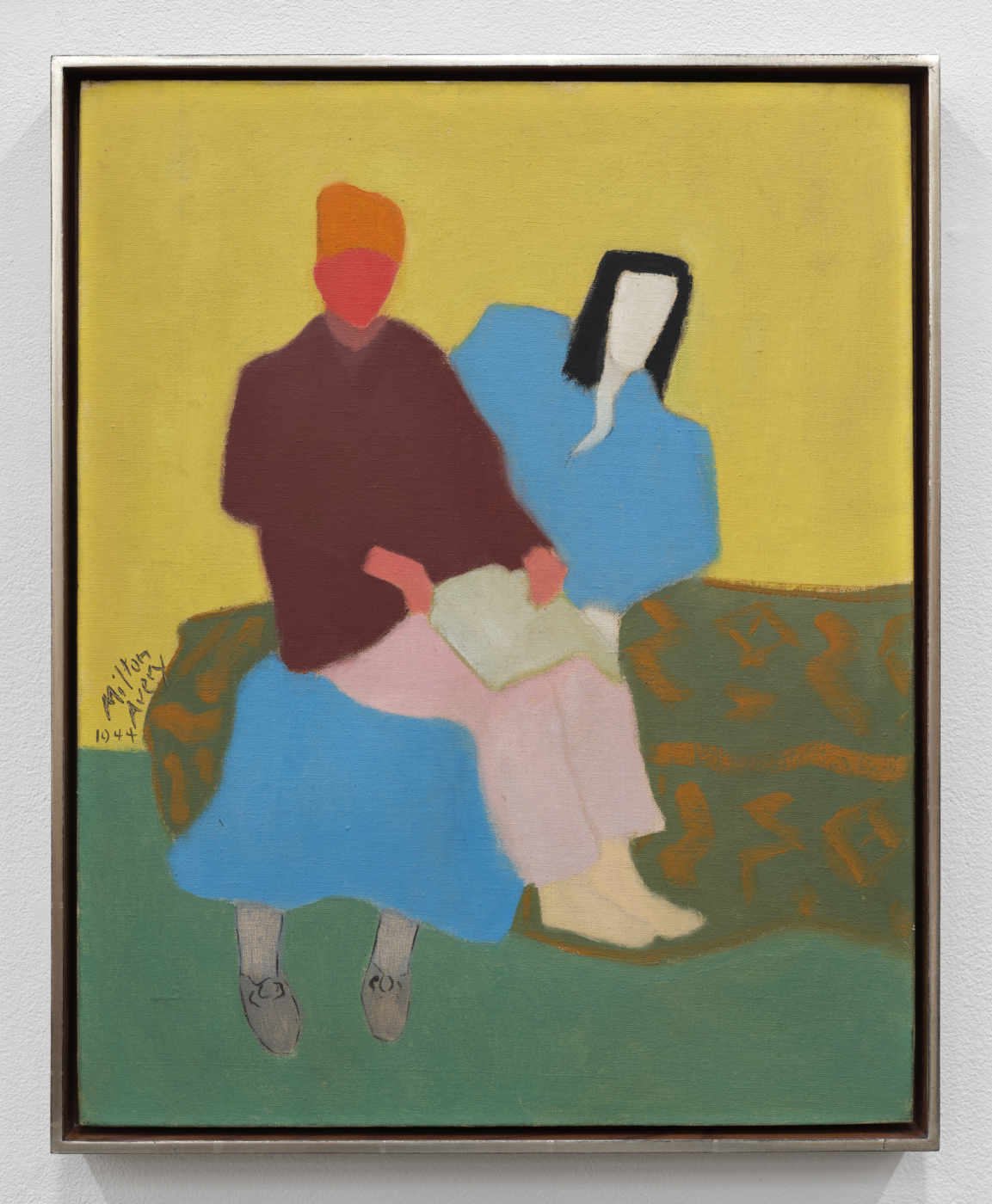
At the height of his creative career, beginning in the 1940s, Milton Avery emerged as one of the most appealing of American modernists, an artist whose singular deployment of color and form resulted in images that have elicited unalloyed delight from the casual gallery-goer and a deep appreciation for their structural integrity from crit- ics and other artists.
Avery was fifty-nine years old when he had his first solo museum show, at the Phillips Memorial Gallery in Washington, DC in 1943. By that time, his work-deeply reflective of his appreciation for Matisse, for whom color was the ne plus ultra of painterly expression-had advanced dramatically from the almost stolidly academic realism of his early years. As he wrote in the early 1950s, “I try to construct a picture in which shapes, spaces, colors form a set of unique relationships, independent of any subject matter.”
The scope of the artist’s efforts is neatly represented this fall with Milton Avery: Portraits (1927-1964) on view at Karma in New York. The gallery, which began representing the Avery estate in 2024, has worked with Avery’s grandson, artist Sean Cavanaugh, to select work from 1927, the year he first publicly exhibited in New York City, through 1964, the year he executed his final paintings (Avery died in 1965).
By the 1930s, the Connecticut-bred Avery was living in New York, where exposure to the paintings of Picasso and Matisse at such venues as the Valentine Gallery changed his understanding of representational painting and realism. While Avery did eventually arrive at a pared-back, luminous style, he never fully abandoned legible subject matter: a man getting a haircut, a woman reading, a scene from the circus.
“Artists get pigeonholed and in my grandfather’s case, people often focus on his later, more abstract work, such as the landscapes,” Cavanaugh says. “But we have other great works from his fifty-plus years of standing at the easel every day and I have been kicking around the idea of a more focused portraiture show for a few years now. We’ve really dug in and are going to be exhibiting works that have either never been on a gallery wall, or haven’t been on a gallery wall since maybe the 1930s.”
Avery died several years before Cavanaugh was born, but the latter spent a lot of time with his grandmother, artist Sally Michel Avery, who lived to be one hundred before passing away in 2003. One of his favorite pieces in the show is Avery Family, 1937- 1938. “Milton is in the corner, my grandmother is in the center and she appears to be sketching. And then there’s my mom, very young. They are probably sitting on the rocks outside of Gloucester, Massachusetts where they spent the summers. I love this painting firstly, because he put himself in there. That’s not something he did a lot. And he’s sort of in the shadows. It’s a very sweet work.”