December 10, 2025
It’s well known that in the 1930s and ’40s Milton Avery (1885–1965) befriended and influenced several younger artists—most notably Mark Rothko, Adolph Gottlieb, and Barnett Newman—who later helped define Abstract Expressionism. This historical fact has shed a sort of reflected light onto Avery’s own paintings, contributing to his common image as a kind of would-be Ab-Exer. He is often seen as an important precursor admired for his inventive color and spare forms, but never quite mustered the courage to plunge into fully nonrepresentational painting.
Considering Avery’s work aesthetically, and not merely historically, reveals the insubstantiality of that narrative. What’s more daring, after all: to fashion—as Rothko did repeatedly—monumental canvases consisting of three or four soft-edged rectangles in predictably harmonious colors, or to put an unnamable brown lump of negative space, a mountain in miniature, smack-dab in the center of a picture, as Avery did in Porch Sitters — Sally & March (1952), surrounding it with the hot-pink legs of a reclining woman? In this painting, done at the height of Avery’s powers, the lingering illusionism of the subject doesn’t detract from the brilliance of the work’s color and composition, but rather heightens it, accentuating its oddness, humor, and mysterious sense of floating permanence.
Porch Sitters is a standout of The Figure, now on view at Karma, which recently began representing the Avery estate. The exhibition’s figurative focus allows us to set aside the usual platitudes about Avery’s late, great works of the 1950s and ’60s—the much-discussed landscapes that brushed up against the work of those younger Abstract Expressionists who had by then eclipsed him in critical esteem. Instead, the fifty-some works here (oils, as well as a handful of gouaches, watercolors, and prints) show Avery responding to a different kind of challenge: fitting human bodies—awkward, organic, and iconic—into a rectangle, and telling a story in doing so.
Indeed, these figure paintings show Avery as a reflexively inventive draftsman whose interest in form and space activated, rather than restrained, his knack for astonishing color. A first gallery surveys works from the late 1920s and ’30s, a period that critics like Barbara Haskell have described as the artist’s early maturity, when he painted American subjects in a style shaped by European modernism. His thinned-out paint and non-naturalistic color led many to label him (approvingly and otherwise) an “American Fauve.” He was linked especially to Henri Matisse—though it should be noted that the Averys’ cocker spaniel was named “Picasso,” and here Untitled (Rose Portrait) (ca. 1930) betrays a clear, if passing, infatuation with the Spaniard’s Rose Period. Other influences come and go, leaving traces: the acidic, lime-green ropes in Avery’s boxing scene Untitled (Between Rounds) (n.d.) recall Ernst Ludwig Kirchner, the log-like Gaspé Fishermen (1939) evokes Marsden Hartley’s painterly musculature, and we find notes of Chaïm Soutine and Amedeo Modigliani in Mandolin Player (1931).
Yet Matisse does remain the most instructive comparison, as superficial resemblances tend to clarify more fundamental differences between the two artists. Avery’s wife, the artist Sally Michel, struck the root in a 1980 interview: “Matisse was a hedonist and Milton was an ascetic. … Milton’s nudes are the purest nudes you ever came across, where, you know, Matisse’s have an erotic quality.” Here Michel seems to allude to Avery’s insistently planar, rather than sculptural, approach to the figure. Avery’s contours don’t dance in arabesque, but meander like ladybugs. His nudes aren’t carved and caressed into the image, as you find in the swift, sturdy hand of Matisse’s charcoal drawings. Rather, they are dropped in place, like a ring in a bathtub.
Double portraits presented a unique compositional challenge that Avery seemed to relish. In Twins (1935), two indistinguishable girls in matching costumes sit in a dark room, their symmetry offset by gestural incident. Elsewhere, Avery unsettles balance through eccentric placement (Two Nudes [1939]), scale relationships both fantastical and precise (Artist and Model [1935]), and disorienting skin tones. In Pink Baby (1933), Avery paints the mother in blue-green and the crying infant in bubblegum pink, underscoring their dissimilarity as well as the moment’s unease, despite Mom’s attentive concern.
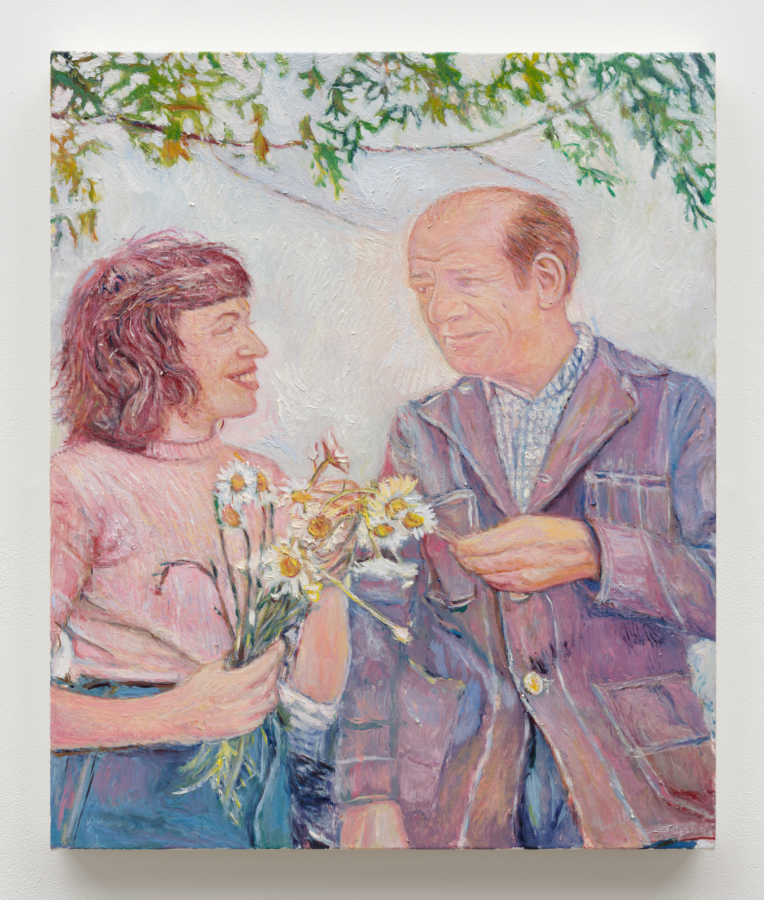
Though beach, city, and circus scenes appear, Avery’s domestic life is in especially sharp focus here, with paintings of Michel and their daughter, March. Yet even with these recurring subjects, and despite his increasingly purified style, little repeats from work to work. Late paintings are collected in a second gallery space lit partially by skylights, giving the room a burst of cool oxygen that matches the work’s own leap in chroma and light. Canvases like Morning Talk (1963) are sparer, larger, their colors lighter and airier. But if these simplifications universalize and even etherealize his figures, Avery’s enduring alertness to the idiosyncrasies of nature gives those colors and shapes an inimitable personality and an unlikely presence.