January 28, 2026
In his 1954 book The Natural House, Frank Lloyd Wright writes that form and function are mutual, not opposite, conditions: How a room is organized structures the routines and rhythms of daily life. Domestication is not a passive state but an active system. Perched on Olive Hill, overlooking East Hollywood from a landscaped rise of gardens and terraces, the famed architect’s Hollyhock House is one of his most exacting experiments in design choreography. He coined its design “California Romanza,” borrowing a musical term meaning “freedom to make one’s own form.” Clerestory windows, pergolas, and porches soften transitions and allow natural light to articulate volume. Horizontal parapets and stepped terraces frame views and produce sequences of compression and release across rooms and gardens. Pre-Columbian ornaments and decorative concrete give the earthen-tone house a monumental cast—at once intimate and imposing, lyrical and severe.
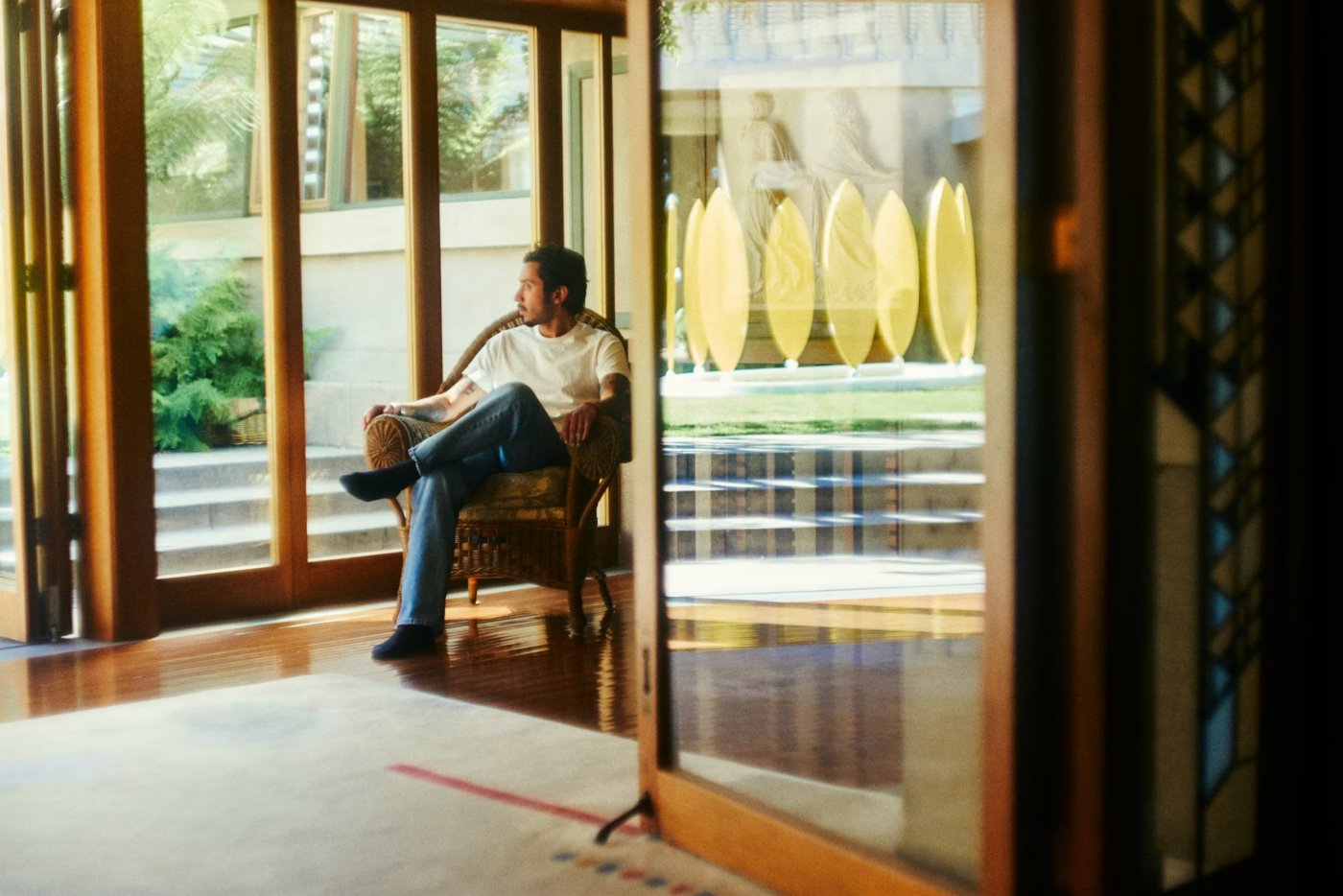
“Hollyhock is not a neutral backdrop,” says the Los Angeles-based artist and designer Ryan Preciado. “The house has its own rhythm and authority.” Installed throughout the U.N.E.S.C.O. World Heritage Site, Preciado’s exhibition “Diary of a Fly” doesn’t decorate the home so much as interrogate it. A courtyard sculpture titled Eight Different Ways, 2025, anchors the show: a ring of upright, high-gloss yellow forms mounted on a white circular base, bright and humming against the late architect’s heavy geometry. The steel and aluminum work was inspired by a construction worker in Boyle Heights who the artist watched repeatedly cut metal fencing by hand. The gesture’s power resided not in what it created, but in its duration. “It wasn’t about producing an image,” Preciado clarifies. “It was about time passing through the body.” The sculpture offers a record of labor, translated into a circular, almost ritual form, but the exhibition resists easy resolution.
Indoors, tapestries produced with craftspeople in Oaxaca contend with Wright’s abstracted hollyhock motif while subtly rerouting the house’s Mesoamerican-inflected modernism back through the hands and geographies from which it once drew. Their pliant surfaces and cyclical structure quietly disturb the building’s muscular order. “I wanted the flat work to come from the same place as the sculpture—labor, material, construction,” Preciado says. “The tapestry becomes a shadow of the sculpture, a kind of field note from memory.”
Preciado’s artistic practice teases out the tension between surface and substance, often pairing sleek finishes inspired by Southern California car culture, for example, with objects that investigate craft traditions, such as those of his own Indigenous Chumash heritage. The group of textiles, collectively titled In a Flat Field, 2025—after the English goth band Bauhaus’ 1980 album debut—translate the courtyard’s sculptural texture into a flattened register. Suspended from tension rods, they render the house’s floral emblems as color fields; they appear less as decoration than as residual impressions of movement and labor.
The exhibition is attuned to the house’s psychology—“historical, but oddly futuristic,” as Preciado puts it, and shot through with what he describes as a “time-warp quality.” Designed as a private residence for arts patron Aline Barnsdall in 1918 but never inhabited, Hollyhock’s interiors preserve domestic trappings—hearths, thresholds, built-in seating—but are absent signs of life. Familiarity shades toward the uncanny.
Minimalist music by composer and mathematician Spencer Gerhardt plays throughout the space, in loose dialogue with the exhibition’s title, which was taken from the jittery, allegro modernist composition by Béla Bartók. “Hollyhock has a way of insisting on restraint,” Preciado observes, noting that during installation he often found himself recalibrating scale and emphasis. “There were moments when aspects I thought would be assertive needed to quiet down,” he says. Where Wright imagined a domicile that would bring architecture into rhythm with daily life, Preciado seeks to expose its aesthetic rules and spatial logic through harmony and syncopation.
“It’s less about individual moments than how the work breathes as you move through it,” says Preciado. Across the exhibition, a house that was never quite a home is newly animated by signs of bodily presence. Gesture by gesture, pattern by pattern, note by note, Preciado’s intervention gives sound and shape to le quotidien, the slow discipline of everyday time. It strikes like a tuning fork, making the house newly audible and your body briefly ring.