February 3, 2026
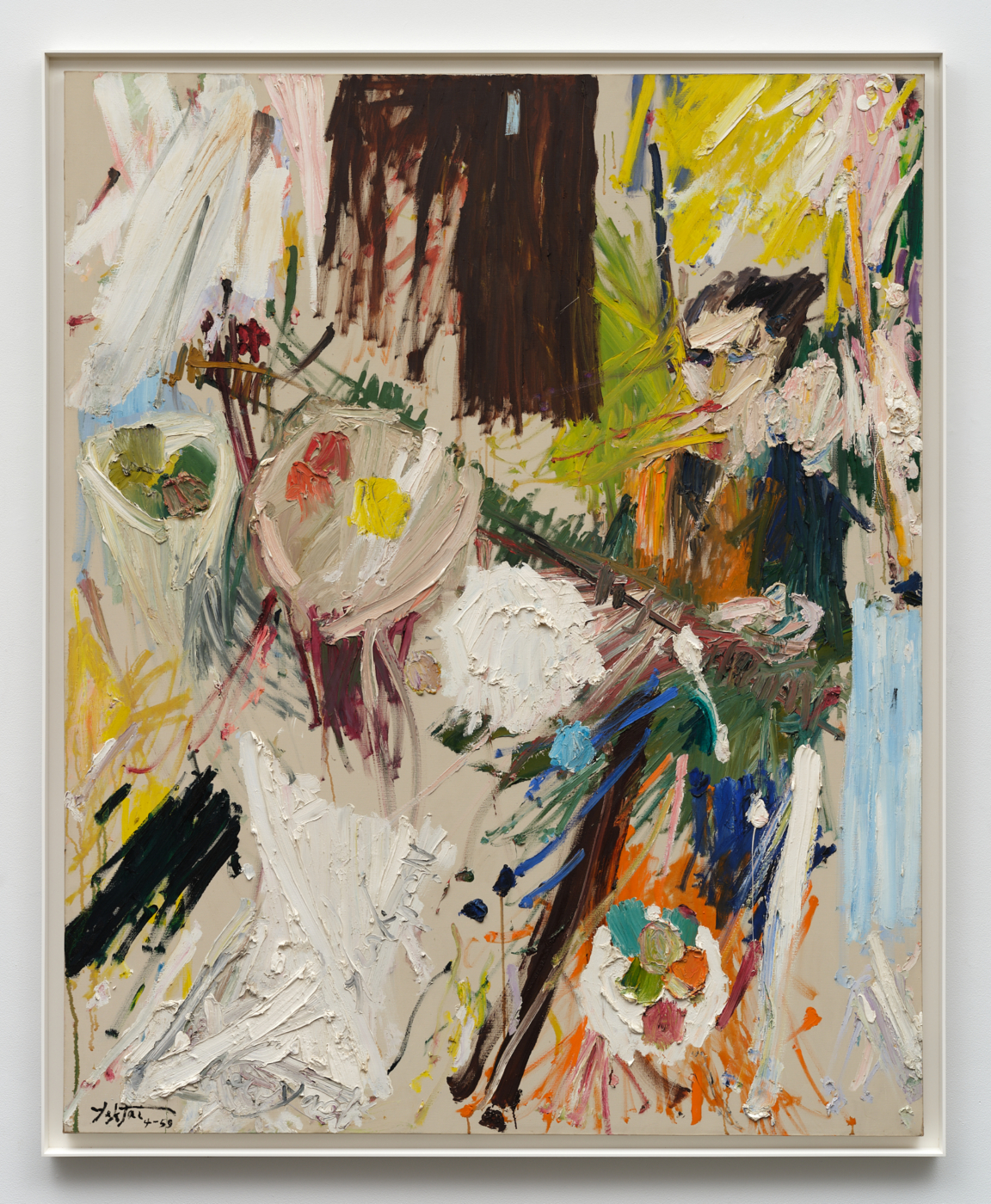
What made Paul Cézanne revolutionary, observed D.H. Lawrence in his essay “Introduction to These Paintings,” was his “intuitive awareness of touch.”1 With it, Cézanne restored the presence and substance that modernity’s strictly “mental-optical” mode of perception had drained from art.2 Upon entering Beginnings at Karma, curated by Negar Azimi, it was immediately clear that Manoucher Yektai painted with a similarly intuitive hand, intent on apprehending the world through sensation, not sight alone. Gathering works from the first two decades of his career, the exhibition traced the abundant materiality that would sustain Yektai’s practice for the rest of his life. Each lushly colored, thickly impastoed canvas invited a haptic encounter: pigment asperous and furrowed, ridged like tilled earth; then suddenly smooth as buttercream with voluptuous curls and contours that catch the overhead light. Restoring tactility to sight, the exhibition replaced intellectual parsing with sensing, reminding us of the body’s role in perception at a time when vision is increasingly mediated by the digital. Compared to the frictionless simulacrum of the screen, the density of Yektai’s surfaces felt invariably alive.
Born in Tehran in 1921, Yektai studied in Paris and New York before establishing himself amid the fervor of postwar abstraction. Often associated with Jackson Pollock and Willem de Kooning, his early encounters with Persian miniatures and Pierre Bonnard, Édouard Vuillard, and Cézanne at the École des Beaux-Arts complicate that lineage. While his gestures carry the emotive energy and spontaneity of abstract expressionism, they remain tethered to the conventions of genre–still life, landscape, and portraiture–and the perceptual discipline of European modernism. Building, literally and figuratively, upon his classical education, he piled paint onto his canvas, even as he kept one eye on his subject. That balance between attention and excess animated the earliest works in Beginnings.
On the left wall of the gallery, two gridded compositions registered the formal abstraction that surrounded Yektai upon settling in New York City. In Untitled (1950), vertical daubs of tangerine, lilac, and ochre are imperfectly divided by streaks of black. Already, the weight of his marks threatened the stability of the flat plane. Farther down, Untitled (1953-54) appears as a palette on which the artist tested the outer limits of the relationship between gesture, density, and gravity. At its center, a churn of scraped and sculpted pigment achieves a quasi-bas relief dimensionality. Textures from puckered to scooped preserve the pressure and velocity of the artist’s spatula and palette knife, rendering the act of painting and the image it yields indistinguishable. The paint, so thickly and insistently applied, becomes its own subject. Accumulated layers affirm the immediacy of matter, especially when contrasted with the illusive, pixelated photographs I’d scrolled through earlier that morning in preparation for my visit to the gallery.
Yektai moderates that intensity in Untitled (1954), concentrating color at the center of a larger canvas, more than five feet tall, surrounded by restless swipes of white, taupe, and sand. As if giving substance to space itself, creamy drags of paint both surround and support a cluster of orange and violet marks-perhaps incipient fruit, like those that would later populate his tablescapes. Beside it, another untitled work from the same year exemplifies his preference for alla prima painting, wet pigments layered in quick succession: Undulating ribbons of lavender and cerulean streak across slabs of white, while floral whirls of pastel pink and orange are limned with adjacent shades of marigold and chartreuse. The startling pictorial depth dares viewers to reach out, run their fingers across the viscous topography of color.
In the adjoining gallery, gestures began to solidify as shapes. The impasto that once overwhelmed form now lent it weight. In these early still lifes, Yektai doesn’t depict fruit, flower vases, and cigar cases so much as reconstitute them. Congealed daubs of oil lend a lemon its roundness, a wine bottle its volume. What distinguishes Yektai from his abstract expressionist peers is his fidelity to the physical world. Rather than striving for the sublime, he reproduced what he could grasp, feel, see. In this way, paint was both medium and message, a theory and its proof. “I’m searching for a firm truth, one that fulfills my own expectations,” Yektai said in a 1976 interview, adding that he sought to imbue his work with that truth “that is hard to shake.”3 He found it in the irrefutable thereness of the tangible, conveyed through the viscosity of oil paint, where touch, sight, and shape are indivisible. How prescient this insistence on authenticity seems amidst the widespread manipulation of our “mental-optical” attentions through misinformation and highly persuasive synthetic media.
Having proven that paint could stand for the inanimate, Yektai tried to translate life. A row of five paintings captured the vitality of the artist’s garden, in particular his tomato plants. Propulsive vertical lines and tangled ropes of pigment in Untitled (1964) replicate the fecundity of the natural world. His answer to the problem of expressing life’s motion and mutability in a static medium is to collapse time: folding growth and decay, the gradual flux of change, into a single frame. Here, furrowed tracts of green, from emerald to pea, crisscross an umber stem, their ends splayed in every direction; scattered red, white, and teal orbs protrude from the canvas. Recalling Cézanne’s pledge to amaze Paris with an apple,4 Yektai once told his friend Larry Rivers, “I want to paint an apple until it flies!”5 The declaration underscored his intention to push the inanimate apple, or tomato, beyond representation into ecstatic aliveness.
Lawrence’s call for a return to the “intuitive aware- ness of touch” and physical presence feels newly urgent as more of our world turns virtual.6 Against this spectral digital realm, the sensuous materiality of Yektai’s canvases reasserts the messy, frenzied, delicious, and demanding reality of three-dimensional life. Their visceral tactility resists the flat, frictionless logic of the screen and posits seeing as something enacted through the body. Each drag and ridge of pigment restores a sense of contact-between vision and substance, between us and the world. For Yektai, this contact was a kind of revelation: To attend to the vitality of matter is to recognize the vitality within ourselves.
- D. H. Lawrence, “Introduction to These Paintings” (1929), Phoenix: The Posthumous Papers of D. H. Lawrence, ed. Edward D. McDonald (Heinemann, 1936), p. 556.
- Lawrence, “Introduction to These Paintings,” p. 556.
- “That Lyricism Called Painting: Aydin Aghdashloo interviews Manoucher Yektai,” Rastakhiz, 1976; reprinted in Herfe-Honarmand 15 (Spring 2006): 131-37, trans. Media Farzin.
- Philadelphia Museum of Art, Cézanne, May 30-Aug. 18, 1996, exhibition catalogue (New York: Harry F. Abrams, 1996), 383.
- Negar Azimi, curatorial statement for Perfect Strangers: Leyly Matine-Daftary and Manoucher Yektai, Dastan Gallery at Frieze’s No.9 Cork Street, London (2024); Lawrence, “Introduction,” p. 556.
- Lawrence, “Introduction,” p. 556.