April 2026
Scottish artist William Turnbull (b. 1922, d. 2012) was the right man born at the wrong place in the right moment. A pilot during World War II and later expatriate in Paris, he remained an art-historical odd man out, despite his friendship with fellow Scot Eduardo Paolozzi (1924–2005) and membership in the avant-garde, postwar, British collective the Independent Group. In his time, Turnbull never suffered from neglect: in 1952, he was included in the Young Sculptors show at the London Institute of Contemporary Art along with Kenneth Armitage and Paolozzi. In 1973, he had a retrospective at the Tate. So why don’t we know more about him?
There is no simple answer, but Karma has taken a giant step in resuscitating his name with Origins (1946–1959), an extensive yet tightly focused exhibition. These forty-two works show the first decades of a nearly sixty-year career. Two keys to understanding Turnbull’s work: one is his experience as a World War II fighter pilot who was able to see the world, including India and Sri Lanka, from both land and air (still a novel experience for people of his generation); the second is his abandonment of the conservatively-minded Slade School in London, whose insistence on figurative art he found restricting. He moved to Paris in 1948 and befriended Alberto Giacometti (1901–66). The complex, incised surfaces of Indian sculpture resonated with Turnbull, while Giacometti provided liberation from British artistic constraints and a direct communication with the postwar phase of European modernism.
Turnbull would require yet another liberation, this time from interpretation. Existentialist exegeses proffered by Jean-Paul Sartre, in his 1948 essay on Giacometti, and the 1952 “Geometry of Fear” assessment of the British artists by Herbert Read—Turnbull among them—at the Venice Biennale of 1952 defined Giacometti and Turnbull’s work as reactions to the despair prevailing after World War II. Giacometti’s skeletal figures or Turnbull’s spiky Torque Upwards (1949) supposedly embody this moral collapse, and the realization that there was no response possible to the Holocaust but anguish. Fortunately, Turnbull had an ace in the hole: an ability to move fluidly between two- and three-dimensional work.
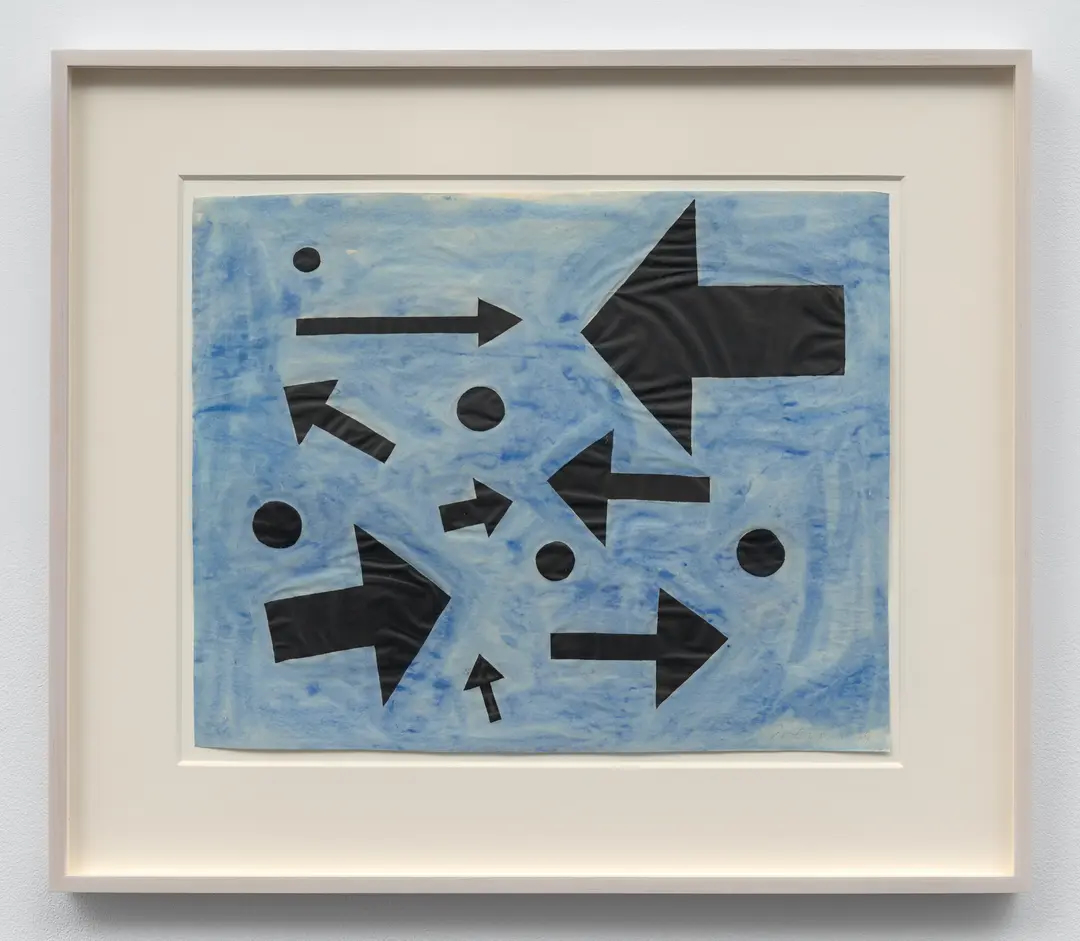
Four wall pieces, all from 1949, show Turnbull creating his own painterly idiom. The influence of Joan Miró and Paul Klee is evident in all four pieces, and like them, Turnbull is open to whimsy: Aquarium is the title he gave to all four, though one is a pastel on paper and three are collages. Turnbull “floats” biomorphic shapes (jellyfish) and geometric figures (arrows) in fields of color, as if the water were a matrix in which his imagination could play and defuse the portentousness of the sculpture. In fact, however, a bronze casting also from 1949 is titled Playground (Game)—a flat field with abstract players deployed on its surface, an indication that even his sculpture was by then escaping angst.
His superb paintings of the 1950s are minimalist explorations of color. 29-1958 (1958) is a 60-inch square oil-on-canvas, a monochrome work reminiscent of Robert Ryman, with the textured paint creating three-dimensional effects on the surface. Untitled (Green/Blue/Dk Blue) (1957) restates its title in paint, its dark heart framed in green, looking like the best of Minimalism. Turnbull moves even further away from the existentialist sorrow of the 1940s in 03-1959 (1959), a pure painting that shows he could easily have abandoned sculpture completely and followed the path taken by friends like Mark Rothko and Barnett Newman.
That metamorphosis did not take place. Even as he made outstanding paintings during the 1950s, Turnbull continued to produce sculpture incorporating his memories of other cultures, especially India and Sri Lanka, with runic overtones. To enter the vast viewing area on the east side of Karma is to enter a space charged with spiritual energy. War Goddess (1956), a human-scale bronze casting, simply stops viewers in their tracks. The hieratic presence of this terrifying goddess—whoever she is—takes us back to the idea of the sculptor as shaman, a bridge between mortal reality and other realms. The same effect prevails in Source (1958), but on an even more enigmatic level. The bronze and stone piece, roughly arrow-shaped, is pierced by holes that simultaneously trace its overall shape and impose a cruciform pattern on it. Its narrowness signals its lethal nature: a source, like the female body, is both an origin and an endpoint. As this and other works on view demonstrate, Turnbull’s career took many twists and turns, but as painter and sculptor he belongs among the great artists of the twentieth century. This astonishing show confirms it.