May 7, 2026
View on T: The New York Times Style Magazine
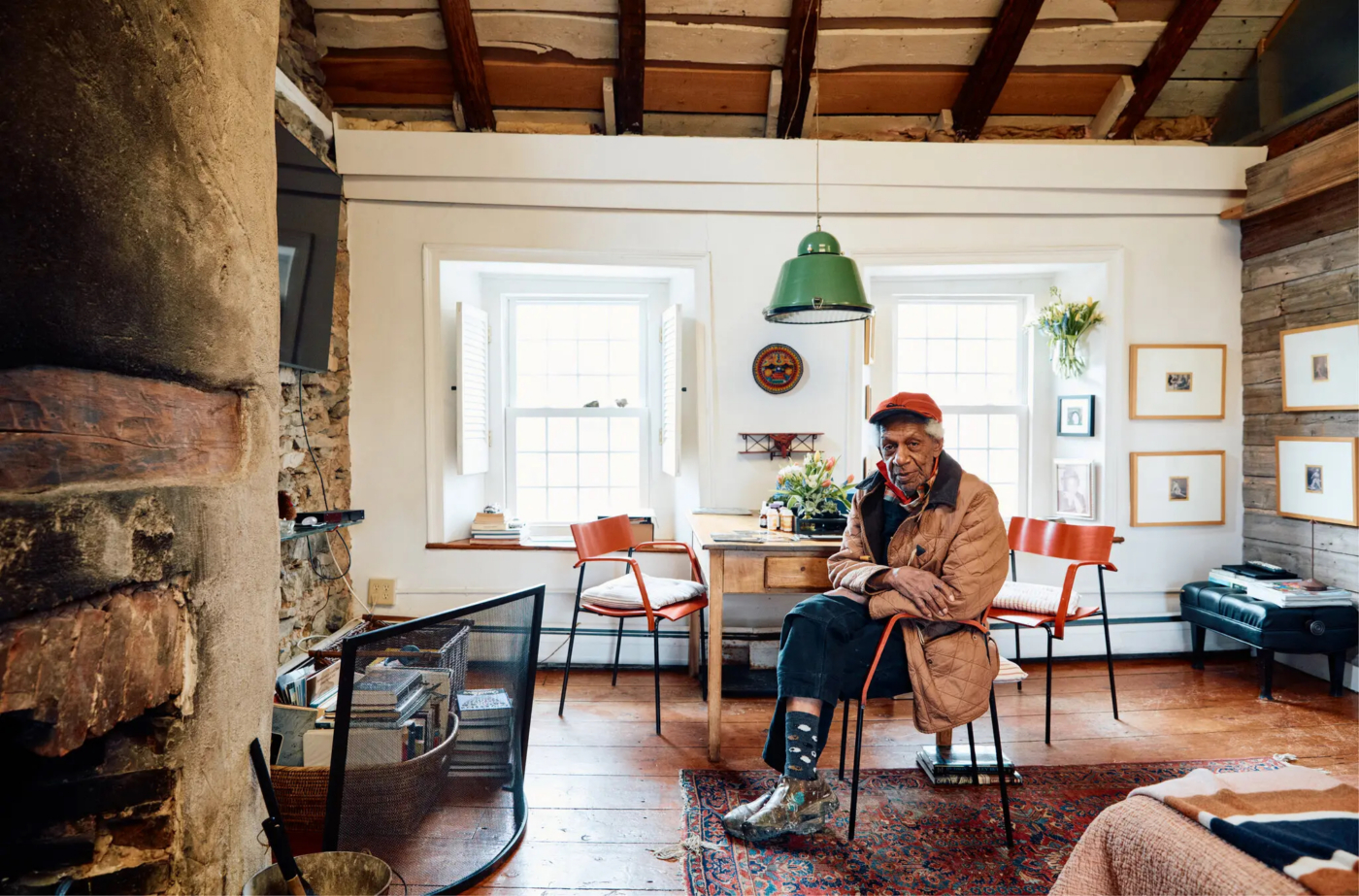
SOMETIME IN THE late 1980s, the artist Peter Bradley was driving around upstate New York. As he remembers it, he was with his friend the musician Eleana Tee Cobb, whom he’d met years prior through Miles Davis. At one point, they passed an abandoned stone house, and Bradley felt compelled to go inside. After speaking with the owner, who lived on the farm up the road and was surprised by his interest — the house had no running water, heat or electricity and needed huge amounts of work besides — he started renting the property with a view to buying it, which he and his wife, Debra Roskowski-Bradley, now 69, did in 1997. Another friend, the jazz drummer Art Blakey, would ask him, “Who the hell wants a gray house?” Bradley recalls, but at 85, he still lives there with Roskowski-Bradley, a retired fashion designer.
A simple Georgian design with two bedrooms, rows of sash windows on the front and a side-gabled roof, the roughly 3,000-square-foot, two-story structure was built for a Dutch family in the mid-18th century. It’s in the town of Saugerties, west of the Hudson River and east of the Catskill Mountains. This promised a very different sort of existence from the one Bradley knew in Manhattan, where he’d arrived in 1960 from Detroit. When a job installing art at the Guggenheim Museum led to one selling it at Perls Galleries, which specialized in works by Pablo Picasso, Fernand Léger and Georges Braque — “better than Picasso,” who had a “big mouth,” says Bradley — he became one of the city’s first Black art dealers. In 1971, with the backing of the collectors John and Dominique de Menil, he curated “The De Luxe Show” at a defunct movie theater in Houston’s Fifth Ward. It featured work by Black abstract artists, including Bradley himself, alongside that of their white peers and was among the first racially integrated exhibitions in the United States. Bradley was part of the second wave of color field painters, who believed that, as the art world increasingly privileged figurative and representational art, color alone could reflect and elicit emotion. Early works of his appeared in a 1968 group show at MoMA and the 1973 Whitney Biennial, and he had multiple solo shows at André Emmerich Gallery.
He navigated New York’s art scene at a time when it was deeply segregated, experiencing both racism — when he did “The De Luxe Show,” someone started a rumor that he was going to steal the artists’ works — and financial instability. In 1989, after a long legal battle, he was evicted from the former firehouse in Chinatown he shared with his then-wife, the artist Suzanne McClelland, and their young daughter, Garrett Bradley, now a filmmaker based in New Orleans. The Saugerties house, then, wasn’t merely a place to stay; as Garrett puts it, “It was a restarting.”
Bradley dug a well, replaced windows and ripped out most of the floor between the second story and the attic, which had become a haven for critters. (For a while, he lived with a baby raccoon, who’d do acrobatics for the neighbors’ kids.) The artist respected the house’s past — he believes, given the history of infrastructure in the region and the fact that slavery wasn’t abolished in New York until 1827, it was built by enslaved people — but wasn’t afraid to overwrite the architecture in places. With the help of two friends, he cut through a two-foot-thick exterior wall to connect the cellar kitchen to a grotto that functioned as a cistern. He wanted to turn the space into a cigar lounge, but it kept filling with water, so he left it as an indoor pond. He also built a greenhouse on the ground floor and planted a tulip garden in the front yard.
To boost natural light in the house, Bradley installed skylights in the roof and metal grates in the floors — the wrought-iron ones in the sitting room previously encased tree trunks on sidewalks in Greenwich Village. Throughout, the home’s raw, rustic quality has been blended with the similarly raw but more industrial spirit of an artist’s loft: In the kitchen, exposed beams run parallel to a five-foot-wide fireplace, and rectangular floodlights shine on stainless-steel countertops procured from restaurant depots on the Bowery.
In the living room, in addition to a refurbished Bastiano sofa covered in teal wool velour and a pink-and-green painting by Bradley, there’s a black-and-white photograph of light on water by his old friend Adger Cowans, who used to work at Life magazine with Gordon Parks. On the other side of the room is a lithograph of a sun with a face by Alexander Calder, whose work Bradley sold at Perls — “To Peter Bradley” is written in faded pencil at the bottom — and an elephant skull Bradley got in South Africa, where he traveled in the mid-1980s to help establish the Thupelo Workshop, which sought to provide a space for artists during apartheid. There’s also a West African mask Bradley bought from Merton Simpson, a fellow artist and uptown dealer who specialized in tribal art.
On the second floor are several objects from earlier chapters of Bradley’s history. While reinforcing the fireplace in the main bedroom, he pressed an ebony airplane model he’d had since childhood into the wet cement. He’s long been fascinated by planes and rocket ships, and it’s not lost on him that his paintings, which he makes on the floor and which are characterized by billowed pools and raised ridges of pigment, have the look of mysterious worlds viewed from above.
BORN IN 1940 and adopted by a woman named Edith Ramsey Strange, Bradley grew up in Connellsville, Pa. His mother earned money by doing laundry, taking in foster children (about 30 in total) and renting rooms to traveling musicians. That’s how Bradley met Davis (whom Bradley’s uncle once insinuated may have been his biological father), as well as other jazz legends, including Clifford Brown, Erroll Garner, Dizzy Gillespie and Blakey, whom Bradley would go on tour with as a manager in the ’80s.
After high school, Bradley went to Detroit and hung out with musicians: When he married his first wife, Grace Burney, he says, Aretha Franklin sang at their wedding. He studied for a few years at what was then known as the Detroit Society of Arts and Crafts before boarding a bus to New York, where his first job was in a frame shop. In 1966, he enrolled at the Yale School of Art, but he dropped out two years later. He’d clashed with his professors and felt reduced to his identity, from which he wanted his work to stand apart.
In New York, he had a lively social circle that included the artists William T. Williams (they shared a studio in a building on Broadway), Joel Shapiro (who lived upstairs), Kenneth Noland (one floor down) and Larry Poons (whom Bradley affectionately calls Looney Tuney). “His environment and social life are such a big part of who he was and a part of his practice, in a certain way,” says Garrett. She remembers there always being a lot of people around at the firehouse, and at the stone house, too: “They’d sit around and drink beer and paint. That was the process.”
In 2021, after decades of working in relative obscurity, Bradley signed with New York’s Karma gallery, which in July will mount a survey of his paintings dating to the ’70s. This fall, he’ll be in a group show at MoMA PS1 called “Hard Art,” a term he coined to describe the works in “The De Luxe Show,” by which he meant art that required serious engagement and was “free of obstruction.”
Nowadays, there are fewer artists and musicians passing through, but Bradley continues to look after the plants and to paint. “I stayed with the art every day of my life,” he says. On a chilly afternoon in March, the artist, who was dressed in overalls, a flannel jacket and a wool cap with flaps, sat feeding the wood-burning stove in the sitting room. Then he made his way to his studio, a newly constructed barnlike building located about 40 yards from the house, past a small forest of bamboo. Outside were a few of his sculptures, assemblages of steel pieces in different shapes; inside were stacks and racks of painted canvases. “Very hip,” he deemed one with a textured pink surface, and opined on what he viewed as the strongest parts of a new work — black splashed over yellow — that he wanted to crop. As if for inspiration, he selected a recording of Derek and the Dominos jamming with Duane Allman to play through the vintage speakers standing on the floor. Bradley likes to listen to music while he works, letting the sound guide his color choices and movements. “He’s going to stay forever” at this house, says Garrett, “even once he leaves this dimension.”