Summer 2026
“He has always gone his own way, and it is a way with a sturdy New England quality.” This verdict on Milton Avery, voiced by critic Adelyn Breeskinin 1960, strikes at the artist’s paradoxical singularity: Both in his lifetime and in the decades since, he has been viewed as a maverick who skirted the boundaries of the avant garde but whose work was the epitome of a certain restrained Americanism.
“Milton Avery: The Figure,” originally staged at Karma’s New York gallery in late 2025, was the first exhibition to concentrate exclusively on the artist’s figurative work. Setting aside the mythical, semiabstract landscapes with which he is habitually associated, the focus on portraits and bodies proved revelatory. A cluster of portraits in the first gallery, dating from the early 1920s to the years preceding his death in 1965, almost might have been by multiple artists—their one unifying feature being that they all portrayed Avery himself. If the shock-haired apparition in Avery Feeling Wild, 1963, recalls the scribbly infantilism of late Picasso, then Reflected Artist, 1927, might as easily pass for a Walter Sickert. Here, the artist captures himself with a muffled naturalism—glimpsed in a mirror, his visage is effaced by russet shadow while vases of flowers compete with his head for attention.
These portraits reflect Avery’s gradual movement away from the realist influence of his training in Connecticut toward that of European modernists. He arrived in New York in 1925, aged forty, having spent his earlier years working night shifts in factories so that he could study art by day. Around this time, he determined that mixing more than three colors together would obscure their clarity. In the ’30s, he became friends with Adolph Gottlieb, Barnett Newman, and Mark Rothko, among others, and these various alliances gave rise to a growing plurality of style. The exhibition’s focus on portraiture was a salient reminder, however, that Avery’s art was always a reflection of inchoate life rather than an expression of artistic allegiance—the product of a self rather than of a school. Repeatedly, his paintings and drawings bear witness to the cast of characters who passed through his and his wife Sally’s home, and the close-knit family unit that expanded to include their daughter, March, in 1932.
Avery was revealed, by degrees, as a sort of modernist Watteau—the frolicsome overtone of various works (notably those featuring performers, such as Mandolin Player, 1931) offset by a fainter melancholy. Untitled (Rose Portrait), ca. 1930, a vision in dusky pink of a woman resting her head on a bulbous hand, once again echoes Picasso—but the turquoise crescents that fill the whites of her eyes undercut the resemblance, introducing a welling sense of strangeness. Images of the family on holiday, such as in Children at Seaside, 1935, and Avery Family, 1937–38, seem to have been cast in a subdued, faintly sepulchral light.
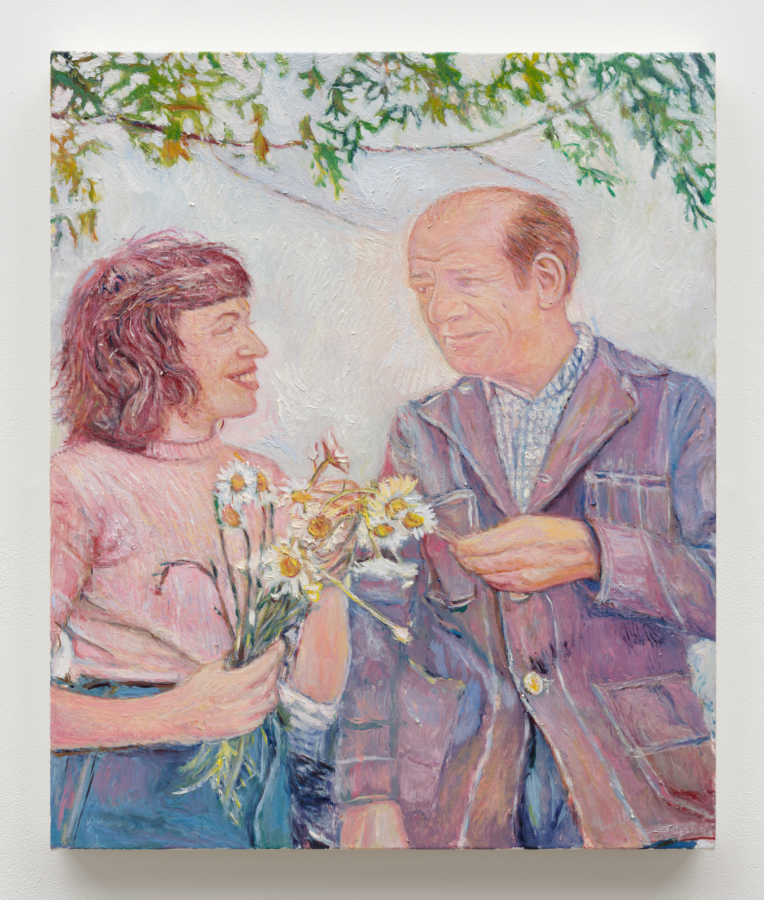
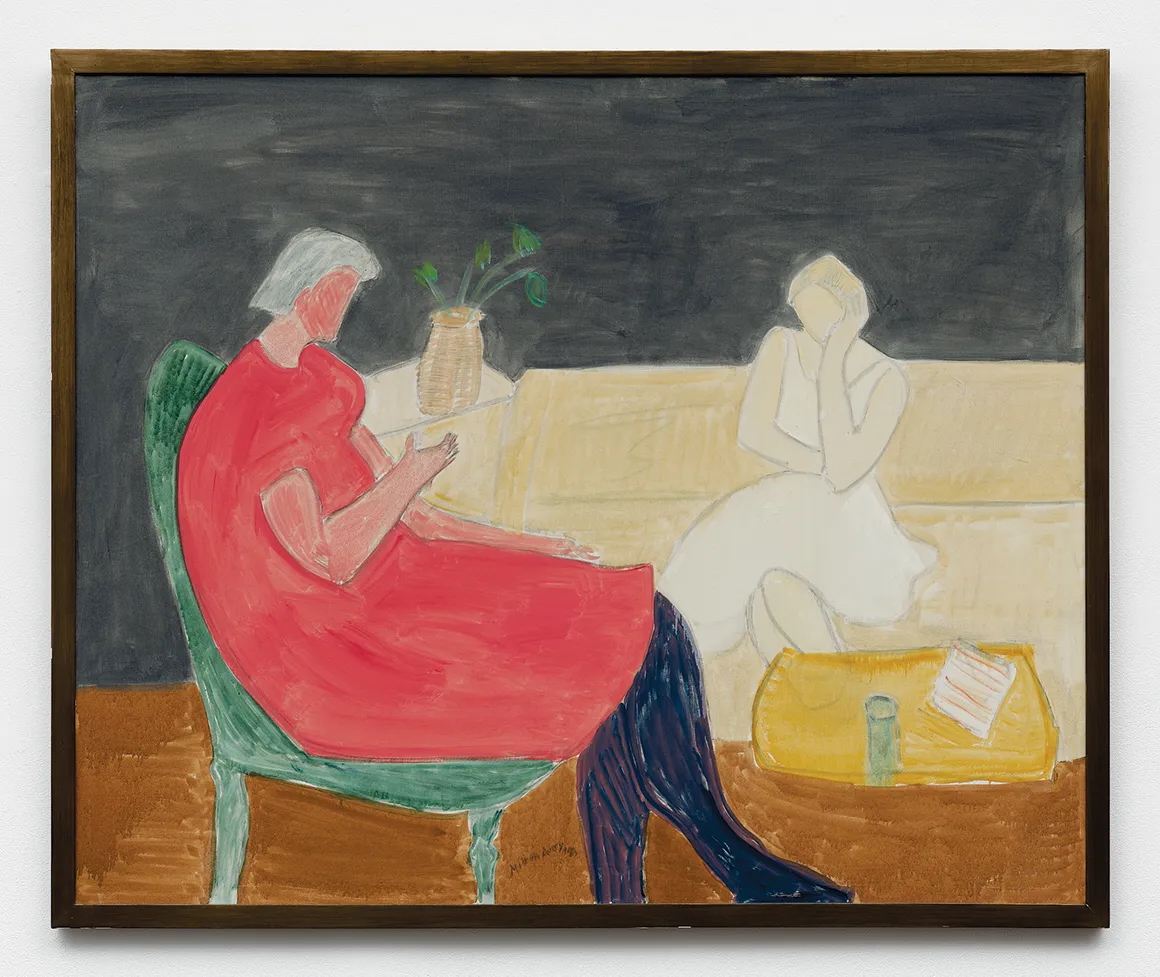
In the second gallery, four canvases from the ’40s evinced a continued interest in performers and a persisting oscillation between naive styles and a sleeker, sharper mode of figuration. Fencer, 1940, a depiction of a muscular sparring athlete, might be regarded as the crux between the somberness of the ’30s and the comparative serenity of the seated and reclining figures that would come later. These works, composed from segments of uniform tone, dominated the space. The relatively large-scale Morning Talk, 1963, a portrait of Sally and March, appears devoid of the grit or covert abjection of earlier character studies, but it would be a mistake to write it off as anodyne. A subdued tension, discernible in the skittish movement between schematic and individualized expressions, endures.
Alternating between eclectic clusters and time-specific sequences, “The Figure” was an elegant rebuttal of any easy notion of “artistic development.” Even in hindsight, it is hard to establish a consistent thread through Avery’s work, akin to the trajectories of other modernists (those many artists he invokes while never quite resembling). His shifts and starts were always unpredictable, perhaps even to him, and his polymorphic figures were a mirror image of his own constantly shifting identity.