Summer 2026
Any show at Frank Lloyd Wright’s Hollyhock House starts out with the deck stacked in its favor. Walking through Wright’s Gesamtkunstwerk—with its long, low-slung lines, sculptural massing, and patterns of light and shadow that prime our receptivity to flashes of the sublime—puts a person in an enchanted state of mind. Titled after the 1939 musical composition by Béla Bartók, Ryan Preciado’s “Diary of a Fly” trained our attention on small domestic moments, charting a peekaboo course through nearly every room as the artist’s chairs, cabinetry, sculpture, and textiles popped up in corners and hid in plain sight.
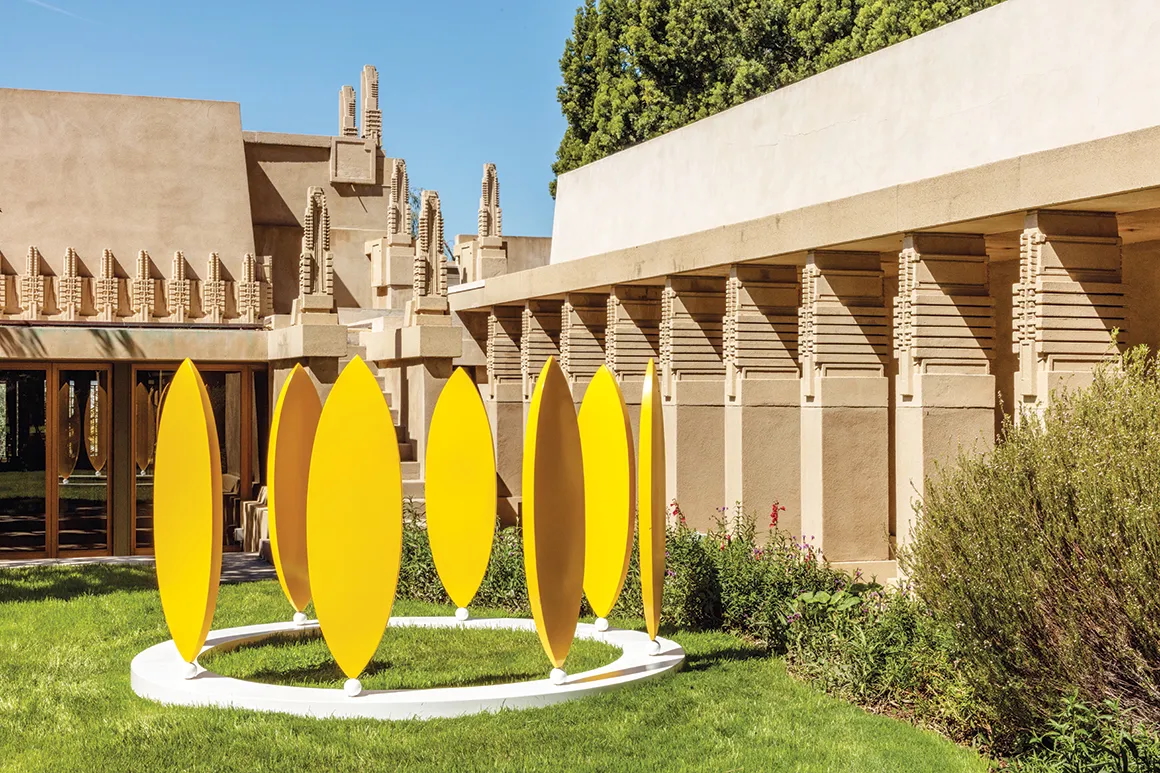
Marrying Memphis-adjacent furniture to sculpture of the Minimalist and postmodernist persuasions, Preciado’s works inhabited the architecture with an easy elegance that also acknowledged the economic demand that contemporary art and design perform as staging for high-end real estate. His approach to object making is built around social narratives, handmade elements, and bodily interaction, as was self-evident in pieces of furniture and more obliquely present in the nonfunctional sculptures on view. For example, Eight Different Ways, 2025, was off to one side of the central courtyard garden and visible from several rooms as the exhibition’s central cog: a circle of eight oblong leaf shapes formed of metal, finished with yellow automotive paint, and standing nine feet tall, with each part angled toward the center as though playing ring-around-the-rosy. The work’s tapered mandorla shape is a motif that recurs elsewhere in the artist’s practice and was inspired by the slashes cut in privacy mesh around construction sites, specifically one such screen Preciado observed being incised near Mariachi Plaza in Los Angeles that reminded him of Lucio Fontana’s slits. A lot of design ideas come from driving his truck around the city, between studio, woodshop, and auto-body shop.
The leaf/slit shape of the outdoor sculpture recurred in other works, rounded and softened into a wobbly egg shape in five large tapestries and rugs installed in the living room, library, child’s playroom, and dining room. As a group, the textiles (a commission executed by the Hernandez family of master weavers from Oaxaca, Mexico) were titled “In the Flat Field” (after the album by the band Bauhaus, which soundtracked the production of this show) and featured varying configurations of one or many teardrops whose abstraction could read as holes or bodies, like Matisse’s goldfish. Beaudry Avenue Daybed, 2024, in the house’s former child’s bedroom, was its own fuchsia and midnight-blue architecture for housing a body in repose, with rows of square windows punched through the walls in the vein of Michael Graves or Ricardo Legorreta. Oceano Cabinet, 2023, in the music room, was a tall, house-shaped maple cabinet with a pediment, a pedestal, a double-door facade with a cutout handle, and a peaked roof at human height that suggested a sarcophagus.
Preciado often calls his works “insecure sculptures,” identifying with their personification “because they feel like sculptures that have to prove themselves. They have to be useful, which is a human feeling.” More than a universal impulse to be of use, the attitude is an outgrowth of his working-class roots. Training first as a carpenter and entering aesthetics through manual labor have informed the way he thinks about functional objects as art objects—finding great beauty and emotional charge in utility. Condensing a microcosm of observed urban detail, childhood associations, collaborative friendships, historical design nods, attention to sensuous surfaces, and love of facture, he makes objects as dense as diamonds. Preciado’s interest in Wright’s creations runs deep, past Wright himself to land on Manuel Sandoval, the Nicaraguan American carpenter who worked with Alvin Lustig, Rudolph Schindler, and Wright to collaborate on and craft their designs for furniture and interiors. When Preciado had his first solo institutional show at California’s Palm Springs Art Museum in 2024, he presented objects by Sandoval alongside his own wood sculptures and furniture. In his predecessor’s lineage, Preciado stakes his position on the conviction that austere and solid craftsmanship, the best that can be done with one’s hands, radiates all the love hours put into a thing. Such radiation can be infectious.