July 2, 2026
“Do you know there are good witches and there are bad witches?” the Chicago-based painter Gertrude Abercrombie once asked a boy in the street. “I am a good witch.”
Since her revival eight years ago at the Karma gallery in Manhattan, Abercrombie (1909-77) has gained an overdue reputation as a supernatural miniaturist whose “Twilight Zone”-ian landscapes and improbable interiors skirted classical Surrealism. With wry bleakness she dragged the unease of wartime well into the decades of American prosperity.
Two shows at the Milwaukee Museum of Art embrace her in all her enchanting eccentricity.
The main show, “Gertrude Abercrombie: The Whole World is a Mystery,” is a very worthy, record-straightening retrospective that proves how well this American outsider can complement the extremes of modern art in national museums: the urbane and the regional. The show, nearly 80 pieces, mainly small works painted on board, was organized by the Carnegie Museum of Art in Pittsburgh and Colby College Museum of Art in Maine.
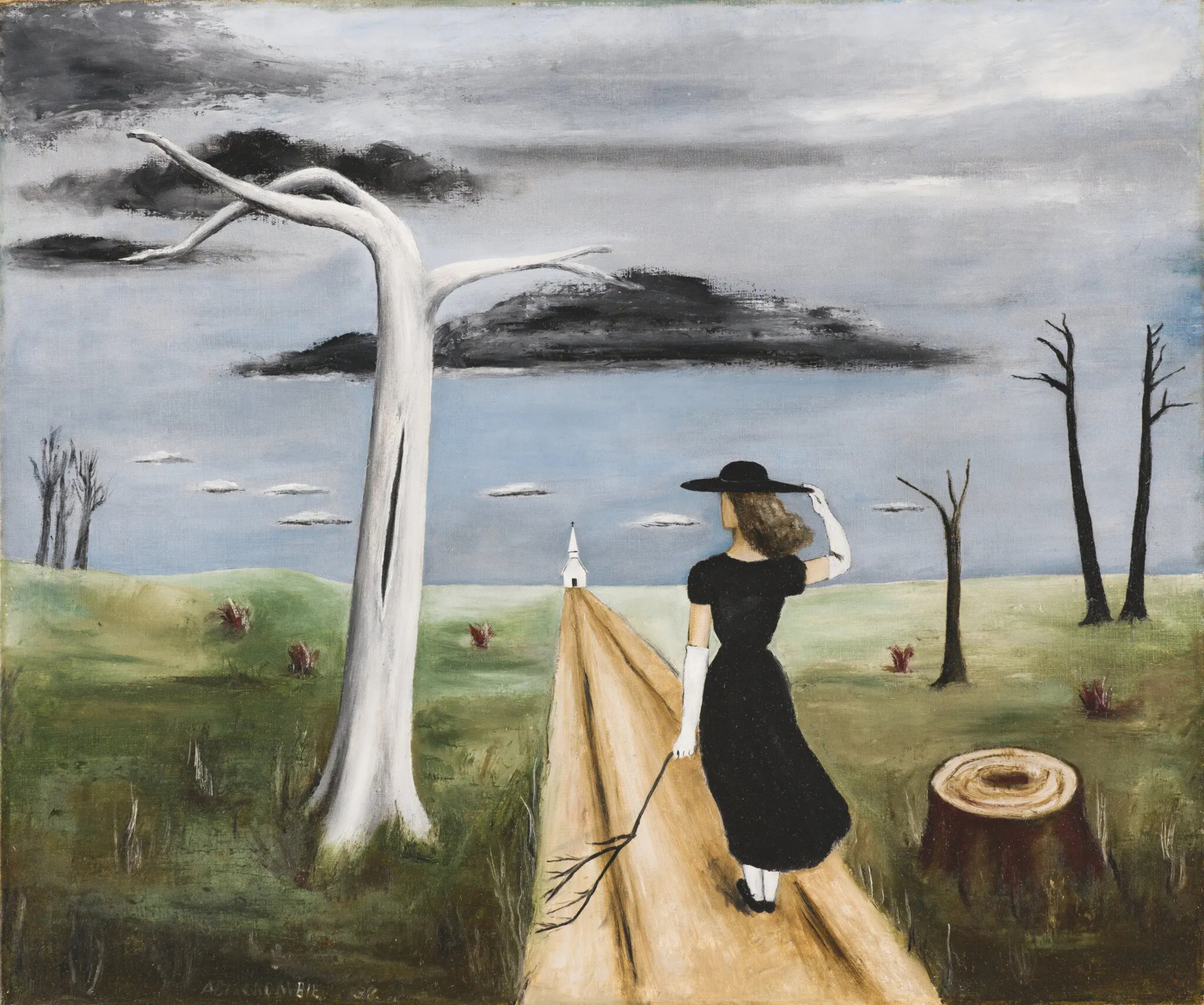
It is roughly chronological. Early landscape-purgatories like “The Church” (1938), with its ruined trees, Dalí-like skies and wandering figures recalling Henri Rousseau’s, were done while she was an easel painter for the Works Progress Administration, the federal program that kept artists employed during the Depression — amazingly, given the studious strangeness she was developing.
By the 1950s, a hypnotic series depicting doors explains how she matured from loose landscapes to smaller scenes that are flat and graphically detailed, with slightly altered proportions lending an overall unease.
In postcard-size paintings on Masonite, the panes of her painted doors are precisely beveled but jarring in their discordant heights and widths — four, five and six doors crammed up against each other into walls that seem to mock the urge to travel. Among them roam black cats, of which the artist kept several and often painted. This is the show’s best section.
As her countrymen stretched bigger canvases, Abercrombie sized down. Several tiny wearable still lifes she sold to bookstores or from the trunk of her Rolls-Royce. The Rolls was beat up. Abercrombie, the child of traveling opera singers based mainly in rural Illinois, struggled with money and sold her work modestly. With a degree in romance languages from the University of Illinois at Urbana-Champaign, she did have some training in figure drawing, at the School of the Art Institute of Chicago.
There are also two shadowboxes here which she outfitted with props and their painted doubles. They play a little like Joseph Cornell’s but are softer and more concerned with the trippiness of reproducing things by brush.
“Gertrude Stein was the one who told me not to be sloppy in my painting,” Abercrombie said in a 1972 interview with a Chicago journalist. “She told me I must learn to draw neatly and draw well.” Stein, the writer who practiced a voice of repetition and American bluntness to the point of near obscurity in her books, had come to Chicago in 1935 to deliver lectures about narration at the request of Thornton Wilder, one of Abercrombie’s friends in the literary scene.
Stein might have approved of her neat “Hand and Tent” (1949), a landscape with a large severed hand clutching some kind of wand or stick in the foreground. Behind it is a tent, with the silhouette of another hand (open this time) on its flap. Plato’s cave? A shadow puppet?
Or Giorgio de Chirico? The pennant on the tent could well have come from his lexicon. Abercrombie seems always to allude to her European forebears, especially the Surrealists, but she also seems wary of their complexes, their baggage and wordplay. Although she admitted late in life that her “spiritual daddy” was René Magritte, she claimed to have discovered him only in the 1950s: “Never had seen him.” (On canvas, maybe. In reproduction, I doubt that.)
The many dominoes, dice, jacks, eggs, snail shells, skeleton keys and lovely, pinned-up ponytails of hair in the Milwaukee show, some in near-classical still lifes such as “Coffee Mill” (1964), seem to lie in conscious wait, as if Abercrombie sees in the inanimate world some force of will that her listless human subjects do not share.
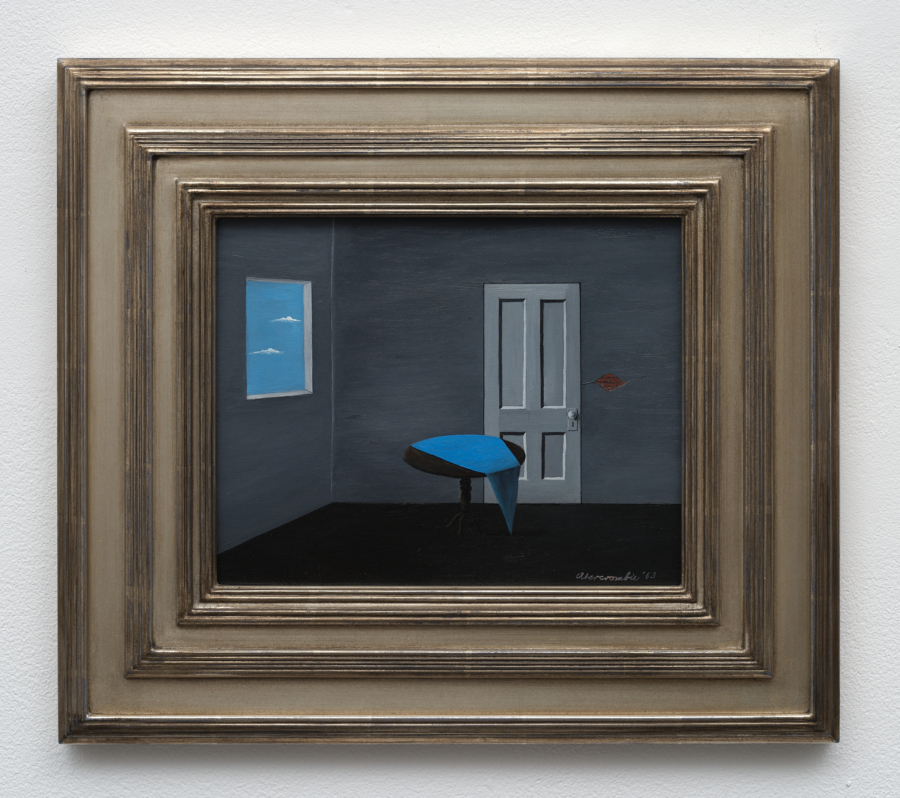
Dream logic and the occult — as in the deadpan séance “Where or When (Things Past)” (1948) — show up in the paintings not to help her escape the real world, but to heighten its impregnable weirdness. For a cold dunk into that everyday weirdness, try the claustrophobic “Past and the Present” (circa 1948), an interior scene.
Personal symbols in the paintings — marriages, a daughter whom she held at an emotional remove, past choices and regrets — are unpacked in eager wall text by the curators, Eric Crosby of the Carnegie Museum and Sarah Humphreville of the Colby College Museum of Art.
Her door-walls, we learn, came from life. Developers in the Hyde Park neighborhood in Chicago where she lived were using doors from the buildings they razed to build makeshift fences around construction sites.
A show with such retrospective potential should not have omitted her early illustration work for Sears & Roebuck, if available, or her early, more traditional portraiture, which is more insightful about the human face than anything on view.
By the 1960s, Abercrombie was wearing down — arthritic, reclusive, twice divorced, alcoholic and broke after her savings were stolen — and approaching a premature retirement from art. But she stayed witty, according to an interview from bed, in her final months, with the great Chicago historian Studs Terkel, who clearly adored her. It is transcribed in the show’s catalog. As they spoke, her friends were busy hanging an institutional retrospective at the Hyde Park Art Center. It was her first. This is her second.
The show makes much of her friendships with jazzmen who would stay on tour with her and her second husband, Frank Sandiford, a jazz critic who brought these luminaries into her orbit. Charlie Parker had a favorite Abercrombie painting. The peppy “Gertrude’s Bounce” was based on the rhythm of her gait, said the pianist Richie Powell in the LP liner notes, in 1956.
Under their spell, Abercrombie called her style of painting “bop art,” a rebuke to the emergent Pop. “Bop art” is a whole section in this show. But it falls flat because, to be honest, her paintings conjure nothing of jazz visually. Back then, however, jazz was the United States’ most strenuous celebration of the self, and Abercrombie’s paintings are nothing if not individualist.
Upstairs from the Abercrombie show you can find, for instance, a fabulous wing of self-taught American artists with which she happens to rhyme beautifully. She shares with them an earnestness that heightens her mystery.
Wisconsin in particular bred some of the regionalist painters against whom Abercrombie, in nearby Chicago, was then rebelling, according to Thomas Busciglio-Ritter, who curated the second show at the museum, “Gertrude & Friends: The Wisconsin Magic Realists,” which corrects the false impression of her as a loner.
The show displays a small still life alongside generally busier and more brightly colored paintings by painters whom she knew in Wisconsin. Highlights include the fantasy avian paintings of Karl J. Priebe, Abercrombie’s pen pal and confidante. His letters appear in some of her interiors like details from some backwoods Vermeer.
There is also “Wisconsin Wildeworld” (1953-55), a large, impressive fantasia in which the artist, John Wilde, looks out over a scene of suburban affluence at left and one of total ruin at right. He raises his metalpoint wand, or maybe his pencil, to gauge the proportions of the landscape he draws.
A predecessor to the Chicago Imagists, this group (posthumously dubbed “magical”) was determined to wring strangeness from the emerging conventions of a new regional art. Abercrombie, too, copied the dead trees and ruined slaughterhouses in her landscapes from photographs of her childhood. The wand in her tent painting, after you see Wilde’s, could be a pen.
She thrives in company. In a group portrait by Wilde, Abercrombie is giggling with her arm around Dudley Hupper, another painter on view, and cozied up to Priebe. Drink in hand, big smile, she seems very much in her element here, enjoyed and understood.