August 18, 2026
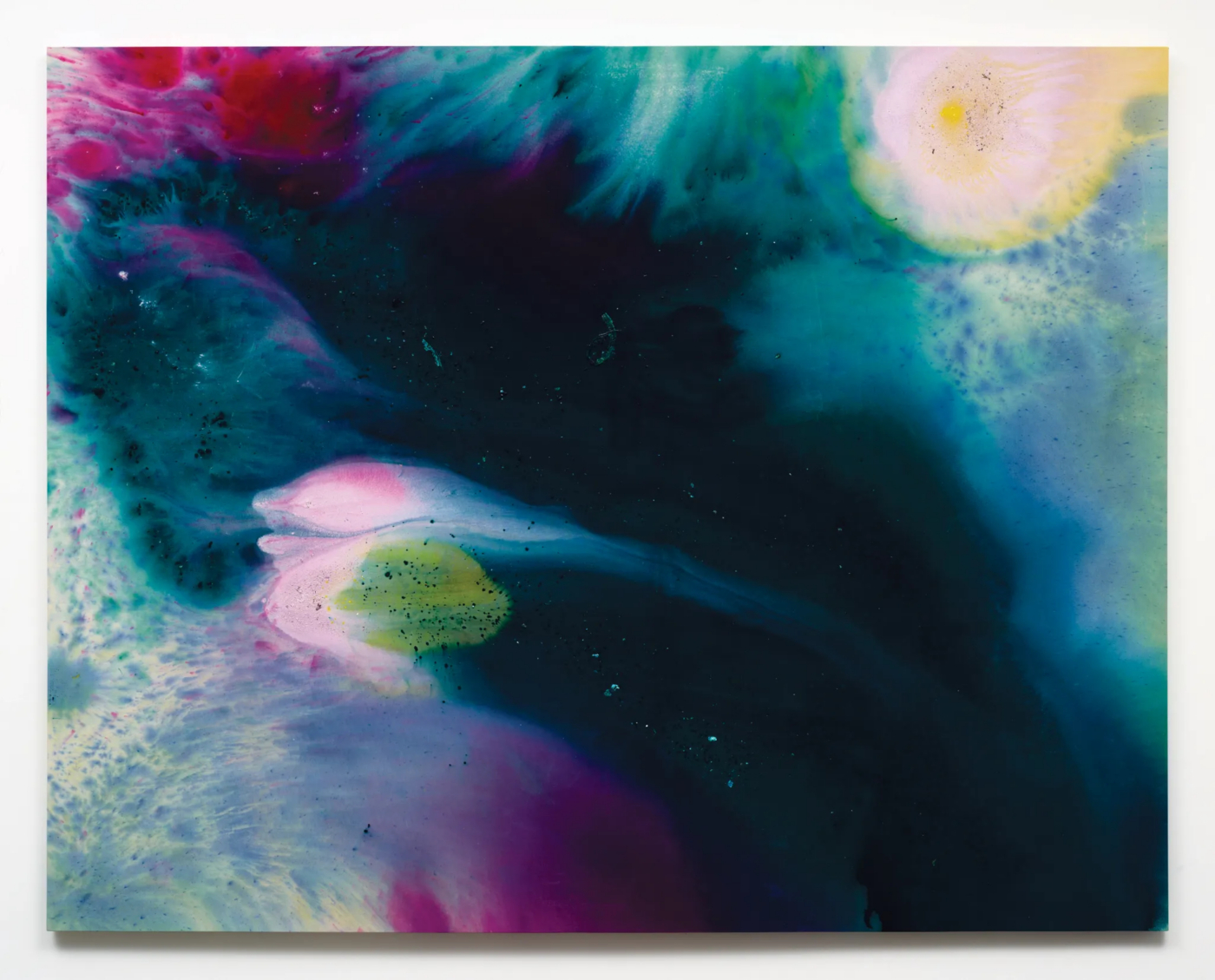
Through August 28, 2026—In an exhibition of fourteen new paintings at Karma, Peter Bradley extends his interest in chance—namely, what happens when the caprices of paint dictate the formation of the image. The artist approaches his work horizontally, pouring acrylic directly onto canvases textured with glass or pumice. As the pigment spreads, pools, bleeds, coagulates, and sediments, it produces forms that seem to belong to a world before representation. To let nature constitute its own image might be the most radical definition of a figurative work grounded in mimesis. Bradley, however, allows this operation to generate compositions read through the lexicon of abstraction. Their titles—which evoke intimate moments, as in Your Embrace (all works 2026); reference music, as in Coltrane’s Nebula; or deploy colors as narrative devices, as in Green Wish—intensify this evolution, functioning as bait: Each picture is an invitation to lose oneself, less through identification than by fabulating stories around Bradley’s suggestively indeterminate forms.
In Corcovado, a luminous passage of cerulean and turquoise shifts toward acidic green at the edges, recalling the eponymous mountain rising above Rio de Janeiro’s Atlantic Forest. At the center, a kinetic splatter of intense crimson and coral forms a vibrating nucleus against the cool expanse, while a granular dispersion of dark-blue sediment introduces a cellular, almost microscopic register. The sensuousness of the painting resides as much in this interplay of chromatic and material properties as in the title, which suggests a kind of landscape painting. Bradley often names his works in a manner reminiscent of Suzan Frecon, whose vernal breath of plum, 2019, and bancha bamboo matcha, 2025, for example, use language to evoke images, playing with the correspondence between words and colors. Such prompts undercut traditional art-historical divisions between abstraction and figuration, revealing the poetic nuances found in the threshold between them.
An energetic painter, Bradley displays an acute attentiveness to nature, studying botany to learn from the drama of its chromatic relations. His paintings seem governed by the rheology of fluids: viscosity, yield stress, surface tension, capillarity, molecular diffusion. These processes surpass demonstrations of material behavior to form a poetic symbiosis, closer to an orchestra or a blooming garden, in which disparate elements retain their individual pitch while contributing to an unstable harmony. In the astonishing Ballade Dreams, jade and seafoam green bleed into teal and Prussian blue, establishing a cosmic ground from which flares of magenta and chartreuse seem to drift outward in gaseous formations. Small deposits of pumice interrupt the painted field with rough tactility, recalling mineral clots in the pigments while suggesting fragments of celestial bodies.
Bradley’s insistence on the correspondence between color and music helps to clarify what is most compelling in his work: the capacity to hold beauty and dissolution in the same register. The paintings derive their force from internal contradictions among their constituent parts. Depth proliferates within a two-dimensional surface; control coexists with vulnerability; solemnity with phantasmagoria; the instantaneous with the eternal. This is not, however, a renunciation of authorship. Bradley simply redistributes creative authority among artist, pigment, gravity, surface, chance, and time, making the compositiona field of negotiated agencies.
His work evokes Helen Frankenthaler’s soak-stain surfaces, Frank Bowling’s topographical landscapes, and Mary Weatherford’s nebulous expanses in her “Sea and Space” series, 2023. Yet Bradley’s procedures also suggest Wolfgang Tillmans’s Freischwimmer photographs, ca. 2003–. These cameraless images are produced through the direct manipulation of light on photosensitive paper (the German title, meaning “free swimmer,” refers to a swimming certificate awarded to children who pass a practical water-proficiency test, while also suggesting freedom of movement). Bradley, a kind of free swimmer himself, emphasizes the liquid condition of painting—not because the works appear wet, but because they retain something of the fluidity and plasticity of their making.
After more than six decades of painting, Bradley remains committed to the possibility that a picture can exceed the intentions that set it in motion. His freedom lies in maintaining a productive tension between initiating and resolving, between driving and allowing the process to run its course. The result is a remarkably generous conception of painting that posits the practice as a free exchange that welcomes unfolding interpretations.