July 16, 2026
Color is the beginning, middle, and end for Peter Bradley. In his latest series of paintings, fluid shapes allude to places near and far.
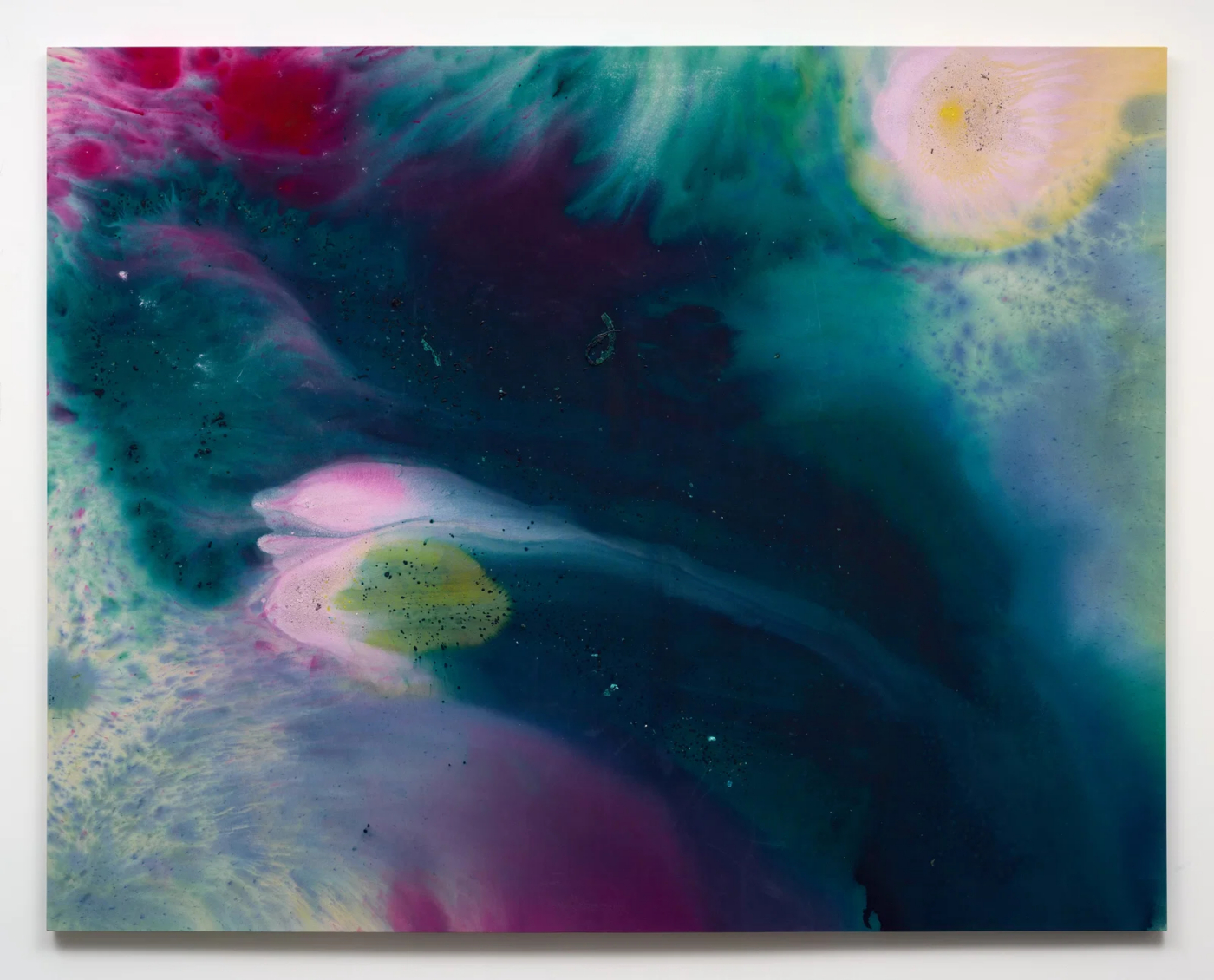
Watery, amorphous washes of rich greens, blues, reds, and purples swell along the surface of Peter Bradley’s 14 new paintings in his solo show “Burning On” on view at Karma in New York. The 85-year-old artist derives these abstract patterns from his natural surroundings in upstate New York, where the Pennsylvania native has lived since 1997. There, on his property, a newly built studio stretches into his yard, with a backdrop of lush woodland. His nearby garden, a longtime passion project, has proved crucial to his art-making. “The flowers help me out. Color is hard to keep in your head,” he says of the patches of irises and pink and red rose bushes.
The resulting compositions freeze in place the moments where Bradley’s deliberate, spontaneous gestures meet chance movements of materials—mainly acrylic paint as well as mixed media like glass and pumice stone. As a base, he tosses pigments across his canvases. “I anticipate the direction it’s going to go in, and I’m delighted when it goes there,” he explains of his strategy. “You can’t just place it there little by little because it looks silly, right? If you throw it, it looks like it got there some kind of way. It’s got some velocity.”
Bradley first started using a spray gun to apply paint at the outset of his career in the 1960s in New York City. From there, he never turned back to the paintbrush, rather leaning into more generalized applications, like mixing layers of wet paint and exposing works-in-progress to the outdoors. This formative period for him dovetailed with the city’s vibrant post-war scene, electrified by Abstract Expressionism.
His early works tend to sit somewhere between color field and splatter paintings—the zen of Mark Rothko meets the freneticism of Jackson Pollock. Since decamping for upstate, Bradley’s mostly settled into the quiet pace of the Hudson Valley. “The only thing I miss about the city is the street talk,” he says. ”Different guys would come into your studio and talk a lot of shit. Now, the only thing that walks into my studio is a cat or dog.”
The shapes that emerge in the artist’s latest works often evoke something far away and even alien from the his current environs: like Montipora 2026, combining swaths of turquoise, ultramarine, and vermilion, and titled after the coral found in the southern Pacific and Indian oceans. For Bradley, meditating on these forms is a part of the process and intrigue. “I see everything in them,” he says. “Sometimes airplanes, sometimes people crying on the street, sometimes water and rain, big storms, sunshine, different planets.”