September 2025
In 1997, leafing through a book about birds that had belonged to her grandmother, Ann Craven chanced upon a photograph of a downy pink canary perched on a branch in front of some shadowy leaves and red berries. She decided to paint it at large scale and the canvas that resulted, the six-foot-tall Pink Canary, launched the New York artist on a project that has occupied much of her time since.
Ann Craven paints birds. She paints a great number of birds, from pets and songbirds to woodpeck-ers, magpies, ravens, swans, doves, peacocks and, occasionally, raptors. And she paints them in great number, over the course of nearly three decades producing scores, if not hundreds, of images of our fine feathered friends. This is not to say that she paints only birds, as she has also prolifically depicted flowers, the moon and other animals, including bear cubs in trees, horses swimming and pandas napping. Yet paintings of birds remain her most recognizable work; her signature motif and the way she paints them accounts for much of their appeal. Using saturated colours and a loaded brush, she applies paint wet-on-wet, with swift, assured sweeping strokes. The vibrant paintings can range from a dazzling bravura to a blunt, more schematic appearance. Facility can make her ostensible subjects seem mere pretext, an effect due in part to the fact that she has painted since she was a child and in part to her quotidian subjects’ familiarity. She renders these familiar subjects with masterful panache, limning the twigs and branches on which they perch with rough, gnarly twists of pigment and their glorious plumage with dexterous brush strokes that often look, well, feathery. In 1949, Willem de Kooning famously quipped, “Flesh was the reason why oil painting was invented.” Craven’s canvases can make us believe he was mistaken, that the adage misses the mark, that feathers actually constitute oil paint’s raison d’être.
Her birds look as though they’d flown out of the pages of pet manuals, birdwatching guides, National Geographic and ornithology texts. She appropriates images and repeats them. Perusing her oeuvre, or just a single one of her exhibitions, you notice the same birds appearing over again, in the same pose, the same lighting, derived from the same source. Sometimes this source may be more properly identified as her own rendition of the images and not the photos from which they were first copied. Sometimes Craven even reproduces the same brush strokes to delineate the same feathers. In this aspect, her practice positions her as a lineal descendant of the Pictures Generation of the early 1980s, artists such as Sherrie Levine, who similarly deployed photography, appropriation, mediation, seriality and repetition as critical strategies in a takedown of inherited pieties that included originality, authenticity and white male privilege. Yet Craven’s devotion to painterly expression, to skill, to the joys of painting’s materiality makes her an unlikely disciple of these ironic and sardonic forebears. Her paintings feel, in a way, too naïve, too sincere, too trusting.
Then there is the matter of Craven’s subjects. Her birds, her other animals, the flowers, the moons, but especially the birds—brightly hued, anodyne, suitable for postcards or calendars, and downright cheerful—embrace the lowbrow, the cliché, kitsch. She has played this up by inserting gorgeous, oversized flowers, even brighter than the birds in many cases, into the backgrounds, which are themselves generally a brilliant sky blue—or orange or yellow or green or pink. She often blurs these thinly painted flowers with a dry brush, à la Gerhard Richter, to simulate photography’s depth of field and further call attention to the photographic nature of the crisply limned, more thickly painted birds. This insistence on the photographic-ness of the serial images, on their chipper banality, might then align her work with one branch of the Pictures Generation’s own antecedents, the pop of the 1960s and its offshoot photorealism, but, again, we come up against the impasse of gestural figuration, of personal, ostentatious touch. We might find a more direct ancestor in the proto-pop stylings of Alex Katz, for whom Craven worked as a studio assistant for eight years in the 1990s, but while this may explain her casually virtuoso paint handling, it does not go far in addressing her reduplications, her compulsion to repeat. The American critic Canada Choate has noted that Craven’s work recalls the duplicated brushwork of Rauschenberg’s Factum I and Factum II of 1957, but this, too, provides a precedent, not a rationale.
Some observers have taken banality and kitsch as the point of Craven’s subjects, and her birds, as if she merely intended expansion, pushing the envelope of taste like a Jeff Koons. She herself refers to her recurring images as “revisitations,” sentimental, emotional attempts to recapitulate, recapture images and objects, feelings and phenomenal past—her grandmother’s books, the flower arrangements from a loved one’s funeral, the way the moon looked in a certain place at a certain time on a certain night in a certain year, a painting lost in a devastating studio fire in 1999, the experience of creating a particular brush stroke, a particular image. But this nostalgic, psychological underpinning of Craven’s art can account for only part of its meaning. Another part arises from her canny utilization of the exhibition itself as an essential mode of enunciation. In her eccentric, radical use of the exhibition’s relations of space and time, Craven engenders and inflects the valence of her work.
In a 2002 exhibition at Klemens Gasser & Tanja Grunert in New York, Craven presented in the anteroom two nearly identical canvases of a lone fawn in a field of daisies; in the main gallery was a roomful of birds that included Hello, Hello, Hello, 2002, a triptych of three repeated panels of an African grey parrot and pale violet orchids. The room also held a pair of virtually indistinguishable canvases of a bright yellow canary with pink hollyhocks in front of a far more saturated and vivid pink background. The image of the deer, it turned out, did not come from the artist’s usual source of wildlife photography but from a film within the 1973 sci-fi flick Soylent Green. In its depiction of a dystopian future, unspoiled nature exists solely as filmed sequences shown to those about to be euthanized. This association gave Craven’s otherwise innocent deer a sinister subtext and further underscored that all her portrayals of nature, not least her birds, stand, always, already mediated, forever cognizant of nature’s forced dis-appearing in our Anthropocene epoch.
Despite the frisson of facture, the repetitions and scale shifts in the exhibition registered as routine to anyone with a passing acquaintance of Warhol. Something else, however, transpired in another set of paintings in the gallery. A painting of an eastern spinebill with three yellow orchids on a pink ground hung on one wall, while on another, a smaller duplicate of it was flanked by two more renditions of the exact same bird with completely different arrangements of flowers and branches against blue. This mix-and-match approach to combinations of figure and ground marked only a subtle tactical advance but it presaged stranger things to come.
Two years later at the same gallery, Craven repeated the show, hanging new versions of the same images in the exact same spots. The effect, to those who had seen the previous exhibition, was uncanny. It induced an eerie sensation of déjà vu but with something wrong, something off, something hard to pin down until you began to notice that the gallery seemed to have shrunk. The space between the paintings appeared to have grown smaller; the floor seemed closer to the ceiling, corner closer to corner. In fact, Craven had remade all of the paintings half again as large as before, perfectly scaled up. The sensation of standing in a too-small space among giant birds proved equally uncanny; at nine feet tall, the birds, no matter how beautiful, had become slightly monstrous, their descent from dinosaurs clear. Craven’s wilfully perverse gesture flew in the face of the art market’s demands for originality and progress, for the new (the protean efforts of Sherrie Levine and her colleagues could never have constituted more than a symbolic assault on commodity capitalism). But it did something more. The artist’s play with repetition, with size and scale, with figure and ground, with memory and mediation posited her image repertoire, images themselves, as a kind of a bank, an archive, a database from which to draw components and recombine, rescale and recontex-tualize them at will. Art, of course, and painting in particular, always did this, yet Craven’s systematic exploitation of these operations on the recurring, nearly ridiculous subjects of the birds represents a reconsideration or re-evaluation of painting’s venerable modus operandi.
It is surely significant that Craven’s professional career coincides almost precisely with the rise and explosion of digital imaging as our primary means of pictorial representation and of Photoshop and similar tools as the primary means of manipulat-ing digitized images. What she posited in the pair of shows at Gasser & Grunert was the themati-zation of the possibilities of digital imaging and its manipulations. This thematics of the digitally manipulated image, presented in expressive, gestural, representational painting, constitutes something of a paradox, certainly. It may well be internalized or even subconscious, but Craven has not, to my knowledge, framed her work in this way. Nonetheless, I believe it remains both legible and elucidating, helping to explain the usually overlooked connections between her work and that of more technologically minded artists such as Wade Guyton.
Later works and exhibitions bear out this idea. Most often through her paintings of birds, she has revisited again and again the investigation into the way images now work. In 2004, between the two Gasser & Grunert shows, in an exhibition with Mario Diacono in Boston, she presented This Way No This Way (Aut Aut), 2003, a 10-foot-wide canvas with two addorsed eastern bluebirds against red hollyhocks, each side of the panel a mirrored replica of the other, as if the image had been duplicated, flipped and stitched back together into a gently psy-chedelic vision. In 2019 at Shane Campbell Gallery in Chicago, ten canvases—five yellow canaries and five eastern bluebirds—faced off on opposite walls, background hues progressing in tandem. On the back wall of the gallery hung two more bluebird paintings with yellow orchids and black backgrounds, one horizontal and one vertical, adding interchangeable portrait and landscape formatting to the manipula-tions internal to the image. On the last wall, five conjoined panels formed a long horizontal expanse of diagonal stripes, an abstraction resulting from Craven’s habitual custom of using up the pigment left over at a painting’s completion. Here, you might think of the digital image’s composition from discrete coloured pixels or bits of data, or the linear glitches that may appear when the program malfunctions. At Karma in New York in 2023, eight large paintings in the main gallery instantiated all the artist’s main motifs—birds, deer, flowers, the moon—while a smaller room held smaller versions of the same works. And in the gallery’s bookstore a block away, eight watercolours replicated the images in another medium entirely.
We may initially find it disconcerting to imagine as dry and “conceptual” canvases that are as lusciously and deftly painted as Craven’s are, but her incisive experimentation using exhibitions as the medium to articulate the implications of her works brings her practice close to some aspects of conceptual art, that other great lineal ancestor of the Pictures Generation—site-specificity and institutional critique. We can also discern something of the “theatricality” that Michael Fried saw in minimalism in Craven’s installations; they remind us of our own embodiment in the playful way they force our perceptual and visceral relations to the object and to space and they correspondingly also force us to consider our relation to time and memory. Re-encountering her iterations of ephemeral events—a flower, the moon, a bird on a branch—ever the same yet always changed, dramatically or not, compels a consideration of temporality and, ultimately, our mortality.
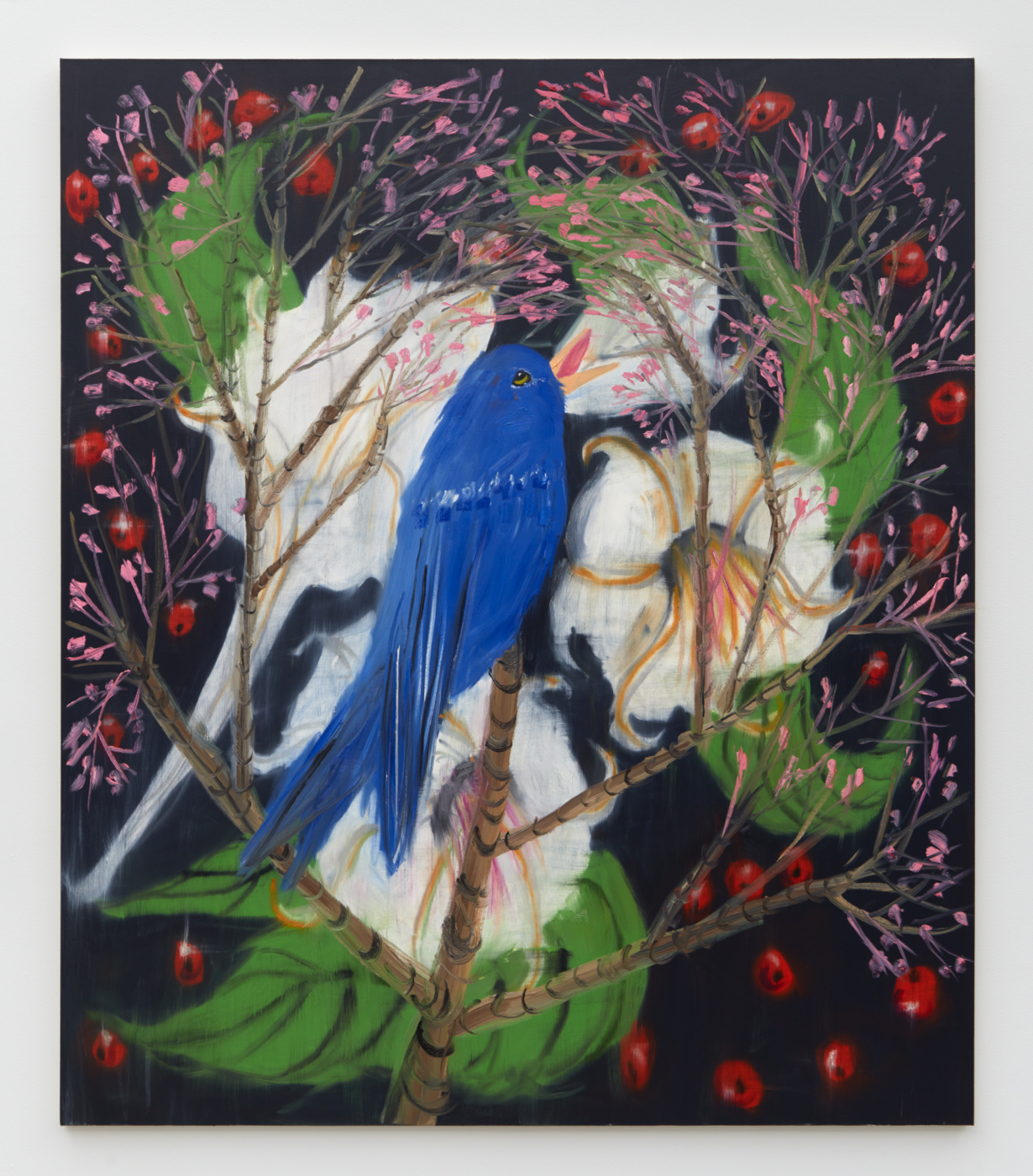
Craven continues to widen her project, pushing the moons painted from observation further towards a visionary expressionism and the birds towards a place more overtly concerned with the history of painting but no less visionary for it. Some recent works have replaced the soft-focus flowers that hold the middle ground behind the birds with flowers and the abstractions borrowed from Georgia O’Keeffe paintings. And some recent birds bear the paren-thetical subtitle “After Picabia” in reference to the protean modernist’s “Transparencies” series of the late 1920s, which intermesh and imbricate apparently unrelated imagery taken from a myriad of sources. Among the most indelible of these, Portrait of a Blue Bird (Night Song, After Picabia), 2023, 2023, pictures the titular bird dead centre in front of some apparitional jimson weed blossoms lifted from an O’Keeffe painting. Strikingly, the branch on which the bird clings explodes in pink buds and shiny red berries that glisten against the black ground like stars and planets in an inky cosmos. More arresting, the chirping bird, seen in profile, has two eyes on the same side of its head, like a flounder or a Picasso. That jarring detail may come from a discrepancy in the accumulated muscle memory of painting the bird before, or from the artist’s interest in the collage-like effects of Picabia’s mash-up of images. It may represent a ghost in the digital machine. But in light of Craven’s ongoing engagement with the radical changes that Photoshop and other programs have wrought upon our relationship with images, I prefer to see it as a next step, a first thought about how the grotesque hallucinations produced by AI might come to impact our vision. Ann Craven paints birds in order to think about how we see. Ann Craven paints birds to think.