October 22, 2025
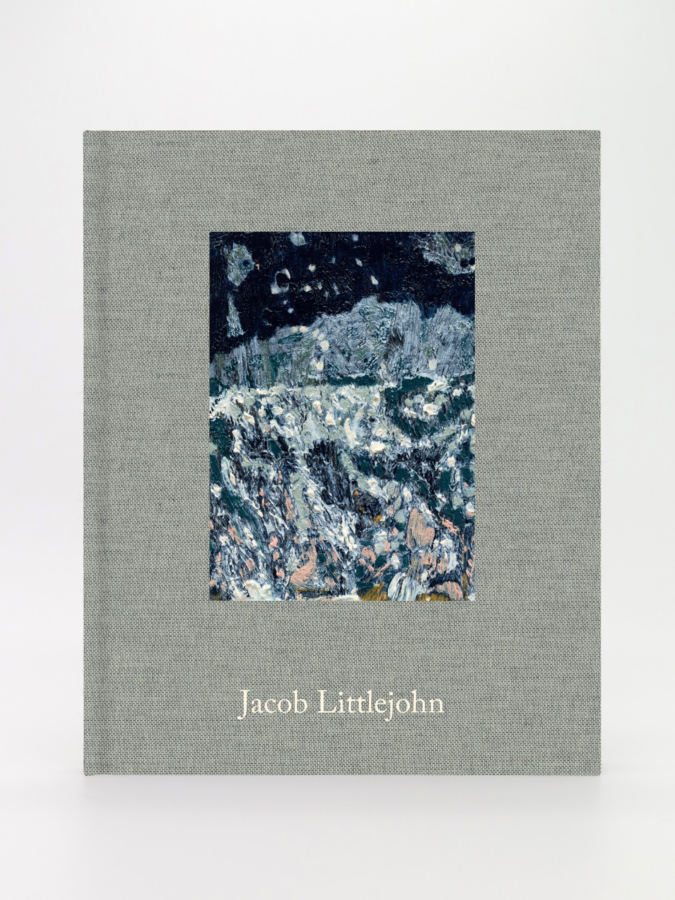
Across Karma’s two East Village locations on East 2nd Street, new work by the artist-painter Jacob Littlejohn shines in What the Thunder Said. Littlejohn, an emerging artist originally from Scotland, presents a handful of large-scale and small paintings, the size of handheld books. But the small paintings carry some of the most intense abstract movement and experimentation such that we’re not sure whether it is sky, land, or water that is melting before us. Though Littlejohn earned his MFA from Hunter College only in 2024, he has managed the rare feat of escaping the rigorous mind-bending mélange of critical discourse often associated with such programs to find visceral freedom and maturity in the alchemical potential of the medium so quickly.
In the growing tensions of our current socio-political climate, Littlejohn’s work makes us wonder how it is that the materiality of painting still has the capacity to engage us, and under what terms. I’ll contend, in the case of this artist, that it is in the small, in the subtle, in the intimate, where we can linger and simmer a little longer; we can lean on these handheld paintings to try and stretch time. Today time tends to compress into a series of replaceable and forgettable images, new ones glimpsing past old ones when the scrolling finger touches a screen. We lose our sense of time by constantly trying to gain more time through multitasking and being in several places at once. Yet in Littlejohn’s current work, we can halt and meditate, gaze and sway, and even though we cannot tell the landscapes apart, we can sense there is an oscillation of differing strata teetering simultaneously on the edges of sublimation, evaporation and condensation. Small causes us to move in closer and large has the opposite effect.
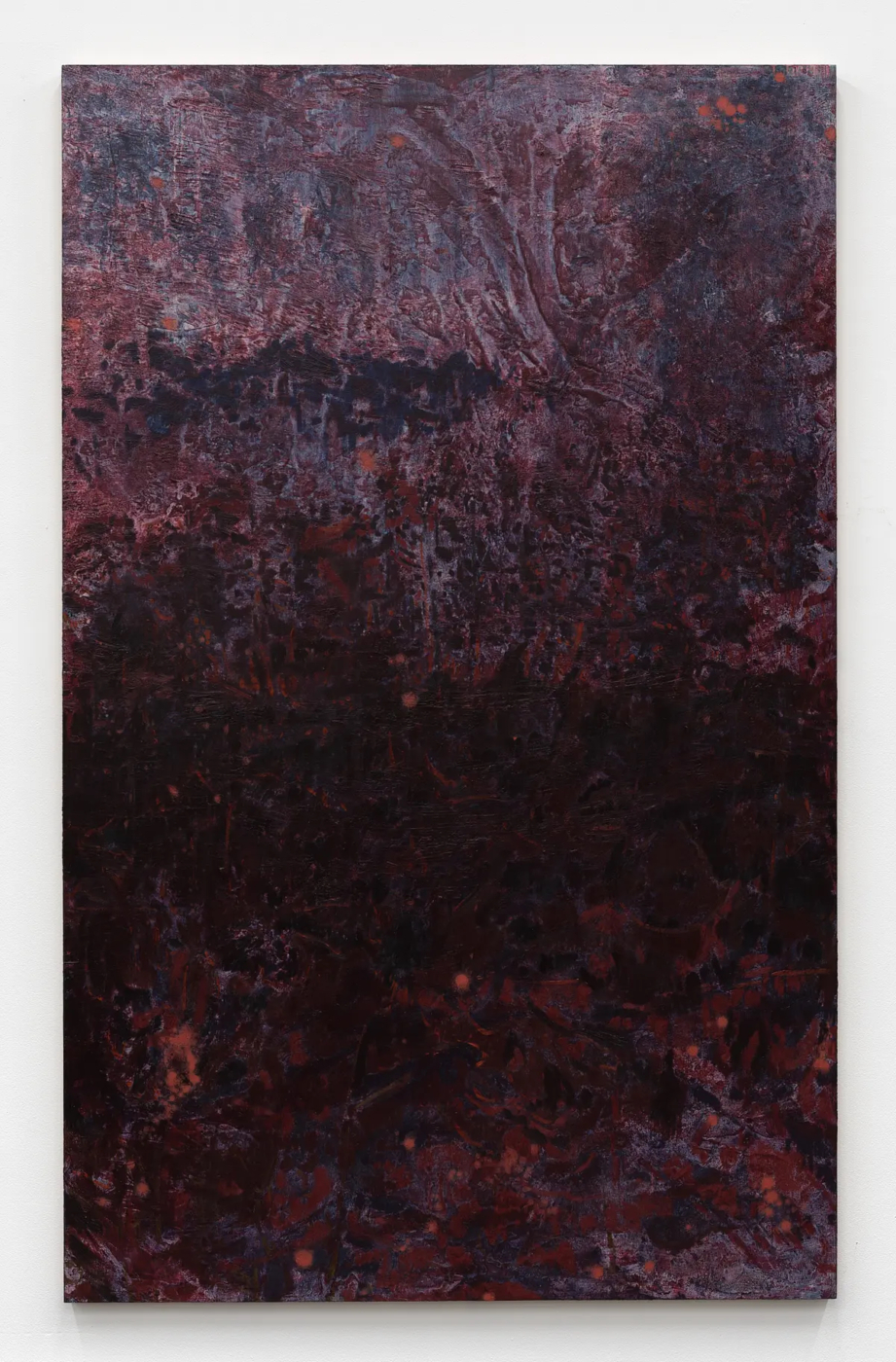
The noticeably dark presence of these large-scale paintings are the first things we notice upon entering the gallery. The dark red of alizarin crimson dominates, as if foreshadowing a battlefield, in Dry Bones Can Harm No One (2024–25), one of the large-scale paintings in the first gallery. The different tones of blood from translucent red to dark brown blend with the noticeable motifs on the top layers of paint, as if a plastic sheet was wrapped around the painting and lifted off leaving an all over palimpsest of plasticky, shadowy ripples unifying the surface. The effect and red-browns evoke a feeling of discomfort.
Upon a second look we see the dominating obscurity of his work is fighting with the comparatively small but brightly hued specks, streaks, strokes, and smudged marks, which move across the surface and create high contrast moments of light against the looming darkness. In Hinkypunk (2025), the darkness is cut by intervals of dramatic light that crack through as dripping vertical lines of cinnabar green are pulled down by gravity. Light also emanates from the matte splatter of the lilac up top, waking up an expansive starry sky, recalling the experimental spirit of the postwar New York painters. The smudged parts add another feeling of melting light and landscape into a messy weave suggestive of another light source, movement, and life. These gestures, compared to the all-over small brush marks of The Wind Whistles and The Thickness of Shadow (both 2025) create a source of life in what is otherwise a shadowy realm of blues, greens, and browns. The animated short brushwork and interplay of colors present have parallels with the landscape work of Marsden Hartley. The legacy of an American modernist like Hartley, whose work existed between European traditions and American landscape has perhaps entered the psyche of this Scotsman as he settles in New York.
Moments that give light the power and velocity of movement are equal, in my eyes, to glimmering hope when one is reaching the end of energy in a battle not yet won. The horizontal rose marks across a dark brown earth, interlaced with thin vertical lines recalling scorched tree trunks after a wildfire in Substrata (2025) read like a musical score. The heavy-handed blotches of white and red in Cast Shadows (2025) are the last layers overlayed on multiple interplays of thin and thick scratches and smoothed out painting layers—an intoxicating color composition! Why is it that this material and its treatment—with no plain narrative, no overt political statement or stance—stirs something within, a feeling, mostly unnamed, but promises a glimmer of hope? It’s telling that the exhibition is accompanied by T.S. Eliot’s poem “The Waste Land,” as if these moments of light are moments of life being transported from the marshes of waste.
We live in a time where multidisciplinary forms of artmaking have been at the forefront of contemporary art as opposed to seeing artists committing to a specific medium and engaging with it in depth and at length during a lifetime. Beyond art, we could draw a parallel to the workforce, where it is rare to have any career professional commit to one company for decades. It is in the air of our times to jump, skip, and change rapidly. Yet, Littlejohn has committed to oil painting, and this exhibition solidifies his arrival as an artist with promise. He is a painter’s painter, evident from the play of the medium of oil paint and allowing us to engage with the inner light of his work, a product of his experimental brush. To go against the grain and to believe in the vision and potential of the work is the core of the artist’s mission. To speak through an old medium, to make it relevant for the ages, to serve as a vehicle for poetry, we realize that it is through simplicity that in the end we hold longevity both of time and place.