February 2, 2026
The term “still life” suggests stillness or tranquility but nothing more. To an English speaker, the French nature morte immediately brings death into the picture. The translation from English to French is not really a translation from one language to another but two different ways to say the same thing. Translation in this case has nothing to do with language, but it does deal with the fact that a specific concept happens to have two unrelated names. Nicolas Party, in this voluminous, multifarious show, has gone to great lengths to invent equivalents, equations, and translations, but each time he does so, he reminds us that no translation can ever be the equivalent of the original.
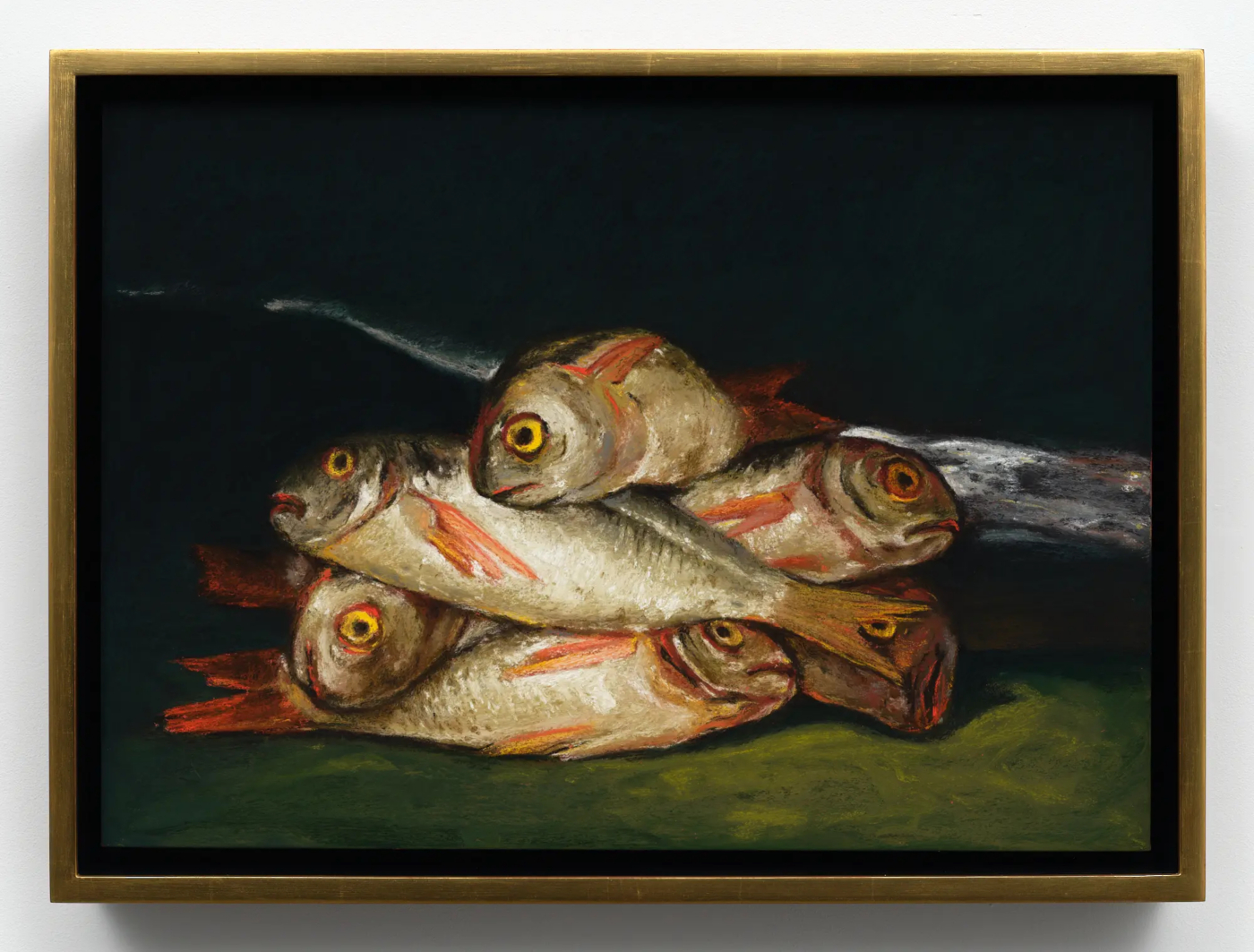
The first image the visitor sees is Still Life with Golden Bream, after Francisco de Goya (2025), a pastel on linen. We might assume this to be a copy of Goya’s Still Life with Golden Bream (1808–1812) oil on canvas, but it isn’t. Party uses pastel instead of oil and changes, ever so slightly, the dimensions of the original—his is 17 ¾ by 24 ¾ inches, while Goya’s is 17 ⅝ by 24 ⅝inches—as if to illustrate Jacques Derrida’s concept of iterability, where repeating a term simultaneously states the original while subtly altering or changing it. Repetition, like translation, confers a Janus-like identity on the word or image replicated: it looks backward to earlier meanings while heralding new ones. This is the operative conceit of Party’s daring show.
But there is more to Goya/Party’s golden breams than meets the eye. Staring out at us are six dead fish (hence Party’s show title) whose unblinking six eyes introduce another topic. The fish are dead, but their eyes constitute six zeroes. Party has evoked the Zen idea of emptiness and the necessary forgetting of self. He depicts the situation of the new artist in relation to tradition: to create, the artist must escape ego and become one with tradition. That fusion alters the past a tiny bit, like Party’s change of Goya’s dimensions, creating a space for innovation.
Goya’s fish crop up again in the show, the first half of which consists of Party’s reproduction of his own earlier work in a different medium, a tactic announced in the pastel Goya. Those pieces were oil on canvas or pastel, but he now renders them in oil on copper. So, we find yet another version of Dead Fish (2025), a 5 by 6 ¼ inch version of that pile of dead bream, accompanied by Party’s signature unnatural forests, fantastic landscapes, and grotesque portraits. The small scale of Party’s work—the largest among them approximately 9 by 11 inches—demands concentration from the viewer. Some details are in fact so minute that Party had to resort to a jeweler’s loupe to paint them. This is especially true in the four-painting series Party calls “Creases.”
These are all 7 ½ by 5 ½ inches and are disconcerting in the extreme. All are distorted renditions of the human body painted grisaille-like against a pinkish background that echoes the pink Party uses on all the walls in the gallery. The third (they all have the same title) is a strange, inverted torso reminiscent of the torso in Marcel Duchamp’s, Étant donnés: 1° la chute d’eau, 2° le gaz d’éclairage (1946–66), though Party’s has arms that might be legs and a bosom unlike any real bosom. Viewed from even a short distance, the figure in the painting seems covered with dots, but those spots, which we can only see if we practically mash our faces to the picture, are actually insects painted on an almost microscopic scale. It is as if Party had accompanied Dr. Frankenstein to charnel house and made his own collection of putrefying anatomical specimens. And that association conjures up yet another: the relationship between creator and creation. Just as Mary Shelley’s Dr. Frankenstein simultaneously rejects his monster while desperately trying to retain control over him, Party takes the connection to another level by recreating his own work in a new way as if to say he could not bear parting with it.
The second gallery space contains work not based on earlier pieces. Preeminent among these new pieces is a magnificent pastel mural we might think of as a sigh of artistic despair. Goya’s fish, now on a monumental scale, 173 by 206 inches, will be effaced when the show comes down. Party created it in situ; it too is an unfaithful copy of Goya’s breams. This show fills us with iterations, reiterations, and memories not our own—a tour de force.