February 4, 2026
It is difficult to view Arthur Simms’s show “Caged Bottle” and not start cataloging the amassed objects that make up his intricate composite sculptures. The title work rests atop skateboards above which two forms collide: a sun-faded 101 Dalmatians bicycle bound in hemp and a handmade cylindrical wire folk basket filled with glass bottles and topped first by a bicycle wheel, then by a birdcage. Inside that cage, a single clear wine bottle—the only element not lashed in place—remains theoretically free to rattle.
This arrested motion recurs in Bugs in the Cars, 2024, where an insect preserved in resin crowns a stack of toy cars resting on a roller-skate, all bound together by bubble-gum pink rope. In interviews, the Staten Island-based Simms has traced his impulse toward assemblage back to his childhood in Jamaica, when he’d make toys for himself. Yet elsewhere, playfulness shades to menace: barbed wire coils through Two Buckles, One Foot, 2011, while The Knife and the Hammer, Fear of Aggression, 1994, binds actual blades and hammers into a towering, totemic, cruciform sculpture.
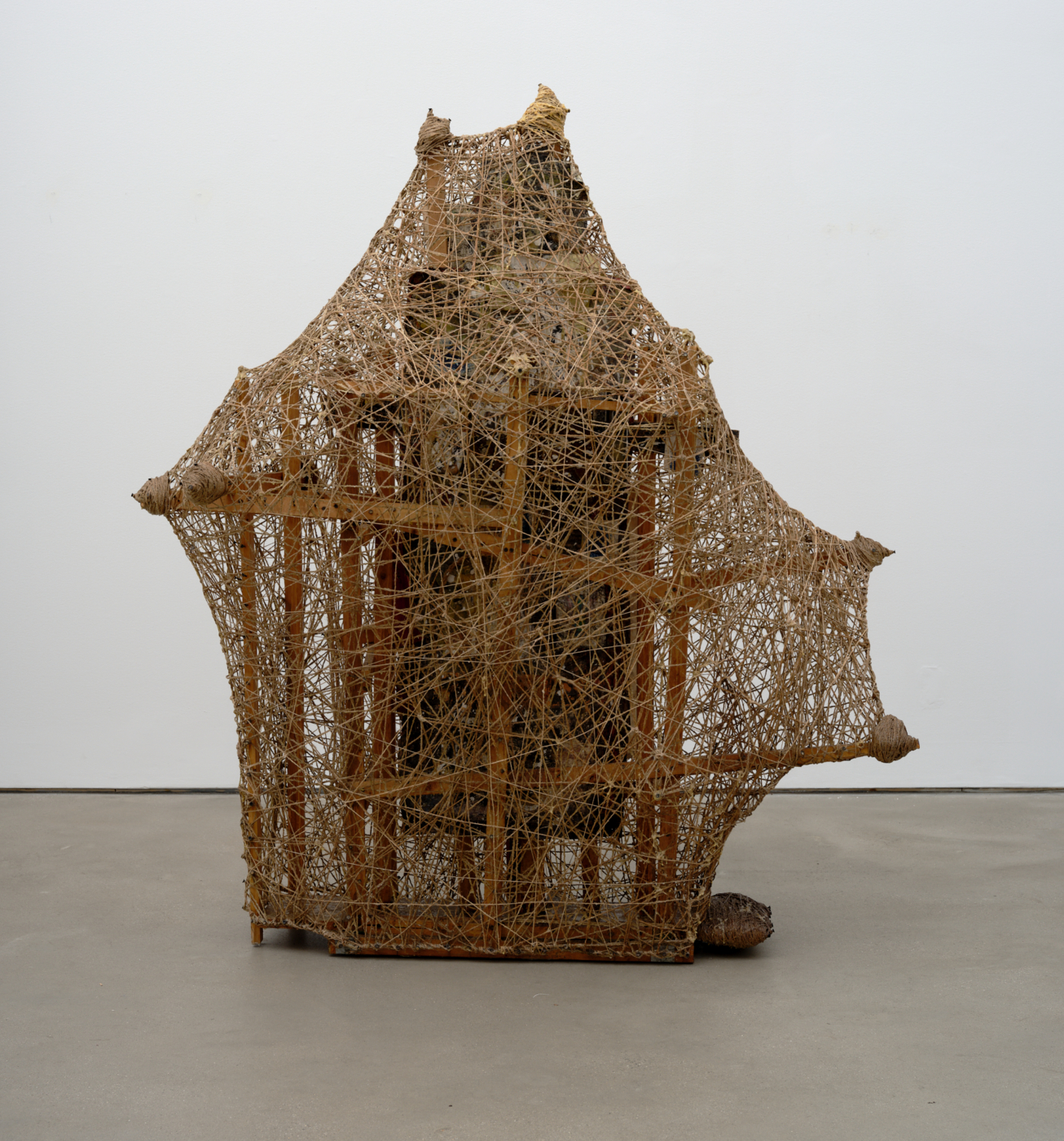
In the center of the gallery stands Sexual Tension, 1992, a hulking form that suggests variously a schooner, a figure, or some spectral architecture. Jute rope coils around a hidden wooden frame, crisscrossing until the cord itself becomes a taut and fibrous skin. What rests within—a painting, maybe—remains tantalizingly obscured. Yet concealment and revelation operate differently across the show. Dreamcatcher IV, 2017, suggests a shopping basket: aluminum wire woven around a wooden skeleton creates a delicate, permeable veil, inside which glass bottles have been placed on bamboo rods and wrapped in rope. The form rests on suspended scooter wheels. Such accumulation demands penetrating, meditative attention: the viewer must painstakingly piece together what each binding constructs and hides. Yet Simms’s compulsive lashing paradoxically creates the conditions for freedom: the wine bottle’s potential tremor, the rope whose weave admits the eye. Constraint and liberation, he suggests, exist not in opposition but in tension, each defining the other.