March 1, 2026
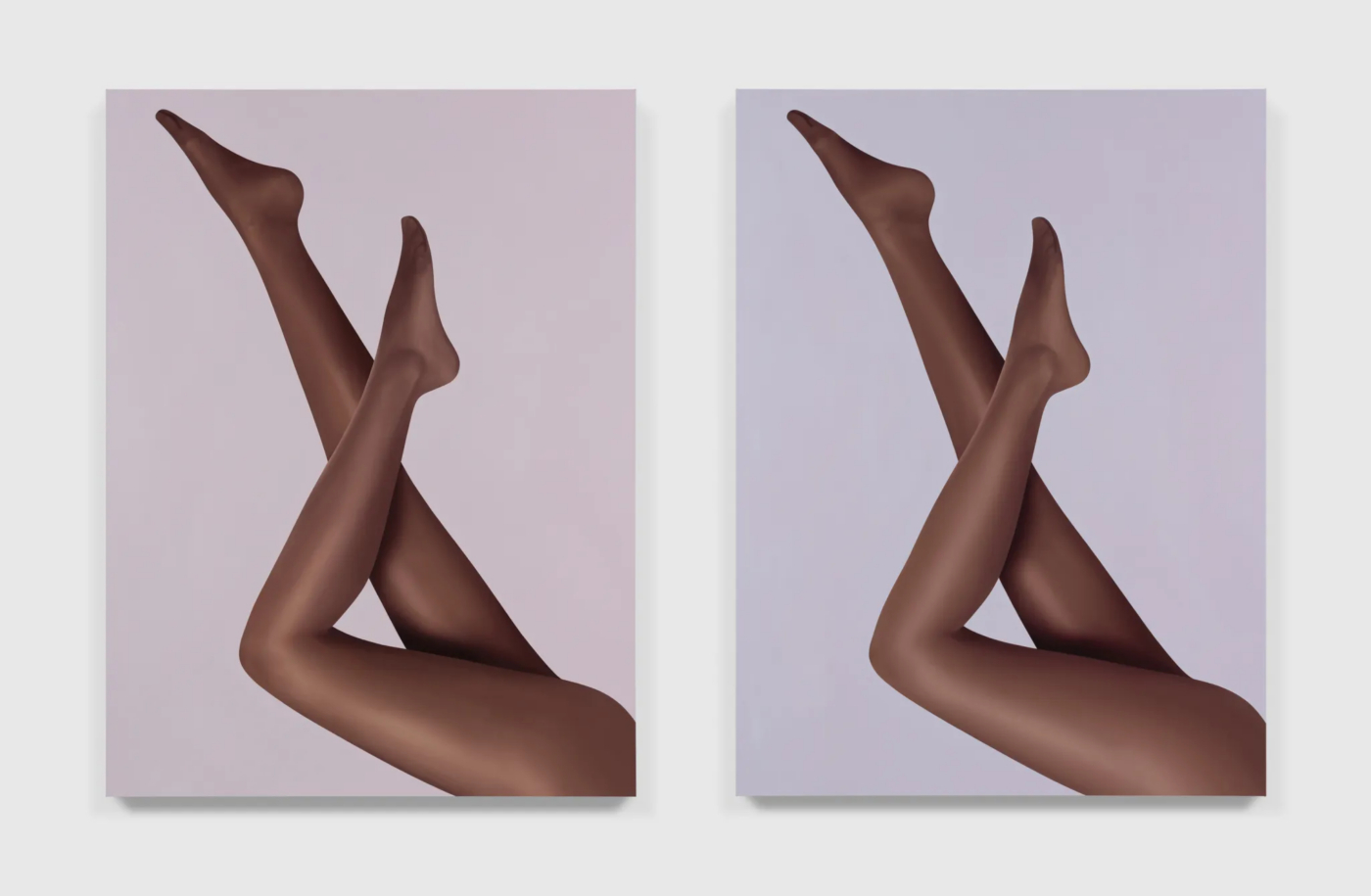
Mathew Cerletty’s hyperrealistic paintings are difficult to pin down—they often evoke a mood that is by turns comical and morbid. His pictures, imbued with a certain stripe of malaise, depict things that are familiar but subtly twisted out of joint, like the two sets of stockinged gams, kicked up in the air showgirl style, in the diptych Lickety Split (all works 2025). Cerletty’s use of tight cropping here and elsewhere separates the subject from any particular kind of body, identity, or space. Such moments of strangeness reflect the artist’s inventiveness, wry humor, and pictorial cunning, à la Peter Cain or Ed Ruscha—elements that subvert the viewer’s expectations.
Despite the appearance of cool detachment, these pictures were anything but neutral. They were portraits in a way, of both inanimate objects and (ostensibly) living, breathing entities. Indeed, Cerletty’s works are representational, but their deadpan affect is decidedly abstract. We learned that the artist and his partner occasionally appear in these compositions, but it is not clear where. (I found out about this detail after participating in a gallery walk-through with Cerletty.) The paintings’ opaque subjects steadily wormed their way under the skin. What initially seemed like a straightforward depiction of towels, eyeglasses, or an egg (Egyptian Cotton, Cheaters, and In the Beginning, respectively) quietly began to multiply, like one’s reflection in a house of mirrors. Perception was torqued, taunted: Take Vanity, a rendering of a Kohler-brand sink. In this piece, a white basin is set inside a black countertop, as deep and rich as a void. Surrounded by this dark ground, the lav seems to expand and contract before our eyes.
Lost Touch depicted Cerletty’s clasped hands. They are sheathed in black nitrile gloves and set aggressively close to the picture plane, practically filling the entirety of the thirty-two-by-forty-inch canvas. This is an oblique self-portrait of the painter in his studio, one in which he is seemingly reduced to the most essential tools (hands, gloves) of his trade. The dull rubber sheen of the gloves gives off a fetishistic air, much like the nylons of Lickety Split—both works appear simultaneously kinky and banal. This repressed style of sexiness also suffused The Shape, a rendering of an unremarkable purple skirt. However, the longer you look at the picture, the more weirdly immodest it becomes. The titular garment clings to the wearer’s body, highlighting the voluminous contours of their abdomen and the depression of fabric over the crotch. Perversity is somehow made more perverse when it’s presented so immaculately.
Cerletty’s subjects are tastefully color coordinated to their monochromatic backgrounds, much like the people or items found in stock photographs or merchandise catalogues. One is impressed by the artist’s skill and the amount of labor that went into creating such “normcore” (to borrow his characterization) paintings. While these were not overtly surrealist pictures, they were certainly uncanny, making the painfully familiar seem utterly alien. Cerletty’s canvases are windows into an elsewhere that surrounds us all the time—they are “boring” in the most remarkable and unsettling ways.