April 2026
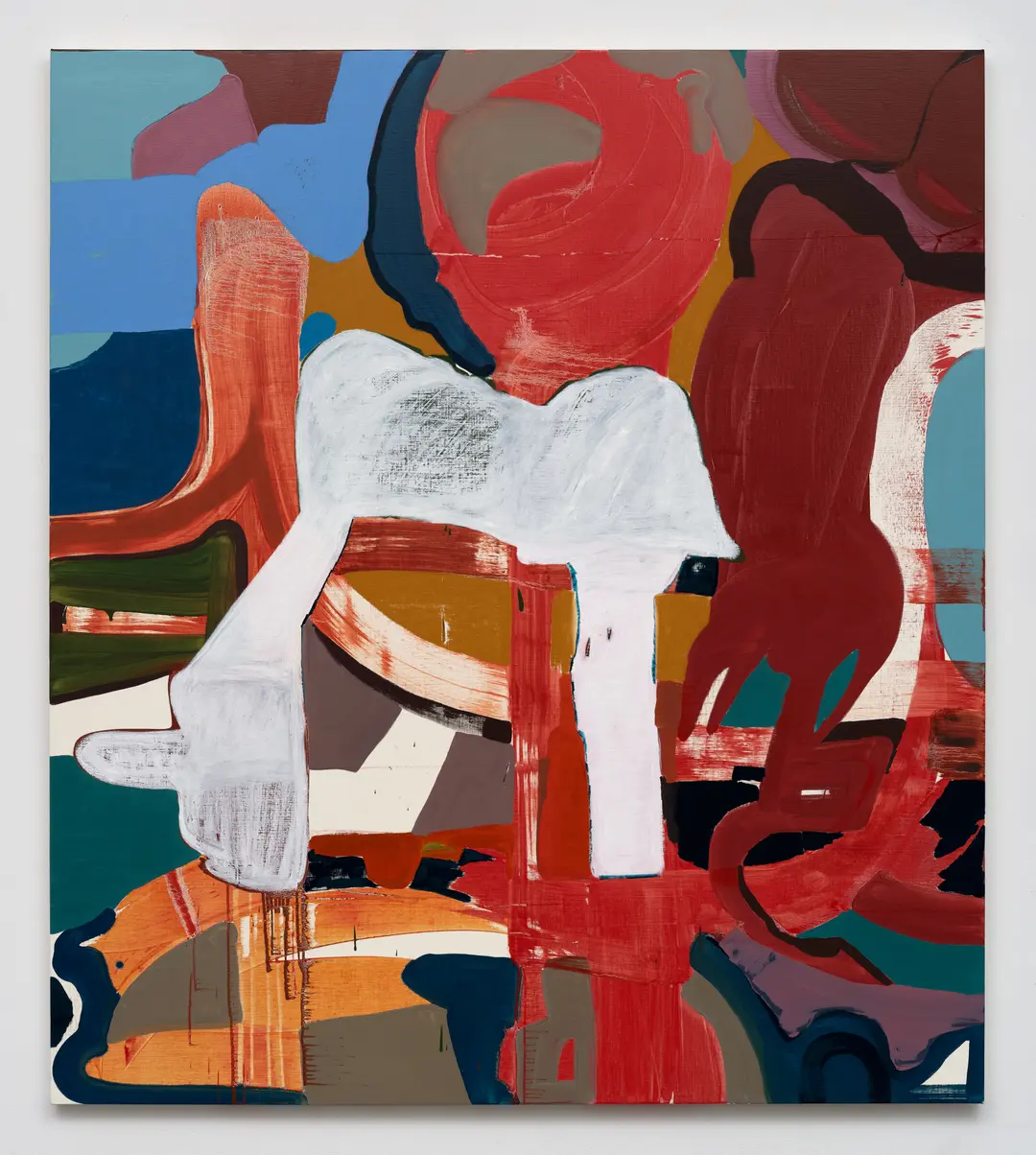
The discipline of painting was made for an artist like Tamo Jugeli. She loves to paint (doesn’t seem to be able to turn off the desire, really), loves to look at paintings, loves to talk with and about other painters. She works intuitively, creating parameters or challenges for herself, like using only specific colors, or limiting the size and texture of a canvas, letting the materials dictate what will transpire. She works in abstraction, though owing to her instinctive process it isn’t an anomaly to see hints of figures, animals, architecture, or landscape that hover at the edge of dissolution. Her paintings are expressive, but beneath the surfaces lie a carefully modulated tension between presence and erasure. Jugeli’s compositions are worked and reworked, with traces of revision left visible—scraped passages, thin veils of pigment, abrupt interruptions of a line. At times, the artist’s treatment of the surface resembles other materials like marbled paper, enamel, or even fabric as she pushes the capabilities of oil paint and oil stick. Colors and motifs might jump from one composition to another, but each piece is singular, completely unaware of the direction another painting has gone. The result is a pictorial field that feels less like an image than an event: something has happened, and is still happening, within the material limits of the canvas.
In From 5 to 7, a two-venue solo show at Polina Berlin Gallery and Karma, Jugeli’s intuitive process is on full view. Agnès Varda’s 1962 film Cléo from 5 to 7, which follows a woman as she waits to hear if she has cancer, grants the exhibition its title. Whether this sense of being in limbo informed Jugeli’s paintings is left vague, but there is a clear parallel with the duality of the two venues. Moreover, she approached each gallery differently, creating two related but distinct bodies of work by setting specific criterion for each. She began with the pieces for Polina Berlin, restricting herself to a palette composed mainly of darker hues and canvases with a more textured surface. For Karma, she increased her scale dramatically, chose oil-primed canvases with slicker surfaces, and opted for a brighter palette with heavy use of yellows and white, in addition to colors she uses often, like red, blue, and orange.
In Jugeli’s work, background and foreground collapse; depth cues are suggested only to be undermined, as seen in Diamond Glints in Snow (2026), where patches of color intertwine and overlap, drawing the eye across the canvas. Likewise, in Playground (2025), an abstract vignette of sorts is surrounded by patches of color, as if the frenetic portion is being pulled forward. At the same time, a curved red shape threatens to swoop down and overtake the composition. This instability creates a sense of dislocation, as though the viewer cannot quite find a secure vantage point. Touching on questions of a sense of place and belonging, the paintings begin to resonate more broadly without ever resorting to explicit narrative. Though the lack of order unsettles, Jugeli’s work evokes a strange sense of calm, as if every brushstroke, every line, every drip has landed precisely where it should be.
Materially, Jugeli demonstrates a keen sensitivity to the expressive potential of paint itself. The tension between thin washes and denser layers generates a tactile dynamism that rewards sustained looking. Edges are rarely fixed; they tremble, blur, or dissolve, contributing to the overall sense of flux, seen in On the Lake (2025), in which orange and green areas appear to have been smeared on with a palette knife or an industrial squeegee. In Weep (2026), cascading, washy drips are juxtaposed with solid lines, like the orange stripe jutting across the composition resembling a wave on a heart monitor. Drips are relatively new to Jugeli’s practice, a welcome addition that immediately brought to my mind the ethereal paintings of Cy Twombly, with both artists foregrounding the labor and contingency of mark-making.
Jugeli’s devotion to the field of painting and her seemingly indefatigable desire to push the boundaries of oil is precisely why her work is so transfixing. It’s hard to imagine how far the artist can take her materials, yet she proves time and again that there is another level to explore. The paintings resist easy legibility, lingering in a more ambivalent register and unfolding slowly, withholding their own thesis. The resulting compositions insist on duration, on the viewer’s willingness to remain in uncertainty long enough for form and meaning to sediment. At its most compelling, painting, as Jugeli proves, is a site of encounter that complicates, rather than confirms, what we believe we see.