June 19, 2026
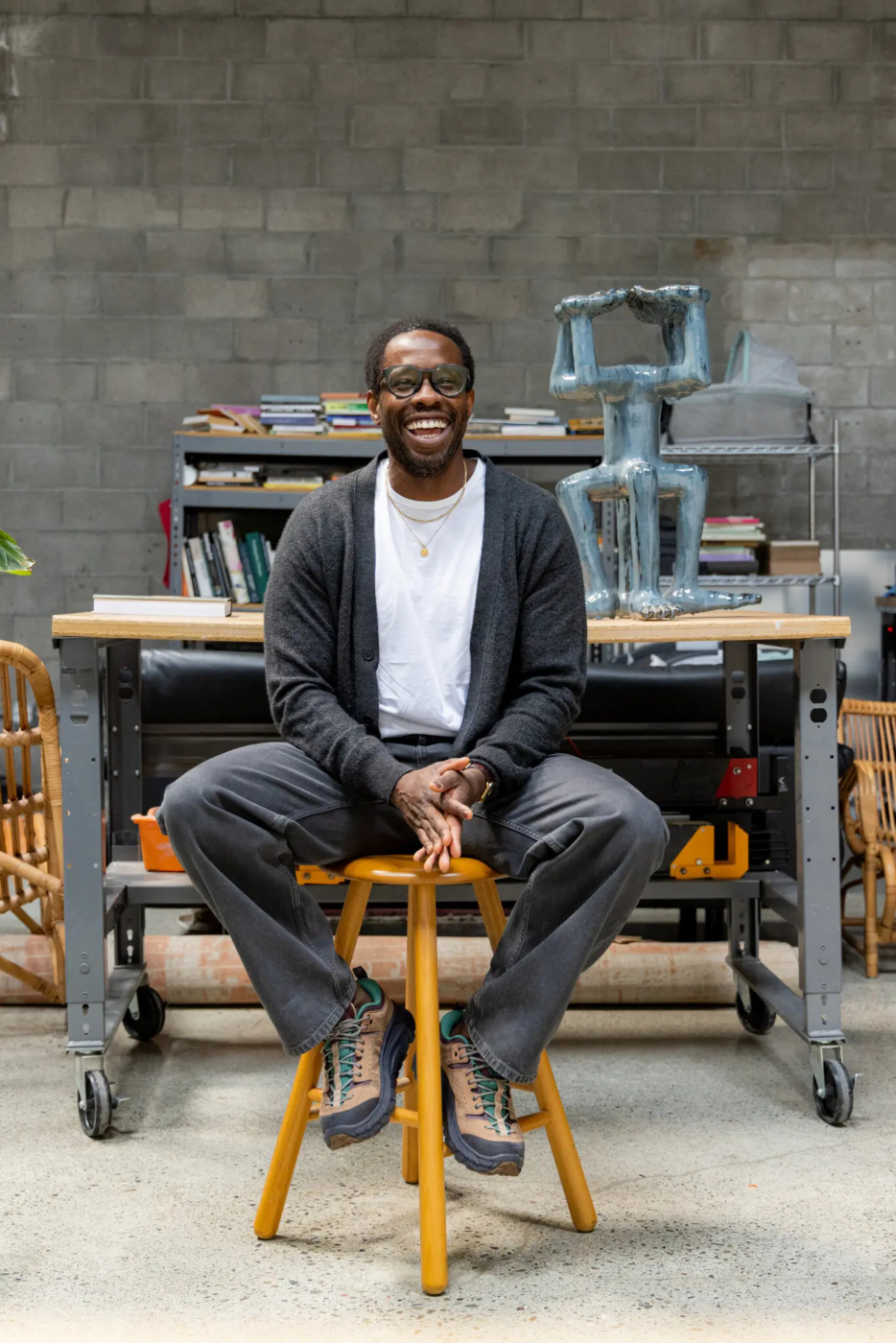
Phones populate the surreal world of everyday objects that Woody De Othello sculpts out of clay and imbues with uncanny animism and personality.
“You never know what a phone call will hold, if it’ll change your life,” he said. Othello, a 35-year-old Miami-born artist now living and working in Oakland, Calif., models his anthropomorphic creations on old-fashioned landlines, clocks, radios and fans, sometimes arranged in theatrical tableaux or scaled to monumental proportions and cast in bronze.
In Othello’s hands, a material as durable as bronze takes on vulnerable human attributes. An oversized hand-held telephone receiver, for instance, slouches against a seemingly wobbly toothed comb standing almost seven feet tall in a 2023 bronze titled “thought in mind,” part of Othello’s exhibition “Guardian Spirit” organized by the Public Art Fund and on view in Brooklyn Bridge Park through March 8.
The show also includes three large abstracted bronzes made in 2025 in which intertwined limbs sprout trumpet-shaped instruments and giant hands and ears. Sited on a green field, they face three new totemic sculptures, which Othello hand carved from redwood, with motifs related to the five senses. The wood sculptures rise nearly 20-feet-tall along the East River, echoing the Manhattan skyscrapers across the water.
“It’s about communication, not only calling out, but also receiving,” he said. “What does it look like to send a prayer into the universe?”
Othello’s work is deeply informed by the centuries-old African tradition of nkisi, in which objects contain spiritual forces and confer protection — a practice transported by enslaved Africans to the American South, where it reappeared in face jugs made by 19th-century potters.
Othello broke through in the art world at the 2022 Whitney Biennial, where, atop a platform, he positioned his version of face jugs — headlike ceramic vessels cradled in cartoonish hands — using mundane objects like a step stool, a radiator and a television as pedestals. The Whitney then acquired the multipart work titled, “The will to make things happen.”
Since then, other major institutions have followed suit. The Metropolitan Museum of Art is showing, for the first time, its acquisition of Othello’s sculpture of an asymmetrical ladder, scaled by tools, with a meditating headless figure on top, in the current show “The Face of Life: Modern Portraits at The Met.” This fall, the Hirshhorn Museum and Sculpture Garden in Washington plans to reopen its renovated outdoor grounds installed with its recent purchase of the artist’s eight-foot-tall lime green rendition of a box fan.
At Art Basel this week, Othello is showing his largest multi-element tableau to date in Unlimited, a curated section of the fair featuring monumental works. “Two sides that hold truth,” co-presented by the artist’s galleries Karma and Jessica Silverman, is a deep blue, free-standing wall about 40 feet long and two feet thick; multiple rectangular cutouts at varying heights present arrangements of more than 50 ceramic, wood, stone and glass motifs, including phones, mirrors, fans and vessels.
“It’s almost like an altar,” said Othello, who is interested in how these composed objects in their niches present windows for viewers to witness themselves looking, and see others on the opposite side doing the same thing. “It’s about seeing each other through the material world and finding commonality.”
The idea of architecture as a pedestal and stage for smaller sculptures “is definitely going to be pushing what’s possible for Woody and for the market and for people’s understanding of his work,” said Karma owner Brendan Dugan, who is presenting the entire structure as one piece, in a phone interview.
The Basel installation evolved from Othello’s exhibition “coming forth by day,” up through June 28 at the Pérez Art Museum Miami, where a similar wall greets viewers and presents arranged vignettes of objects in niches.
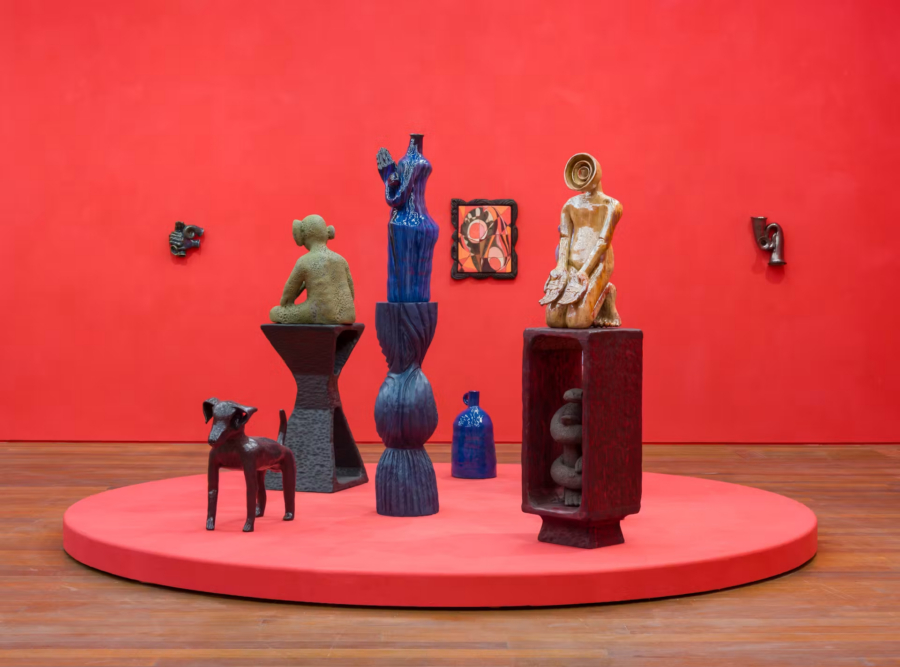
“Woody wanted to create a space of intimacy where you walk through this hallway, almost like your grandma’s house with shelves of little artifacts,” Jennifer Inacio, the Pérez curator who organized the show, said in a phone interview. The exhibition then opens into an expansive gallery of larger sculptures and tiled wall works, where Othello used an herbal scent to infuse his tactile ceramics, a shade of ruddy vermilion for the walls and a sound element keyed to that color by a musician, designed to serve as a guided meditation.
“He wanted us to really experience the exhibition with our bodies,” Inacio said, of the multi-sensory elements. (The show travels to the Jan Shrem and Maria Manetti Shrem Museum at the University of California, Davis in August.)
For Othello, the Miami exhibition was a return to his hometown, where his parents immigrated from Haiti. The artist, in a recent interview in New York, described being bullied at school throughout his childhood and finding healthy escape in his love of drawing and of building little scenes using aluminum foil. He called himself a regular city kid who did not go to museums, but hung out at Aventura Mall, where he remembers encountering public art from its unusually extensive collection.
As an undergraduate student at Florida Atlantic University, Othello was convinced by a roommate to take a ceramics class. “The first time I touched clay, I had this epiphany where it felt like I’d done it before,” he said, describing clay as the foundation for his work and a stabilizing force in his life. “Everything I felt I needed to know about my present, past and future was in the material.”
Drawn to the ceramics movement in California pioneered by artists including Viola Frey, Ken Price and Ron Nagle, Othello got his Master of Arts at the California College of the Arts in San Francisco. In school, he started to remove the human body from his work and focus more on the commonplace objects that inhabit the space a figure occupies. “That led me down the rabbit hole of animism and how everything in nature is alive — very much a part of a lot of African ontologies,” he said. “Trying to understand where I came from led me to nkisi.”
Shortly before graduating in 2017, Othello’s first personified telephone sculpture and a faceless face jug with big ears caught the eye of the gallerist Jessica Silverman, who dropped in during the school’s open studios. She took those two works to the high-profile Armory Show in New York that spring, where they quickly sold. Othello was stunned. “I had never seen that much money in my life!” he laughed.
These days, navigating greater career demands as he and his wife are new parents to their infant daughter, Othello said he was becoming increasingly comfortable with “the quality of almost rummaging in the dark and letting my instincts be the thing that dictate the direction I’m going.” Without a clear road map, he forged ahead on carving his wood totems for Brooklyn Bridge Park.
“I’m astonished by the fact that Woody worked in a material that he’s never worked in at this scale, but it feels so attuned to how he’s worked before in other materials,” said Jenée-Daria Strand, assistant curator at Public Art Fund, who organized the show, in a phone interview.
While working with clay is an additive process, wood carving is “completely subtractive,” Othello said. “My brain had to work in a different way, almost like the hemispheres crossing.” With an unforgiving chain saw, he would move around the tall block of wood making cuts. If he did not like a mark, he would have to carve out more. New motifs such as eyes, owls and seashells began to emerge.
“I just really wanted to throw a curve ball to the way that I was working,” he said. “Not knowing is for me where I feel you learn the most about yourself.”