July 30, 2026
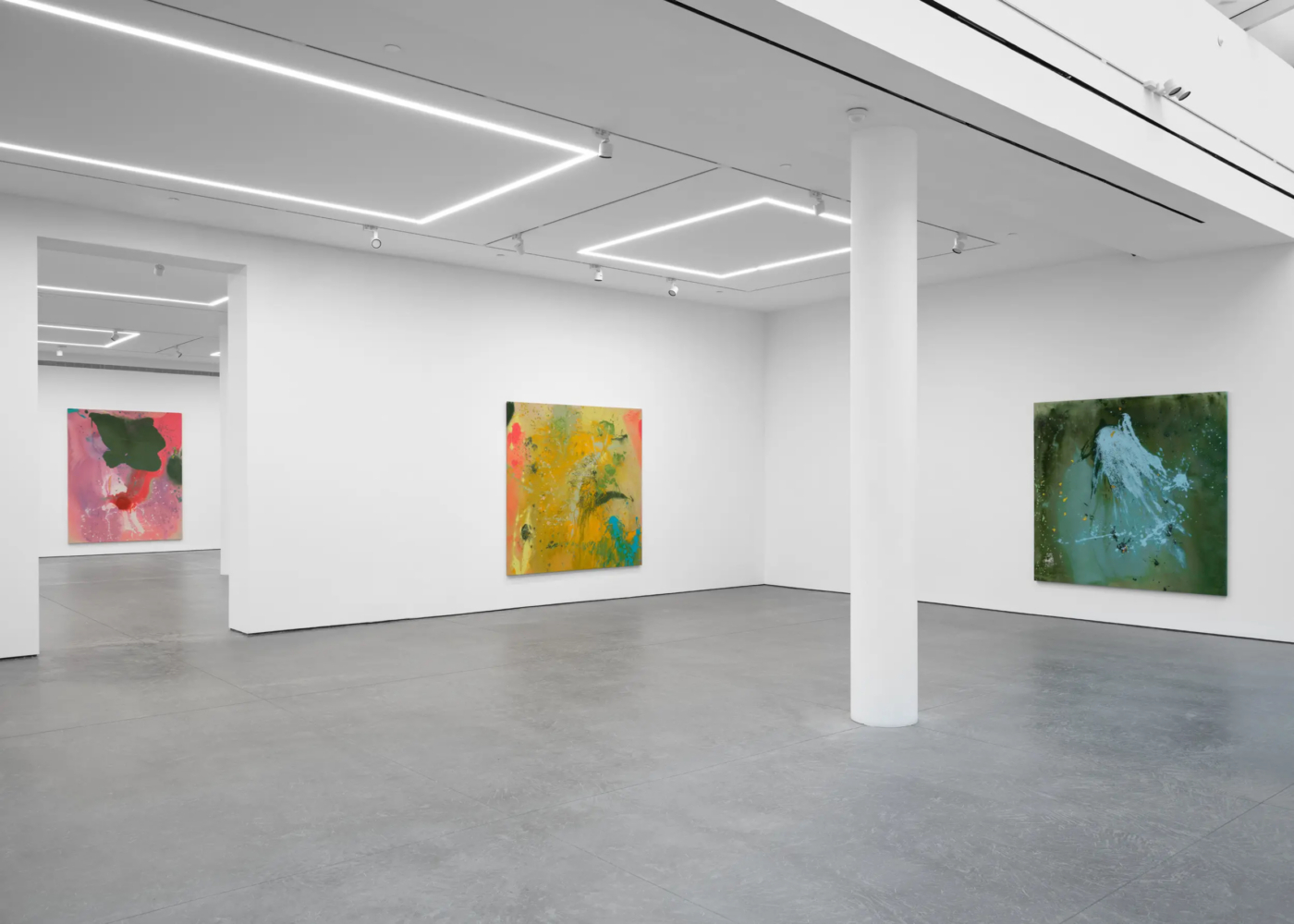
For his summer show at Karma in Chelsea, Peter Bradley (b. 1940) presents fourteen new paintings, all made in 2026. The indefatigable Bradley has managed simultaneously to continue developing his signature color aesthetic and to connect his work, especially his other-worldly flower paintings, with an earlier tradition, the nineteenth-century Symbolism of Odilon Redon. This linkage of Bradley to the concept of art-for-art’s-sake is extremely important today, because it reminds us that art does not have to make ideological arguments to justify its existence. In fact, what makes Bradley’s work so important is that it sidesteps politics of all kinds and instead stands on its own two feet, making no excuses for itself. In this sense, his work today echoes the precept of the groundbreaking 1971 exhibition he curated in Houston. The De Luxe Show was the first fully racially integrated presentation of abstract art, a show Karma replicated in 2021.
Rather than delivering a specific spiritual message, the paintings invite us to experience all the emotions dazzling color can inspire. In 1877, critic Walter Pater asserted, “that all art aspires to the condition of music;” that is, art seeks to transcend language to express emotion. Bradley, who paints with jazz as his background music, uses color to capture our visual sensibility and send it into zones where semantics are beside the point. Like J. M. W. Turner’s late watercolor sketches that turn landscape into abstraction, Bradley’s works ask us to turn away from contingency and circumstance and focus instead on the elusive universe of art.
It is impossible not to be enthralled, swept away by these paintings. A work like Bye Bye Blackbird, a 36 by 36-inch acrylic on canvas, constitutes a summary of Bradley’s aesthetic. First recorded in 1926, the song he quotes in the title quickly became a standard. In 1957, Miles Davis included it in his album Round About Midnight, transforming it by maintaining the song’s basic structure but then metamorphosing it into his own style, a sui generis act of artistic deconstruction. Bradley accomplishes something analogous by creating a hellish red field dominated by two figures. There is a black shape we can identify as the blackbird of the song and a white ellipse contaminated by the red. The song deals with the idea of exorcising the dismal past—the blackbird—and moving on. Yet in all the musical renditions, including Davis’s, there is a pervading sense of melancholy. We can say bye-bye to the blackbird, but we cannot expunge its memory. So, in Bradley’s painting the bird is gone but not forgotten. Memory is a double-edged sword; sadness is a component, but also, as William Shakespeare wrote, it is also the place where “all losses are restored and sorrows end.” Bradley, like Davis, transfigures the song.
That same sense of leaving things behind recurs in the piece that supplies the show’s title, Burning On, an 80 by 80-inch acrylic on canvas. Once again, red, brighter here, dominates, but there is a fundamental ambiguity: do we read the painting from left to right or right to left? Read from the viewer’s left, the spray of red seems like a flamethrower in action; read from the other direction, it might be a rocket taking off on a horizontal axis. “Burning the candle at both ends” is probably the best metaphor to understand this piece—and Bradley’s seemingly inexhaustible energy.
The dazzler in the show is Callisto, and 80 by 80-inch acrylic and pumice on canvas. In Greek mythology, Zeus morphed the nymph Callisto into the stars that compose the Great Bear constellation. Callisto is also a moon revolving, appropriately, around the planet Jupiter, Zeus’s Roman equivalent. Bradley replicates neither the nymph nor the moon but instead captures the explosive presence of a deity as a golden nebula. As we gaze into the painting’s myriad depths, we find color after color, a reconstituted universe where we may temporarily lose our identities. This colossal release of energy is Bradley’s self-portrait, another grand chapter in an artistic career spanning six decades.