May 1, 2026
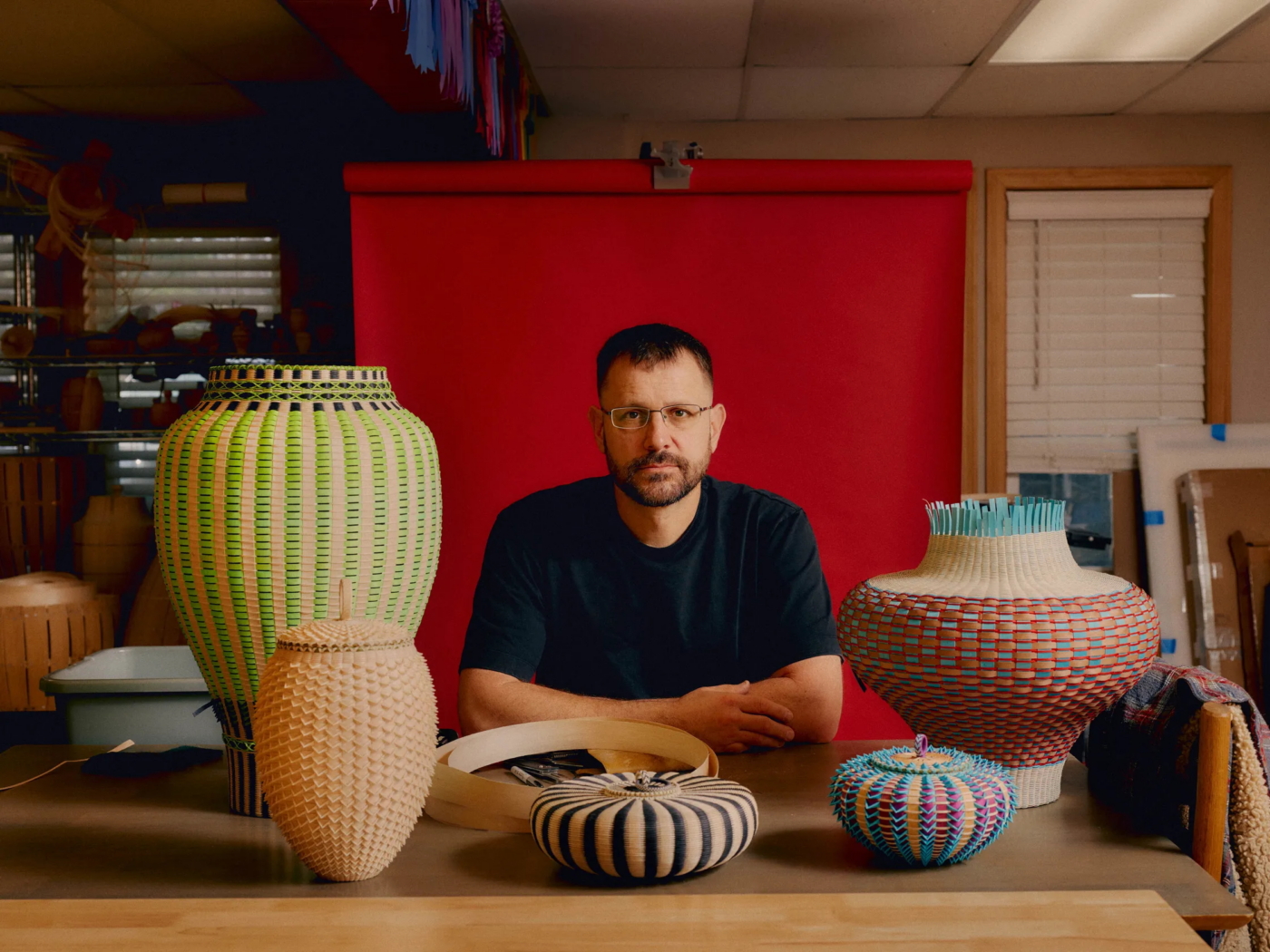
“Do you mind if I work while we talk?” asks the Maine-based weaver Jeremy Frey, joining our Zoom call from his studio in the rural town of Eddington, population: 2,272. As we speak, his fingers—sometimes with the help of tweezers—casually transform thin ribbons of ash wood, dyed jet black, into triangular points that dazzle overtop a layer of lime green strips. It’s go time for Frey, who is weaving day in and day out to complete some 15 pieces for his solo show, opening this month at Karma gallery in New York City. The basket he’s working on now—the largest one of the bunch, measuring in at nearly 24 inches tall—will take more than a month to complete.
Frey, a seventh-generation basket maker, joins a long line of Wabanaki people (his tribe, the Passamaquoddy, is part of this larger confederacy) to practice the age-old craft. But Frey, a 2025 MacArthur Fellow, doesn’t let himself get stuck within that tradition. “I’m weaving to innovate,” he explains of his work, which, through nuanced use of technique, material, and color, pushes the craft form squarely into the realm of fine art.
Growing up on the Passamaquoddy Indian Township Reservation, Frey found a voice through art early on, painting, drawing, and making his own toys. When he returned home as a young adult after a few bumpy years away, his mother, who was learning to weave from Sylvia Gabriel, an elder in the community, started to teach him the craft. “It scratched my itch for the arts,” recalls Frey, who tried making one of the complex point weaves Gabriel was known for. Soon, he convinced his uncle to show him how to harvest ash, the local timber that—cut, hauled, sliced, and hand-pounded into thin strips—is typically used.
The earliest Wabanaki baskets were strong and bulky; practical tools for everyday life. But as settlers arrived and their environment shifted, an appetite for what Frey calls “fancy baskets” emerged, i.e., usable artworks made of thinner, more colorful material, typically sold at local markets for minuscule profit. Frey places his pieces, which mix ash with cedar and birch bark, sweetgrass, spruce root, and porcupine quills, within this lineage: “My work has all the elements of traditional baskets, but my shapes are different, the way I cut my ribbing is different, my finishes are different,” he explains. “So one of the first things I did was help develop a market for the work I wanted to make.”
He succeeded. Now, his pieces are in the collections of institutions like the Smithsonian American Art Museum and The Met, where they operate the way Frey always intended: as works of art. Like the vision-bending creations of Victor Vasarely or Bridget Riley, with their fluctuating dimensions and clever use of color, they become optical illusions.
His Karma show, Frey explains, “is about the growth of the art form.” He’ll realize sculptures of his baskets in bronze, a material whose durability and manufacturing process opens up a world of new possibilities. “You could put it outside,” he says. “Or really scale it up.” Meanwhile, he’s trying out weaving with copper strips, a response to the effects of the emerald ash borer, an invasive species that hit Maine a few years ago and will eventually decimate its ash population. This environmental catastrophe has given Frey’s practice a sense of urgency. “Every tree I take is immortalized,” he says. “Otherwise it will die.” He’s harvesting as much as he can, but is still preparing for a future without his primary material. And it’s more than that: “Ash is a very spiritual tree for the Passamaquoddy,” Frey explains, recalling the legend of Glooskap, who supposedly spawned civilization by shooting an arrow into an ash tree. “So for it to go away, I mean, what does that say for our people?”